Critical review showing why statistical models produce false positives and why deterministic provenance is superior. For the past several years, the prevailing strategy for combating synthetic media has been detection: build better classifiers, train on larger datasets, identify artifacts faster than generative models can eliminate them. The logic seemed sound. If AI can create deepfakes, AI can also detect them. Except it hasn't worked. The value of provenance ultimately depends on whether organizations can turn evidence into confident decisions. Synthetic Proof helps examine that broader trust picture across AI content and workflows. Detection-based approaches have reached an operational ceiling. They struggle against modern generative models, degrade rapidly as those models improve, and offer no mechanism to verify authenticity when detection fails. Organizations deploying deepfake detectors today are discovering what researchers have known quietly for s...

Navigating the gray area of human-edited, AI-assisted, and hybrid synthetic content.
A creative director uploads a client video for review. The platform flags it as AI-generated. It wasn't. A journalist submits an authentic field recording. The newsroom's verification tool rejects it. A product team shares legitimate user-generated content. Their content moderation system removes it automatically.
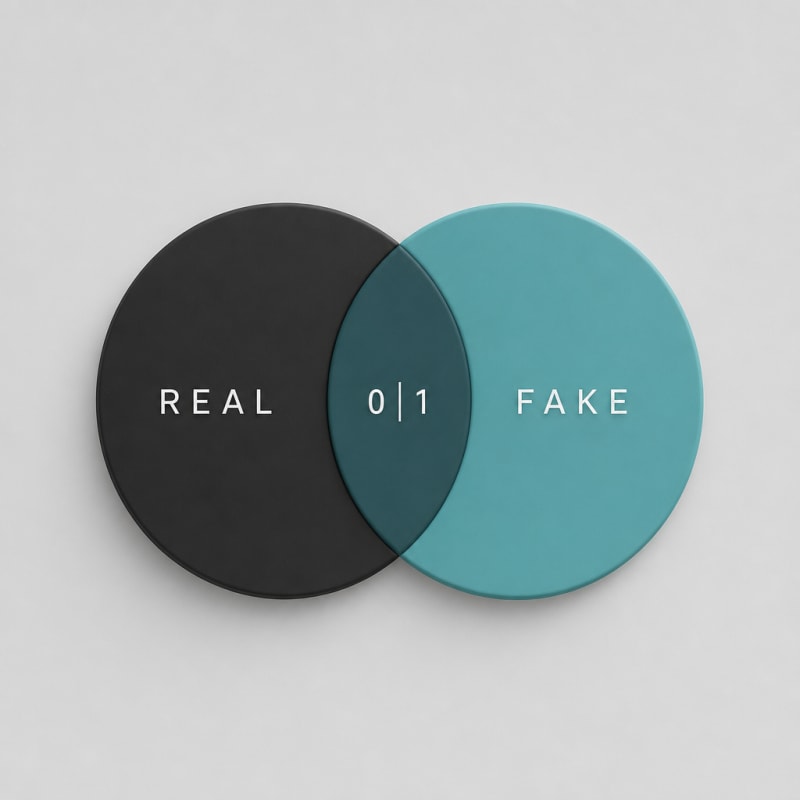
These aren't hypothetical scenarios. They're becoming routine friction points in modern creative workflows. As organizations rush to deploy detection systems that categorize content as either "real" or "fake," they're discovering that the binary itself is breaking down—and the consequences extend far beyond false positives.
Governance policies are only as strong as an organization’s ability to verify what happens inside real AI workflows. Synthetic Proof helps teams identify the trust gaps those policies may not reveal.
The issue isn't simply that detection algorithms make mistakes. It's that the entire premise of binary classification is colliding with how content is actually created, edited, and distributed today.
The Binary Made Sense Until It Didn't
Binary "real versus fake" detection emerged during a simpler moment in digital content. Deepfakes were distinct artifacts. Synthetic media was relatively rare. The boundary between human-created and machine-generated content felt clear enough to build classification systems around.
That clarity is evaporating rapidly. Modern creative workflows don't produce content that fits neatly into "real" or "fake" categories. They produce hybrid artifacts: photographs with AI-assisted color correction, video with algorithmically stabilized frames, audio cleaned through neural noise reduction, text drafted by humans and refined by language models.
Detection algorithms trained on cleaner datasets struggle with these hybrid forms. They weren't designed to evaluate content that exists along a spectrum. They were built to answer a yes-or-no question that creative professionals have stopped asking.
The result is classification drift. As legitimate creative tools incorporate more AI assistance, previously reliable detection systems begin flagging authentic work as synthetic. The algorithms haven't necessarily become less accurate by their own metrics—they're answering a question that no longer matches the reality of content creation.
When False Positives Become Operational Friction
Early detection failures were easy to dismiss as edge cases. Now they're accumulating into systemic workflow problems.
Media organizations implement blanket detection policies, then watch as their systems reject legitimate journalist submissions edited with standard industry tools. Marketing teams deploy automated content verification, then spend hours manually overriding flags on assets they created themselves. Creative platforms add detection layers for user protection, then face support backlogs from creators whose original work keeps getting misclassified.
The typical response is to adjust thresholds—make the detector less sensitive, accept more false negatives to reduce false positives. But threshold adjustment doesn't solve the underlying problem. It just shifts where the breakage occurs.
What organizations discover is that binary detection creates a forced choice: either block legitimate creative work or allow potentially problematic content through. There's no threshold that eliminates this tension because the tension isn't about calibration. It's about asking the wrong question.
The Automation Trap
The appeal of binary detection was always automation. A simple yes-or-no answer enables automated decisions: accept or reject, publish or block, verify or flag. It scales in ways that human review doesn't.
But as accuracy degrades, organizations find themselves building manual override processes, exception workflows, and appeal mechanisms—the very operational complexity they hoped to avoid. The automation promise remains, but it's now wrapped in escalation procedures that consume the resources binary detection was supposed to save.
Worse, these override systems often lack transparency. Creators don't understand why their work was flagged. Reviewers don't have sufficient context to evaluate appeals. The detection model itself becomes a black box that everyone works around rather than trusts.
Trust Signals Replace Binary Judgments
The emerging alternative isn't better detection—it's richer information. Rather than forcing content into "real" or "fake" buckets, forward-looking organizations are building systems that capture and communicate how content was created.
This represents a fundamental architectural shift. Instead of asking detection algorithms to make increasingly unreliable classifications, the focus moves to documenting provenance, modification history, tool usage, and creator attestations. The question changes from "Is this real?" to "What can we know about how this was made?"
That shift enables more sophisticated decision-making. An editor can see that a video was captured on a verified device, edited with disclosed tools, and submitted through authenticated channels—without needing an algorithm to classify it as "real" or "fake." The context informs judgment rather than replacing it.
This approach also degrades more gracefully. As creative tools evolve, provenance records adapt to document new workflows. There's no classification boundary to maintain, no accuracy threshold to defend. The system captures what happened and lets downstream users interpret that information according to their own requirements.
The Shift Toward Compositional Trust
Provenance-based approaches also better reflect how creative work actually happens. Professional content is rarely pure—it's compositional. A photograph might combine original capture, licensed elements, AI-assisted enhancement, and manual finishing. Binary detection treats this as a classification problem. Provenance treats it as documentation.
Organizations implementing these systems report that creators adapt quickly. Documenting workflow steps feels natural to professionals already accustomed to asset management and version control. What feels unnatural is having finished work arbitrarily rejected by opaque detection systems.
The challenge isn't creator adoption—it's infrastructure. Provenance documentation requires technical capabilities that many platforms lack: secure metadata attachment, tamper-evident logging, chain-of-custody tracking, and standards-based interoperability.
What Accuracy Loss Reveals About Infrastructure Gaps
The degrading accuracy of binary detection is exposing a deeper problem: most organizations lack trust infrastructure entirely. They've relied on detection as a substitute for systematic provenance, verification, and attestation capabilities.
This infrastructure gap becomes critical as AI assistance becomes standard in creative tools. Without proper documentation layers, there's no way to distinguish between legitimate creative work that used AI tools and content created to deceive. Binary detection attempts to make that distinction through algorithmic classification alone—and it's failing.
Organizations building trust infrastructure are approaching the problem differently. They're implementing:
- Provenance capture at creation time, not verification after the fact
- Transparent documentation of modifications and tool usage
- Authenticated submission channels that establish content origin
- Standardized metadata that travels with content across platforms
- Audit capabilities that provide accountability without blocking workflows
These capabilities don't replace human judgment—they inform it. Editors, moderators, and compliance teams get context rather than binary classifications. Decision-making becomes more nuanced and more defensible.
The Migration Path Forward
Organizations currently dependent on binary detection face a practical question: how do you transition to provenance-based trust without disrupting existing workflows?
The answer typically involves running systems in parallel. Provenance documentation begins capturing information alongside existing detection. Teams learn what context proves most valuable. Policies evolve to incorporate richer signals. Detection gradually shifts from gatekeeper to supplementary signal.
This migration doesn't happen overnight, and it requires investment in capabilities that many organizations haven't prioritized. But the alternative—doubling down on detection systems with declining accuracy—increasingly looks like technical debt accumulating faster than it can be managed.
Early adopters aren't necessarily abandoning detection entirely. They're repositioning it as one input among many, rather than the sole arbiter of authenticity. The detection signal becomes more valuable when combined with provenance documentation, creator attestations, and distribution context.
Final Thoughts
The accuracy problems facing binary detection systems aren't temporary calibration issues that better training data will solve. They're symptoms of misalignment between how classification algorithms work and how creative content is actually produced.
As AI assistance becomes standard across creative tools, that misalignment will only deepen. Content won't fit into neat "real" or "fake" categories because those categories no longer describe the creative process. Attempting to maintain binary classification through increasingly complex detection will consume resources while delivering decreasing reliability.
The organizations adapting most effectively aren't fighting to preserve binary detection accuracy. They're building trust infrastructure that documents how content was created, modified, and distributed. They're replacing brittle classification with rich context. They're treating authenticity as a documentation problem rather than a detection problem.
This shift requires investment, but the cost of inaction is becoming harder to justify. Every workflow disrupted by false positives, every creator frustrated by opaque rejections, every manual override needed to fix automated mistakes—these are signals that binary detection is solving yesterday's problem while today's creative reality has moved on.
The question isn't whether detection accuracy will continue declining as creative AI assistance proliferates. The question is whether organizations will build trust infrastructure before detection failure becomes an operational crisis.
The Practical Position
The industry is learning a painful lesson: binary classification systems optimized for a previous generation of content are now creating more friction than the problems they were meant to solve. Detection accuracy isn't declining because algorithms are failing—it's declining because the question itself has become obsolete in hybrid creative workflows.
— Kevin Marsh, Editor-in-Chief
SYNTHETIC PROOF
TURN TRUST INTO AN OPERATIONAL CAPABILITY
Evaluate Where Trust Breaks Down
Synthetic Proof helps teams identify trust gaps across prompts, digital media, verification practices, and emerging AI workflows.
Assess Your Trust ReadinessSynthetic Proof
Verified — Editorial Layer
This content has passed editorial verification for clarity, accuracy, and trust alignment.
Editor-in-Chief: Kevin Marsh
Verification Status: PASSED
Verification Status: PASSED
Comments
Post a Comment