Critical review showing why statistical models produce false positives and why deterministic provenance is superior. For the past several years, the prevailing strategy for combating synthetic media has been detection: build better classifiers, train on larger datasets, identify artifacts faster than generative models can eliminate them. The logic seemed sound. If AI can create deepfakes, AI can also detect them. Except it hasn't worked. The value of provenance ultimately depends on whether organizations can turn evidence into confident decisions. Synthetic Proof helps examine that broader trust picture across AI content and workflows. Detection-based approaches have reached an operational ceiling. They struggle against modern generative models, degrade rapidly as those models improve, and offer no mechanism to verify authenticity when detection fails. Organizations deploying deepfake detectors today are discovering what researchers have known quietly for s...
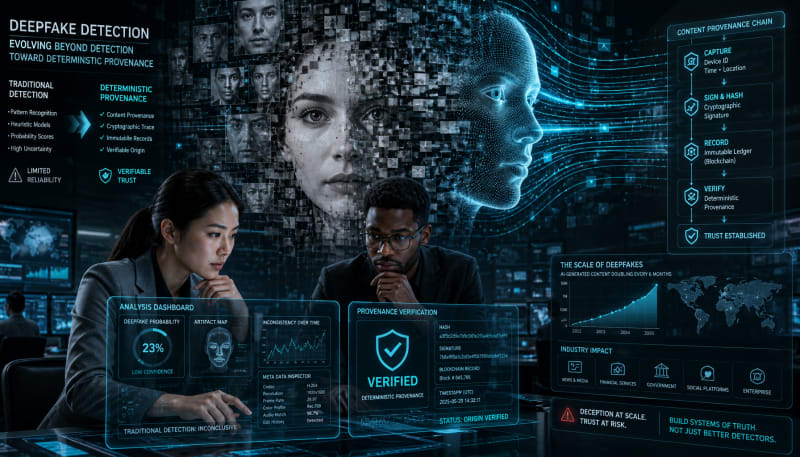
Critical review showing why statistical models produce false positives and why deterministic provenance is superior.
For the past several years, the prevailing strategy for combating synthetic media has been detection: build better classifiers, train on larger datasets, identify artifacts faster than generative models can eliminate them. The logic seemed sound. If AI can create deepfakes, AI can also detect them.
Except it hasn't worked.
The value of provenance ultimately depends on whether organizations can turn evidence into confident decisions. Synthetic Proof helps examine that broader trust picture across AI content and workflows.
Detection-based approaches have reached an operational ceiling. They struggle against modern generative models, degrade rapidly as those models improve, and offer no mechanism to verify authenticity when detection fails. Organizations deploying deepfake detectors today are discovering what researchers have known quietly for some time: detection is a losing game.
What's emerging in its place isn't a better detector. It's a fundamentally different architecture—one that stops asking whether content is fake and starts proving whether it's real.
Detection Works Until It Doesn't
Traditional deepfake detectors operate as binary classifiers. They analyze visual, audio, or behavioral artifacts—compression patterns, facial inconsistencies, temporal discontinuities—and output a probability score. The approach worked reasonably well when generative models were crude and artifacts were obvious.
But modern generators have become artifact-aware. They're trained explicitly to evade detection signatures. This creates an adversarial loop: detectors identify new signals, generators eliminate those signals, detectors retrain, generators adapt again. The cycle accelerates with each model release.
More concerning is the asymmetry. A detector must achieve near-perfect accuracy to be operationally useful. A generator only needs to evade detection once. That imbalance isn't technical—it's structural. Detection assumes attackers will leave traces. Modern synthetic media increasingly doesn't.

The result is predictable decay. Detectors trained on one generation of models fail catastrophically on the next. Operational performance collapses within months. Organizations find themselves in a constant retraining cycle with diminishing returns and no path to durable reliability.
The Adversarial Treadmill Has No Exit
Even when detection works technically, it fails operationally. Detection is reactive. It can only analyze content after creation, after distribution, often after damage. By the time a deepfake is flagged, it may have already influenced elections, manipulated markets, or compromised reputations.
Detection also can't verify authenticity. A detector might confidently label something "real," but that assessment is probabilistic, not definitive. There's no cryptographic proof, no chain of custody, no mechanism to independently validate the claim. The detector simply didn't find artifacts—a condition indistinguishable from sophisticated synthesis.
This creates an evidentiary gap. Courts, compliance systems, and verification workflows require proof, not probability. Detection offers inference. That gap becomes critical in high-stakes contexts: insurance claims, regulatory filings, legal disputes, investigative journalism. Saying "our model scored this 73% real" doesn't establish trust—it exposes fragility.
Organizations are beginning to recognize this limitation not as a technical problem to solve, but as a structural constraint to route around.
Deterministic Provenance Inverts the Model
The alternative emerging across enterprise and regulatory environments is deterministic provenance. Rather than trying to detect whether content is synthetic after creation, provenance systems establish a verifiable record of authenticity at the moment of capture.
The shift is definitional. Detection asks: "Can I find evidence this is fake?" Provenance asks: "Can I prove this is real?"
Provenance systems operate at the point of creation—inside cameras, recording devices, content management systems, and publishing workflows. When an image is captured or a video recorded, cryptographic signatures are embedded directly into the file. These signatures bind the content to metadata describing how, when, where, and by what device it was created.
That binding is tamper-evident. Any modification to the content—cropping, filtering, editing—breaks the cryptographic seal. The result is a deterministic record: either the signature validates and the provenance is intact, or it doesn't and the content's history is uncertain.
This architecture doesn't compete with generators. It doesn't try to outsmart adversarial models or predict future synthesis techniques. It simply establishes a baseline: content with valid provenance has a verifiable origin. Content without it doesn't.
From Artifact Detection to Chain of Custody
Provenance doesn't stop at capture. The more important layer is custody—tracking what happens to content after creation. Authentic content is routinely edited. Photos are cropped, color-corrected, resized. Videos are trimmed, stabilized, compressed. These transformations are legitimate, but they also alter the original file.
Provenance-aware systems maintain a cryptographic audit trail across those changes. Each transformation is logged, signed, and appended to the content's metadata. The result is not a static assertion of authenticity, but a verifiable history: this image was captured by device X at time Y, edited by application Z, and published by entity A.
That chain of custody provides what detection cannot: accountability. If content is manipulated deceptively, the break in provenance is evident. If it's edited legitimately, the edits are documented. Either way, the recipient has enough information to assess trustworthiness—not based on probabilistic inference, but on verifiable record.
Adoption Is Following Regulatory and Reputational Risk
Provenance infrastructure is moving from pilot projects to operational deployment, driven primarily by sectors where authenticity failures carry regulatory or reputational consequences.
News organizations are embedding provenance into editorial workflows, not because detection failed, but because readers increasingly demand proof. Insurance companies are requiring provenance for visual claims documentation, recognizing that synthetic evidence is no longer theoretical. Legal systems are beginning to distinguish between content with verifiable provenance and content without it, creating evidentiary tiers that disadvantage unverified material.
This isn't universal adoption—it's selective pressure. Organizations operating in high-trust environments recognize that detection alone can't establish authenticity. They need mechanisms that prove origin, demonstrate custody, and withstand adversarial scrutiny. Provenance provides that; detection doesn't.
The shift is also appearing in platform governance. Social networks and content distribution systems are exploring provenance as a moderation signal—not to censor synthetic content outright, but to label provenance status and let users assess risk. Content with intact provenance from a trusted source receives one treatment. Content with broken or absent provenance receives another.
The Technical Foundation Is Already Standardizing
Much of the infrastructure enabling deterministic provenance is built on open standards, most notably the Coalition for Content Provenance and Authenticity (C2PA). C2PA defines how cryptographic signatures are embedded into media files, how metadata is structured, and how custody chains are maintained across editing workflows.
The standard is hardware-agnostic and format-agnostic, designed to work across cameras, smartphones, editing software, and publishing platforms. Major technology companies—Adobe, Microsoft, Intel, Sony, others—have integrated C2PA support into their products. The result is an emerging interoperable layer where provenance metadata travels with content regardless of where it's created, edited, or consumed.
That interoperability matters. Provenance only works if it's verifiable across systems. A photo taken on one device, edited in one application, and published on one platform must retain its provenance signature in a way that any downstream system can validate. Proprietary provenance systems create silos; open standards create infrastructure.
The technical foundation is maturing quickly. What remains unresolved is adoption incentive—convincing creators, platforms, and consumers that provenance provides enough value to justify integration cost. That's happening unevenly, but directionally, the momentum is clear.
Detection Still Has a Role—Just Not the Lead Role
Deterministic provenance doesn't eliminate the need for detection. It complements it. Provenance establishes a baseline for content with verifiable origins. Detection remains useful for analyzing content without provenance—which will be the majority of media for years.
The difference is operational scope. Detection becomes a secondary signal, useful for flagging suspicious content but insufficient for establishing trust. Provenance becomes the primary signal—where available. Together, they create a tiered trust model: high confidence for content with intact provenance, lower confidence for content that passes detection, minimal confidence for content that fails detection or lacks provenance entirely.
This layered approach reflects the reality of digital media ecosystems. Not all content will have provenance immediately. Legacy media, user-generated content, and materials created before provenance infrastructure was available won't carry cryptographic signatures. Detection still provides value there, even if that value is limited and decaying.
But the strategic direction is clear: organizations building trust infrastructure are investing in provenance, not better detectors.
Final Thoughts
The failure of traditional deepfake detectors isn't a scandal—it's an inevitability. Detection was always a stopgap, a temporary defense while generative models were immature. Those models have matured. Detection hasn't kept pace, and structural constraints suggest it won't.
What's replacing detection isn't another probabilistic model. It's a deterministic architecture that stops chasing artifacts and starts establishing verifiable truth at the source. Provenance inverts the trust model: instead of trying to prove content is fake, it provides mechanisms to prove content is real.
That shift has profound implications. It moves authenticity from inference to evidence, from probabilistic scoring to cryptographic proof, from reactive analysis to proactive infrastructure. It changes who bears the burden of proof and where trust is established in digital media workflows.
Organizations serious about operating in high-trust environments are beginning to recognize that provenance isn't optional—it's foundational. The question isn't whether deterministic provenance will replace detection-based approaches. It's how quickly industries will recognize that the replacement is already underway.
The Practical Position
The deepfake debate has been framed incorrectly from the start. The question was never whether detection could keep pace with generation—it was whether probabilistic inference could ever substitute for cryptographic proof. Organizations still investing in detection architectures are solving yesterday's problem with yesterday's assumptions. Provenance doesn't compete with detection. It replaces the need for it entirely.
— Kevin Marsh, Editor-in-Chief
SYNTHETIC PROOF
FROM PROVENANCE TO OPERATIONAL TRUST
Understand Your AI Trust Gap
Synthetic Proof helps teams evaluate verification, provenance, prompt risk, and digital media trust through independent audits and structured findings.
Explore Synthetic ProofSynthetic Proof
Verified — Editorial Layer
This content has passed editorial verification for clarity, accuracy, and trust alignment.
Editor-in-Chief: Kevin Marsh
Verification Status: PASSED
Verification Status: PASSED
Comments
Post a Comment