Critical review showing why statistical models produce false positives and why deterministic provenance is superior. For the past several years, the prevailing strategy for combating synthetic media has been detection: build better classifiers, train on larger datasets, identify artifacts faster than generative models can eliminate them. The logic seemed sound. If AI can create deepfakes, AI can also detect them. Except it hasn't worked. The value of provenance ultimately depends on whether organizations can turn evidence into confident decisions. Synthetic Proof helps examine that broader trust picture across AI content and workflows. Detection-based approaches have reached an operational ceiling. They struggle against modern generative models, degrade rapidly as those models improve, and offer no mechanism to verify authenticity when detection fails. Organizations deploying deepfake detectors today are discovering what researchers have known quietly for s...
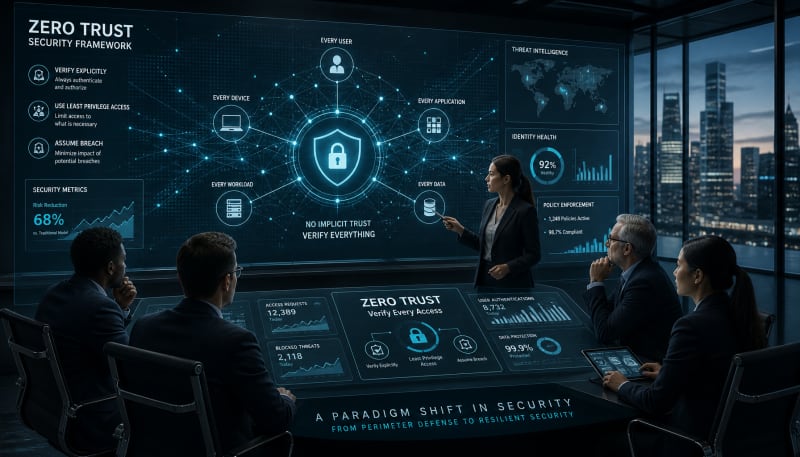
Industry-level analysis framing media verification as an essential branch of Zero-Trust security.
For decades, security operated on a simple premise: build a strong perimeter, authenticate users once, then trust everything inside the network. Firewalls kept threats out. VPNs created secure tunnels. Internal systems operated under the assumption that anyone who made it past the front door belonged there.
That model is collapsing.
The move from AI policy to operational trust requires independent evidence. Synthetic Proof helps organizations understand where their current trust posture stands.
The paradigm shift the security industry is experiencing isn't just another evolution in threat detection or encryption standards. It's a fundamental rethinking of what trust means in digital infrastructure. Organizations are dismantling the very concept of trusted networks and replacing it with something far more rigorous: the assumption that trust must be continuously earned, verified, and revoked when conditions change.
This is Zero Trust, and it represents the most significant architectural transformation in enterprise security in a generation.
The Perimeter That No Longer Exists
The traditional security model made sense when corporate networks had clear boundaries. Employees worked in offices. Applications ran in data centers. The network edge was a real place you could point to on a diagram.
That world is gone. Cloud infrastructure scattered applications across multiple providers. Remote work dissolved the office perimeter. Mobile devices blurred the line between corporate and personal computing. Supply chains created dependencies on third-party systems operating outside any single organization's control.
The perimeter didn't weaken—it disappeared entirely.
What remains is a sprawling, interconnected ecosystem where users, devices, applications, and data interact across networks no single entity controls. In this environment, the old model doesn't just fail occasionally. It fails structurally. There's no longer an "inside" to trust.
Zero Trust Assumes Breach, Not Security
Zero Trust begins with a deliberately pessimistic assumption: every network is hostile, every request is suspect, and compromise is not a possibility but an inevitability.
Rather than asking "Is this user inside the network?" Zero Trust asks: "Can this specific user, using this specific device, from this specific location, access this specific resource right now?" Every transaction requires fresh verification. Access grants are scoped to the minimum necessary. Trust expires quickly and must be continuously re-established.
This represents a philosophical inversion. Traditional security tried to keep threats out. Zero Trust assumes threats are already present and focuses instead on limiting what they can do once inside.
The difference is profound. In perimeter-based security, a single compromised credential could provide access to entire network segments. In Zero Trust architectures, that same credential grants access only to what that specific identity requires for that specific task at that specific moment. Lateral movement—the ability for attackers to spread through a network after initial compromise—becomes exponentially harder.
Identity Becomes the New Perimeter
If networks can no longer be trusted, something else must become the foundation of security decisions. In Zero Trust architectures, that foundation is identity.
But identity in this context means more than usernames and passwords. It's a composite signal incorporating user credentials, device health, behavioral patterns, location data, and contextual factors like time of day or sensitivity of the requested resource.
An authentication request isn't evaluated in isolation. It's measured against historical patterns, correlated with other access requests, and assessed for anomalies that suggest compromise. A legitimate user accessing familiar resources from a known device receives frictionless access. That same user attempting unusual access from an unfamiliar location triggers additional verification.
This dynamic, context-aware approach to identity transforms authentication from a binary gate—you're either in or out—into a continuous assessment process that adjusts in real time.
Verification Happens at Every Layer
Zero Trust extends beyond user authentication. It applies the same verify-always principle to devices, applications, network traffic, and data itself.
Devices must prove their security posture before accessing resources. Is the operating system patched? Is endpoint protection running? Are encryption standards current? Devices that fall out of compliance lose access until remediated.
Applications communicate through authenticated, encrypted channels regardless of whether they're in the same data center or separated by continents. Network traffic is inspected and logged even when traveling between internal systems. Data is classified, tagged, and protected based on sensitivity rather than location.
The result is defense in depth without reliance on network boundaries. Security becomes a property of every transaction rather than a characteristic of network topology.
The Operational Complexity Is Real
Zero Trust solves critical security problems, but it introduces operational challenges that can't be ignored.
Implementing continuous verification across every access request generates enormous volumes of authentication events, policy evaluations, and log data. Organizations need infrastructure capable of processing these signals in real time without creating latency that disrupts user experience.
Policy management becomes dramatically more complex. Instead of maintaining firewall rules at network boundaries, security teams must define granular access policies for thousands of users, devices, applications, and resources. These policies must remain consistent across cloud platforms, on-premises systems, and SaaS applications while adapting to changing business requirements.
Perhaps most challenging is the cultural shift required. Zero Trust asks organizations to abandon assumptions that have guided security decisions for decades. It requires cross-functional collaboration between security, IT operations, application development, and business units. It demands visibility into systems and data flows that many organizations have never fully mapped.
This operational burden is why Zero Trust adoption happens in stages rather than overnight transformations. Organizations typically begin with high-value assets or high-risk users before expanding coverage across the enterprise.
TrustOps Is Emerging to Manage the Trust Infrastructure
As Zero Trust architectures mature, a new operational discipline is taking shape around managing trust at scale.
TrustOps focuses on the infrastructure, processes, and workflows required to maintain continuous verification across complex technical environments. It addresses questions traditional security operations weren't designed to answer: How do we verify AI-generated content before it enters decision workflows? How do we audit trust decisions across distributed systems? How do we maintain provenance chains for data moving through multiple transformation stages?
This discipline extends Zero Trust principles into domains where traditional identity and access controls are insufficient. When organizations deploy AI systems that generate content, make recommendations, or automate decisions, verifying the trustworthiness of those outputs becomes as critical as verifying user identities.
TrustOps is still emerging rather than established, but it represents a logical evolution of Zero Trust thinking applied to the broader challenge of maintaining operational trust in increasingly automated environments.
Zero Trust Is Becoming Table Stakes
What began as a forward-thinking security philosophy is rapidly becoming a baseline requirement.
Regulatory frameworks increasingly expect Zero Trust principles. Cyber insurance providers are adjusting premiums based on implementation maturity. Large enterprises are extending Zero Trust requirements to their supply chains, making it a prerequisite for vendor relationships.
The shift is particularly visible in sectors handling sensitive data or critical infrastructure. Government agencies, financial institutions, and healthcare organizations are treating Zero Trust not as a security enhancement but as foundational architecture.
This transition from best practice to baseline expectation is accelerating. Organizations that have delayed implementation are finding the gap between their current security posture and industry expectations widening rather than narrowing.
Final Thoughts
The paradigm shift the security industry is experiencing goes deeper than new tools or updated protocols. It's a fundamental reimagining of what security means when perimeters no longer exist and trust can no longer be assumed.
Zero Trust isn't perfect. It introduces complexity, requires significant investment, and demands organizational change that extends far beyond security teams. But it addresses a structural problem that perimeter-based security cannot solve: how to maintain security in environments where everything is distributed, everything is connected, and compromise is inevitable.
The organizations adapting fastest aren't necessarily those with the most sophisticated technology. They're the ones willing to question assumptions that have guided security thinking for decades and rebuild their approach on principles designed for the environment that actually exists rather than the one that used to.
The Practical Position
The security industry isn't updating its playbooks—it's inverting its foundational logic. Organizations that continue treating trust as a default state rather than a continuously adjudicated decision will discover that architectural assumptions matter more than tactical defenses. Zero Trust isn't a product category; it's the operational acknowledgment that perimeters were always temporary infrastructure.
— Kevin Marsh, Editor-in-Chief
SYNTHETIC PROOF
TURN TRUST INTO AN OPERATIONAL CAPABILITY
Evaluate Where Trust Breaks Down
Synthetic Proof helps teams identify trust gaps across prompts, digital media, verification practices, and emerging AI workflows.
Assess Your Trust ReadinessSynthetic Proof
Verified — Editorial Layer
This content has passed editorial verification for clarity, accuracy, and trust alignment.
Editor-in-Chief: Kevin Marsh
Verification Status: PASSED
Verification Status: PASSED
Comments
Post a Comment