Critical review showing why statistical models produce false positives and why deterministic provenance is superior. For the past several years, the prevailing strategy for combating synthetic media has been detection: build better classifiers, train on larger datasets, identify artifacts faster than generative models can eliminate them. The logic seemed sound. If AI can create deepfakes, AI can also detect them. Except it hasn't worked. The value of provenance ultimately depends on whether organizations can turn evidence into confident decisions. Synthetic Proof helps examine that broader trust picture across AI content and workflows. Detection-based approaches have reached an operational ceiling. They struggle against modern generative models, degrade rapidly as those models improve, and offer no mechanism to verify authenticity when detection fails. Organizations deploying deepfake detectors today are discovering what researchers have known quietly for s...
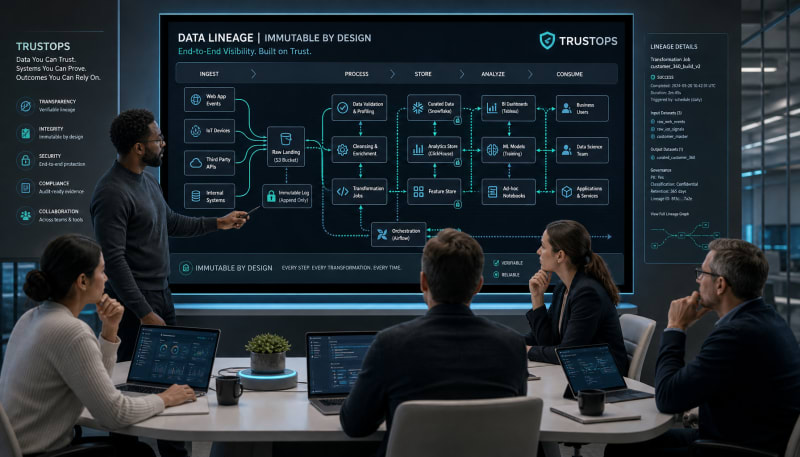
How leading organizations are structuring verifiable content audit trails for full accountability.
Organizations building AI governance programs are discovering a consistent pattern: policies without provenance don't scale. You can establish review committees, adopt ethical principles, and document decision processes, but when auditors, regulators, or internal stakeholders ask fundamental questions about how a model was trained or where specific predictions originated, many systems fall silent.
The missing layer isn't more governance documentation. It's immutable data lineage—a technical foundation that makes trust operationally verifiable rather than theoretically aspirational.
As content history becomes a governance concern, organizations need more than another metadata field. Synthetic Proof provides an independent way to assess provenance, verification, and wider AI trust risk.
As TrustOps emerges as a distinct operational discipline, the conversation is shifting from whether organizations need lineage capabilities to how they should architect them. The difference matters more than it appears.
Lineage Wasn't Built for AI-Scale Questions
Traditional data lineage tools were designed to answer workflow questions: Which database fed this report? Where did this column originate? What transformations occurred between systems?
AI operations ask fundamentally different questions. Was this training dataset modified after governance approval? Which prompt template generated this customer-facing output? Has this model been retrained since the last compliance review? Did this prediction use data subject to regional restrictions?
These questions require lineage systems that capture not just data movement but decision context, temporal states, and the precise conditions under which AI systems operated. More importantly, they require answers that can't be retroactively altered.
Standard lineage architectures—built on relational databases, metadata catalogs, or workflow logs—weren't designed with immutability as a foundational requirement. They track history, but that history remains editable by administrators, vulnerable to system migrations, and difficult to verify independently.

Why Immutability Changes the Trust Equation
Immutability shifts lineage from documentation to evidence.
When lineage records can be modified, they function as internal reference materials. Useful for troubleshooting, helpful for optimization, but insufficient for compliance, legal discovery, or external validation. The moment someone asks "prove it," mutable records introduce doubt.
Immutable lineage creates a different relationship with recorded history. Once a lineage event is recorded—a dataset snapshot, a model training run, a prediction with its associated inputs—that record becomes permanent and independently verifiable. Not because the organization promises to preserve it, but because the architecture makes modification computationally detectable.
This distinction becomes critical when AI systems face regulatory scrutiny, legal challenges, or high-stakes audits. The question isn't just "what happened?" but "can you prove what happened?" Immutable lineage architectures are designed to answer the second question.
The Technical Foundation
Immutability in this context doesn't mean write-once storage or access restrictions. It means cryptographic tamper-evidence.
Lineage systems built for TrustOps typically use content-addressed storage, where each record generates a cryptographic hash based on its contents. That hash becomes the record's permanent identifier. Any modification—however small—produces a different hash, making changes immediately detectable.
More sophisticated architectures chain these hashes together, creating verifiable sequences where each lineage event references the hash of previous events. This approach, borrowed from distributed ledger design principles, makes it computationally expensive to alter historical records without detection.
The result isn't a system that prevents modification—it's a system that makes modification evident. For trust operations, that's often sufficient. Auditors don't need perfect security. They need reliable detection.
Where Lineage Becomes Operational Infrastructure
The practical challenge isn't understanding why immutability matters. It's determining where lineage capabilities should exist within the operational stack.
Many organizations initially treat lineage as a reporting layer—something that sits above existing systems, collecting metadata after operations complete. This approach works for retrospective analysis but struggles with real-time governance decisions.
TrustOps architectures are increasingly embedding lineage capture directly into operational workflows. Before a model serves a prediction, lineage is recorded. Before a dataset enters a training pipeline, its provenance is verified and logged. Before a prompt reaches a language model, context about the request is captured immutably.
This shift—from lineage as documentation to lineage as infrastructure—changes what becomes possible operationally.
Access control policies can reference lineage directly: only serve predictions if the underlying model's training lineage meets compliance requirements. Audit systems can verify governance in real-time rather than reconstructing events months later. Incident response teams can trace problematic outputs back to specific data sources or configuration changes with precision.
The Architectural Trade-offs Nobody Discusses
Immutable lineage introduces overhead. Storage grows continuously—you can't delete historical records without breaking cryptographic verification. Write operations become more complex, particularly when chaining hashes across distributed systems. Query performance requires different optimization strategies than traditional databases.
Organizations implementing lineage architectures face genuine design decisions.
Some choose to capture comprehensive lineage for all AI operations, accepting storage costs as the price of complete auditability. Others implement tiered approaches: immutable lineage for production systems, lighter-weight tracking for development environments.
The granularity question proves particularly nuanced. Capturing lineage at the dataset level is straightforward. Capturing it at the individual data element level—tracking which specific records influenced which specific predictions—becomes exponentially more complex.
There's no universal answer. The appropriate architecture depends on regulatory requirements, risk tolerance, operational scale, and the specific trust questions an organization needs to answer. What matters is making these decisions explicitly rather than inheriting whatever capabilities existing tools happen to provide.
Integration Without Disruption
The most successful lineage implementations share a common characteristic: they integrate with existing workflows rather than replacing them.
Organizations already have MLOps platforms, data pipelines, model serving infrastructure, and monitoring systems. Wholesale replacement isn't realistic. Instead, lineage capabilities are being added as a parallel trust layer.
APIs capture lineage events from existing systems. Cryptographic proofs are generated and stored independently of operational databases. Verification happens asynchronously, avoiding performance impacts on production systems.
This architectural approach—lineage as an independent layer rather than embedded functionality—provides another advantage. It enables third-party verification. When lineage systems are separate from operational systems, external auditors can validate records without requiring direct access to production infrastructure.
For organizations in regulated industries, this separation increasingly matters. Proving compliance means demonstrating that trust capabilities exist independently of the systems they're monitoring.
What Immutable Lineage Enables Next
Once lineage infrastructure exists, it becomes the foundation for capabilities that weren't previously feasible.
Automated compliance verification stops being a periodic audit exercise and becomes continuous validation. Policy engines can evaluate whether current operations align with governance requirements by querying lineage directly.
Cross-organizational trust becomes architecturally possible. When two companies collaborate on AI development, immutable lineage provides a mechanism for sharing provenance information without exposing underlying data or models.
Insurance and liability frameworks gain the technical evidence they need. As AI insurance markets develop, underwriters are beginning to ask for verifiable lineage as part of risk assessment. Organizations that can demonstrate comprehensive, immutable tracking of AI operations may eventually see that capability reflected in coverage terms.
Perhaps most significantly, immutable lineage creates the possibility of AI systems that can explain not just their outputs but their complete operational history—a requirement that's shifting from theoretical to regulatory in multiple jurisdictions.
Final Thoughts
Immutable data lineage represents a fundamental architectural decision about how organizations operationalize trust. It's not a feature that can be added retroactively to existing governance programs. It's infrastructure that must be designed into AI operations from the beginning.
The organizations prioritizing lineage architectures now aren't responding to current regulatory requirements—those remain largely undefined. They're building the technical foundation that makes future requirements answerable, whatever form they take.
As TrustOps matures from emerging discipline to operational standard, the question won't be whether organizations have lineage capabilities. It will be whether those capabilities were architected for trust from the start, or bolted on as compliance afterthoughts.
The difference between those two approaches becomes visible the first time someone asks the question that matters: Can you prove it?
The Practical Position
Organizations treating lineage as audit preparation are solving yesterday's problem. The actual shift is that immutable provenance is becoming the control plane for AI operations—the infrastructure that determines which models can deploy, which data can be accessed, and which decisions require human review. Trust isn't being documented after the fact; it's being architected into runtime behavior.
— Kevin Marsh, Editor-in-Chief
SYNTHETIC PROOF
FROM PROVENANCE TO OPERATIONAL TRUST
Understand Your AI Trust Gap
Synthetic Proof helps teams evaluate verification, provenance, prompt risk, and digital media trust through independent audits and structured findings.
Explore Synthetic ProofSynthetic Proof
Verified — Editorial Layer
This content has passed editorial verification for clarity, accuracy, and trust alignment.
Editor-in-Chief: Kevin Marsh
Verification Status: PASSED
Verification Status: PASSED
Comments
Post a Comment