Critical review showing why statistical models produce false positives and why deterministic provenance is superior. For the past several years, the prevailing strategy for combating synthetic media has been detection: build better classifiers, train on larger datasets, identify artifacts faster than generative models can eliminate them. The logic seemed sound. If AI can create deepfakes, AI can also detect them. Except it hasn't worked. The value of provenance ultimately depends on whether organizations can turn evidence into confident decisions. Synthetic Proof helps examine that broader trust picture across AI content and workflows. Detection-based approaches have reached an operational ceiling. They struggle against modern generative models, degrade rapidly as those models improve, and offer no mechanism to verify authenticity when detection fails. Organizations deploying deepfake detectors today are discovering what researchers have known quietly for s...
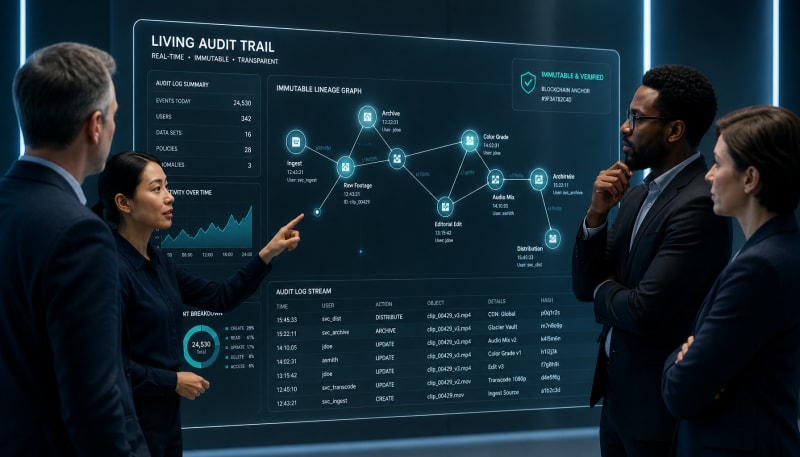
Hands-on technical architectural guide for building dynamic audit logging into CMS platforms.
When a national broadcaster kills a story an hour before air, the decision chain needs to be reconstructable six months later. When a defense contractor disputes the authenticity of satellite imagery, someone needs to prove what happened between capture and delivery. When pharmaceutical marketing teams edit patient testimonials, compliance officers need more than version numbers—they need to see every transformation, every decision point, and every human intervention that touched that content.
Traditional audit logs weren't built for this. They capture events, not lineage. They record what happened, not how content evolved. And in high-stakes media environments where synthetic content, automated editing, and distributed workflows are becoming standard, static audit trails leave dangerous gaps between what organizations think they can prove and what they actually can.
The value of provenance ultimately depends on whether organizations can turn evidence into confident decisions. Synthetic Proof helps examine that broader trust picture across AI content and workflows.
Living audit trails represent a fundamental shift in how organizations approach media accountability. Rather than logging discrete events in isolation, they maintain dynamic, immutable records of content lineage—capturing not just the fact that something changed, but the complete transformation chain, the context surrounding each decision, and the relationships between all actors in the content lifecycle.
Static Logs Can't Keep Up With Dynamic Workflows
The traditional enterprise audit log was designed for simpler problems. User authentication. Database queries. File access. These are discrete events with clear boundaries. A user either accessed a file or didn't. A query either executed or failed. The log entry is complete the moment the event concludes.
Media workflows don't work that way anymore. A single video asset might pass through automated transcription, AI-assisted editing, human review, synthetic voice replacement, compliance verification, and regional localization before publication. Each transformation creates new derivatives. Each decision point introduces new actors. Each edit potentially changes the meaning, context, or legal standing of the content.
Static logs capture these as separate events but lose the thread connecting them. You can see that a video was edited at 2:47 PM and approved at 3:12 PM, but you can't reconstruct what changed between those moments or why. You know an AI model processed the content, but you can't trace which version it received, what parameters governed its operation, or how its output was subsequently modified.
The gap becomes critical when stakes rise. Legal teams need to demonstrate that editorial standards were maintained. Compliance officers need to prove that automated systems operated within approved parameters. Brand teams need to show that influencer content wasn't manipulated beyond agreed boundaries. Static logs answer "what happened" but struggle with "how did we get here."

Lineage Must Be Captured, Not Reconstructed
The instinct when gaps appear in traditional audit systems is to log more events. Capture more timestamps. Store more metadata. The assumption is that if you collect enough data points, you can reconstruct lineage after the fact by analyzing patterns and relationships.
This approach fails in practice. Reconstruction requires interpretation, and interpretation introduces uncertainty. Did that content transformation happen because of the automated workflow or because a human overrode it? Was that approval routine or exceptional? Did that AI model use the production version or a staging variant someone forgot to disable?
Living audit trails invert the model. Instead of collecting events and hoping to reconstruct relationships later, they capture lineage as a first-class object. Every content transformation explicitly declares its inputs, its process, and its outputs. Every decision point records not just the decision but the context that informed it. Every derivative asset maintains cryptographic links to its sources.
This isn't about logging more—it's about logging differently. A traditional system might record fifty discrete events as a video moves through post-production. A living audit trail captures the same workflow as a single, evolving lineage graph where each node represents a transformation and each edge represents a dependency. The graph is built incrementally as work happens, not reconstructed forensically when questions arise.
Immutability Becomes the Foundation
The "living" aspect of these trails creates an obvious tension. If the audit record is constantly evolving as content moves through workflows, how do you prevent tampering? How do you ensure that the lineage graph you examine today accurately reflects what happened last month?
Immutability resolves this tension, but it requires precision in what gets locked. The answer isn't to make the entire trail static—it's to make each incremental addition irreversible while allowing the trail as a whole to grow organically.
When a transformation occurs, the lineage entry is cryptographically signed and written to append-only storage. The entry can reference previous entries and be referenced by future ones, but it cannot be modified or deleted. The trail grows forward in time but never changes backward. You can add new context—annotations, reviews, audits—but you can't rewrite history.
This model supports workflows that span weeks while maintaining forensic integrity. A video that undergoes daily edits for three weeks generates a lineage trail with dozens of entries. Each entry is immutable. The relationships between entries are immutable. But the trail itself is living—it reflects the current state of the content while preserving the complete history of how it got there.
Context Separates Audit Trails From Accountability Systems
Logging what happened is table stakes. The difficult work is capturing why it happened in ways that remain meaningful months later when organizational memory has faded and the people involved have moved to different projects.
Living audit trails address this through structured context capture. When a human approves a piece of content, the system doesn't just record the approval—it captures the review criteria that were applied, the guidance documents that informed the decision, and the conditional logic that determined which approval pathway was required. When an automated system transforms content, the trail doesn't just log the operation—it records the model version, the configuration parameters, the policy constraints that governed execution, and the validation tests that confirmed output quality.
This contextual depth transforms audit trails from compliance artifacts into operational intelligence. When regulators ask how AI-generated content was validated, the answer isn't a verbal explanation relying on institutional memory—it's a verifiable record showing exactly which validation rules were applied, which thresholds were enforced, and which human reviewers confirmed the results.
The context also makes the trails self-documenting. A compliance officer reviewing a workflow six months after the fact doesn't need to interview participants or guess at intent. The lineage graph shows not just the sequence of events but the decision framework that shaped them. The trail becomes the institutional memory rather than depending on it.
High-Stakes Environments Can't Afford Gaps
Not all media workflows require this level of rigor. Social media posts, internal presentations, and routine marketing materials can usually operate with simpler audit mechanisms. The cost and complexity of living audit trails aren't justified when stakes are low and questions are rare.
But certain domains increasingly can't function without them. Broadcast journalism, where editorial decisions must withstand public scrutiny. Financial services marketing, where every claim must be defensible under regulatory review. Healthcare communications, where patient privacy and accuracy requirements create legal exposure. Political advertising, where provenance and authenticity directly impact democratic processes.
These environments share common characteristics. Content has legal or reputational consequences that extend beyond publication. Multiple parties—human and automated—collaborate on creation and review. Workflows are complex enough that no single person understands the complete transformation chain. And questions about what happened often arise long after the work is complete.
In these contexts, the inability to definitively reconstruct content lineage isn't a minor inconvenience—it's an existential risk. A broadcaster that can't prove editorial standards were maintained loses credibility. A pharmaceutical company that can't demonstrate compliance with promotional guidelines faces regulatory penalties. A political campaign that can't verify content authenticity becomes vulnerable to manipulation claims.
Dynamic Logging Requires Architectural Choices
Implementing living audit trails means confronting questions that traditional logging systems never had to answer. Where does lineage data live in relation to content? How do distributed teams append to shared trails without coordination bottlenecks? What happens when workflow systems fail mid-process? How do you query lineage graphs that span thousands of transformations?
The architectural pattern that's emerging treats lineage as infrastructure rather than feature. Instead of embedding audit logic in individual applications, organizations are building dedicated lineage layers that sit between content storage and workflow systems. Applications declare transformations to the lineage layer rather than managing audit records themselves. The lineage layer handles immutability, cryptographic verification, and graph persistence while presenting a consistent interface to diverse systems.
This separation creates portability. A video that moves from one editing system to another carries its lineage trail with it because the trail isn't locked inside either system. An AI model that processes content across multiple platforms appends to the same lineage graph regardless of where execution happens. The trail becomes independent of the tools that create it.
It also creates opportunities for specialized tooling. Because lineage data follows consistent structures, purpose-built systems can emerge for querying, visualizing, and analyzing content history without understanding the specific workflows that generated it. Compliance teams can build review interfaces that work across different content types. Audit teams can create automated verification systems that check for pattern anomalies across all workflows rather than manually reviewing individual cases.
The Human Element Remains the Hardest Part
The technical challenges of building living audit trails are solvable. Cryptographic verification, append-only storage, graph databases, and distributed logging are all well-understood technologies. The harder problem is getting humans to use these systems reliably when they're under deadline pressure and the audit trail feels like bureaucratic overhead.
This is where thoughtful design becomes critical. Systems that require manual audit entries at every step fail in production because people skip them when they're busy. Systems that automatically capture everything generate so much noise that meaningful signals get lost. The balance point is selective automation—capturing technical lineage automatically while creating lightweight, contextual prompts for human decision points that genuinely require explanation.
When a video editor makes a cut, the system automatically records what changed. When that same editor overrides an automated quality check, the system prompts for a brief explanation—not a formal justification, just enough context that the decision makes sense to reviewers later. The prompt appears in the moment when context is fresh rather than days later when details have faded.
This approach respects the reality that high-stakes media environments can't function at bureaucratic speed. The audit trail has to support the work rather than obstruct it. When the system succeeds, compliance becomes a byproduct of normal operations rather than a separate, resentful obligation.
Final Thoughts
Living audit trails represent more than an incremental improvement in logging technology. They reflect a fundamental shift in how organizations think about accountability in automated, distributed, high-stakes media workflows. The question is no longer whether something happened—traditional logs answer that adequately. The question is how content evolved from source to publication, who and what influenced that evolution, and whether the transformation chain complies with editorial, legal, and ethical standards the organization claims to maintain.
As media workflows become more complex—with AI systems handling more transformations, distributed teams collaborating across tools and time zones, and synthetic content becoming indistinguishable from captured media—the gap between what organizations think they can prove and what they actually can prove will only widen. Living audit trails close that gap not by logging more events but by capturing the relationships between them in ways that remain verifiable and meaningful long after the work is done.
SYNTHETIC PROOF
FROM PROVENANCE TO OPERATIONAL TRUST
Understand Your AI Trust Gap
Synthetic Proof helps teams evaluate verification, provenance, prompt risk, and digital media trust through independent audits and structured findings.
Explore Synthetic ProofSynthetic Proof
Verified — Editorial Layer
This content has passed editorial verification for clarity, accuracy, and trust alignment.
Editor-in-Chief: Kevin Marsh
Verification Status: PASSED
Verification Status: PASSED
Comments
Post a Comment