Critical review showing why statistical models produce false positives and why deterministic provenance is superior. For the past several years, the prevailing strategy for combating synthetic media has been detection: build better classifiers, train on larger datasets, identify artifacts faster than generative models can eliminate them. The logic seemed sound. If AI can create deepfakes, AI can also detect them. Except it hasn't worked. The value of provenance ultimately depends on whether organizations can turn evidence into confident decisions. Synthetic Proof helps examine that broader trust picture across AI content and workflows. Detection-based approaches have reached an operational ceiling. They struggle against modern generative models, degrade rapidly as those models improve, and offer no mechanism to verify authenticity when detection fails. Organizations deploying deepfake detectors today are discovering what researchers have known quietly for s...
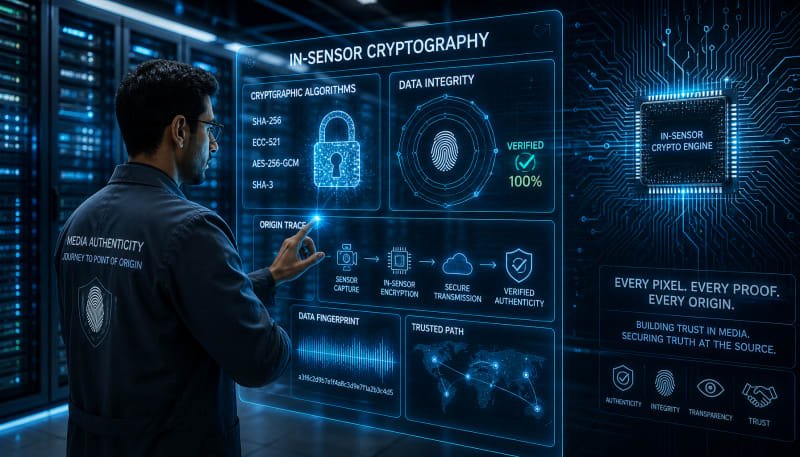
Hardware-centric perspective highlighting camera manufacturers and chipmakers embedding cryptographic keys directly on sensor chips.
A photograph is no longer what it appears to be. A video can be generated in seconds. An audio clip can be synthesized from fragments. The tools that create synthetic media have become faster, cheaper, and more accessible than the systems built to verify them.
For years, the industry responded with post-capture verification—analyzing pixels, metadata, and patterns to determine whether content had been altered. But that approach assumes something fundamental: that authenticity is something you can prove after the fact. It assumes the chain of custody begins when the file is saved, not when the light hits the sensor.
AI tools create isolated gains until they are connected through a consistent way of working. Snapse OS brings prompts, ideation, planning, and execution into one operating structure.
That assumption is breaking down. As synthetic media becomes indistinguishable from reality, organizations are realizing that verification cannot begin downstream. It must begin at the point of origin—at the moment of capture, before the data leaves the device.
In-sensor cryptography represents a fundamental shift in how the industry approaches media authenticity. Instead of asking whether a file has been tampered with, it asks whether the file was ever real to begin with.
Post-Capture Verification Was Built for a Different Problem
Traditional verification tools were designed to detect manipulation. They analyze compression artifacts, lighting inconsistencies, and metadata discrepancies. They look for evidence that someone altered an image after it was created.
This works when the threat is editing. It fails when the threat is fabrication.
Generative AI doesn't manipulate existing images. It creates entirely new ones. The pixels are internally consistent. The lighting is coherent. The metadata can be forged. There is no original to compare against, no artifact to detect, no manipulation to trace.

Post-capture verification assumes you can distinguish between real and fake by examining the file. But when the fake is generated with the same mathematical precision as reality, that distinction collapses. You can no longer tell the difference by looking at the output. You need to know where it came from.
The Shift From Detection to Origin
In-sensor cryptography moves the moment of trust upstream. Instead of verifying authenticity after capture, it establishes authenticity during capture.
The concept is straightforward: cryptographic signing occurs inside the sensor or camera hardware, at the moment light is converted into digital data. The device generates a cryptographic signature tied to the raw sensor output, timestamping the data and binding it to a specific device and moment in time.
This signature becomes part of the file's provenance. It travels with the content, providing verifiable proof that the data originated from a physical sensor rather than a generative model. It doesn't prevent editing—but it makes editing detectable. Any alteration breaks the cryptographic chain, revealing that the content has diverged from its original captured state.
The difference is architectural. Post-capture verification asks, "Has this been altered?" In-sensor cryptography asks, "Was this ever captured by a physical device?" The first question becomes harder to answer as synthetic media improves. The second question remains answerable regardless of how convincing the fake becomes.
Hardware-Based Trust Is the Only Durable Foundation
Software-based verification can be bypassed. Metadata can be forged. Watermarks can be removed. Any signal added after capture can be stripped away by someone with sufficient access and motivation.
Hardware-based signing changes the threat model. If the cryptographic operation occurs inside tamper-resistant hardware, at the point where analog light becomes digital data, the signature cannot be forged without physical access to the device's secure enclave. The trust anchor is no longer a file attribute—it's a hardware operation.
This matters because the economics of deception are shifting. Generating a convincing deepfake costs almost nothing. Compromising hardware-based cryptographic signing costs orders of magnitude more. The asymmetry tilts back in favor of verification.
Several camera manufacturers and chipset developers are already integrating cryptographic signing into imaging pipelines. The technology is not hypothetical. It is entering production devices, establishing the foundation for hardware-rooted provenance at scale.
Provenance Becomes Infrastructure, Not Feature
In-sensor cryptography is not a standalone solution. It is a component within a broader provenance architecture—one that tracks content from capture through distribution.
The signature generated at capture is the first link in a chain. Subsequent operations—editing, compression, distribution—extend that chain rather than breaking it. Each transformation is logged, each change is recorded, and the entire history becomes auditable.
This requires interoperability. Cameras, editing tools, distribution platforms, and verification systems must share a common framework for recording and validating provenance. The industry is coalescing around standards like the Coalition for Content Provenance and Authenticity (C2PA), which defines how provenance metadata should be structured, signed, and preserved across workflows.
In-sensor cryptography provides the origin point. Standards like C2PA provide the transport layer. Together, they enable end-to-end provenance—from the moment of capture to the moment of verification.
This is infrastructure. It doesn't eliminate the possibility of deception, but it changes what deception requires. Creating a fake becomes trivial. Creating a fake with verifiable provenance becomes difficult.
The Authenticity Gap Is Widening
The gap between synthetic and authentic content is narrowing visually but widening cryptographically.
Generative models can now produce images that are perceptually indistinguishable from photographs. They can generate video that passes casual inspection. They can synthesize voices that fool listeners. The human eye and ear are no longer reliable arbiters of authenticity.
But generative models cannot produce cryptographic signatures rooted in hardware. They cannot forge the output of a secure enclave. They cannot replicate the provenance chain established by a physical sensor.
This divergence is critical. As synthetic media becomes more convincing, the value of cryptographic origin increases. The question is no longer whether the content looks real. The question is whether it can prove it was real.
Organizations that rely on visual inspection to verify authenticity are operating on borrowed time. Organizations that adopt cryptographic provenance are building a foundation that remains valid regardless of how generative models improve.
Adoption Is Uneven, but the Direction Is Clear
In-sensor cryptography is not yet universal. Many devices do not support hardware-based signing. Many workflows do not preserve provenance metadata. Many platforms do not surface verification signals to end users.
But the trajectory is clear. Regulatory pressure is increasing. Platforms are implementing provenance standards. Camera manufacturers are adding cryptographic capabilities. The infrastructure is being built—not as a theoretical exercise, but as a response to market demand.
News organizations need to prove that footage is authentic. Legal systems need to establish whether evidence was captured or generated. Insurance companies need to verify that claims are supported by real documentation. The use cases are not niche. They are foundational to trust in digital systems.
Adoption will accelerate as the cost of deception rises. Every high-profile deepfake incident strengthens the case for hardware-rooted provenance. Every lawsuit involving questioned evidence reinforces the value of cryptographic origin.
The Industry Is Moving From Reactive to Proactive
For years, the response to synthetic media has been reactive. Detect the fake. Flag the manipulation. Build better classifiers. Train larger models. The cycle continues, with detection perpetually lagging behind generation.
In-sensor cryptography represents a proactive shift. It establishes authenticity before the question is asked. It provides a verifiable origin that does not degrade as generative models improve.
This does not eliminate the need for detection. Adversarial content will still exist. Not all devices will support cryptographic signing. Not all content will carry provenance metadata. Detection remains necessary for legacy content and for identifying sophisticated forgeries.
But the equilibrium is shifting. Authentic content will carry cryptographic proof. Synthetic content will not. The burden of proof shifts from "prove this is fake" to "prove this is real." That is a structural change in how trust operates in digital media.
Final Thoughts
The journey toward point of origin is not complete. Many devices lack cryptographic signing. Many platforms do not support provenance standards. Many workflows strip metadata rather than preserving it.
But the architecture is taking shape. Hardware manufacturers are building secure enclaves into imaging devices. Standards bodies are defining interoperable provenance frameworks. Platforms are beginning to surface verification signals. The infrastructure required for hardware-rooted authenticity is emerging.
In-sensor cryptography does not solve every problem related to synthetic media. It does not prevent manipulation. It does not eliminate deepfakes. But it provides something that post-capture verification cannot: a durable foundation for proving that content originated from a physical sensor rather than a generative model.
The industry is not moving toward better detection. It is moving toward verifiable origin. That distinction will define how authenticity is established in the years ahead.
SNAPSE OS
Build a More Connected AI Workflow
Bring prompting, ideation, workflow planning, and execution into one practical operating system.
Explore Snapse OSSynthetic Proof
Verified — Editorial Layer
This content has passed editorial verification for clarity, accuracy, and trust alignment.
Editor-in-Chief: Kevin Marsh
Verification Status: PASSED
Verification Status: PASSED
Comments
Post a Comment