Critical review showing why statistical models produce false positives and why deterministic provenance is superior. For the past several years, the prevailing strategy for combating synthetic media has been detection: build better classifiers, train on larger datasets, identify artifacts faster than generative models can eliminate them. The logic seemed sound. If AI can create deepfakes, AI can also detect them. Except it hasn't worked. The value of provenance ultimately depends on whether organizations can turn evidence into confident decisions. Synthetic Proof helps examine that broader trust picture across AI content and workflows. Detection-based approaches have reached an operational ceiling. They struggle against modern generative models, degrade rapidly as those models improve, and offer no mechanism to verify authenticity when detection fails. Organizations deploying deepfake detectors today are discovering what researchers have known quietly for s...

NUANCED perspective on modern creative workflows where content is rarely 100% real or 100% synthetic.
The content authenticity problem looked simpler a year ago. Organizations worried about deepfakes and synthetic media scams. The solution seemed straightforward: build better detectors, label what's AI-generated, and restore trust through classification.
That framing is already obsolete.
No detector is perfect, and the strongest decisions rarely depend on one score. Synthetic Proof helps teams evaluate multiple verification and provenance signals before acting on suspicious media.
The actual challenge emerging across enterprises, newsrooms, legal teams, and compliance organizations isn't determining whether content is real or fake. It's understanding a far more complex question: what happened between creation and delivery, who was responsible for each transformation, and whether the final output can be trusted for its intended purpose.
Binary detection—the practice of classifying content as either human-created or AI-generated—was never designed to answer those questions. And as AI becomes embedded throughout content workflows, the limitations of this approach are becoming impossible to ignore.
Detection Was Built for a Different Problem
Early AI detection tools emerged to solve a specific concern: identifying fully synthetic content designed to deceive. The assumption was that human-created content could be trusted and AI-generated content required skepticism.
That assumption no longer holds.
Most professional content today exists somewhere between purely human and purely synthetic. A legal brief may be drafted by an attorney, restructured by an AI writing assistant, fact-checked by a junior associate, and refined through additional AI editing. A news photograph might be captured by a photojournalist, enhanced using computational photography built into the camera itself, and cropped by an editor using AI-powered selection tools.
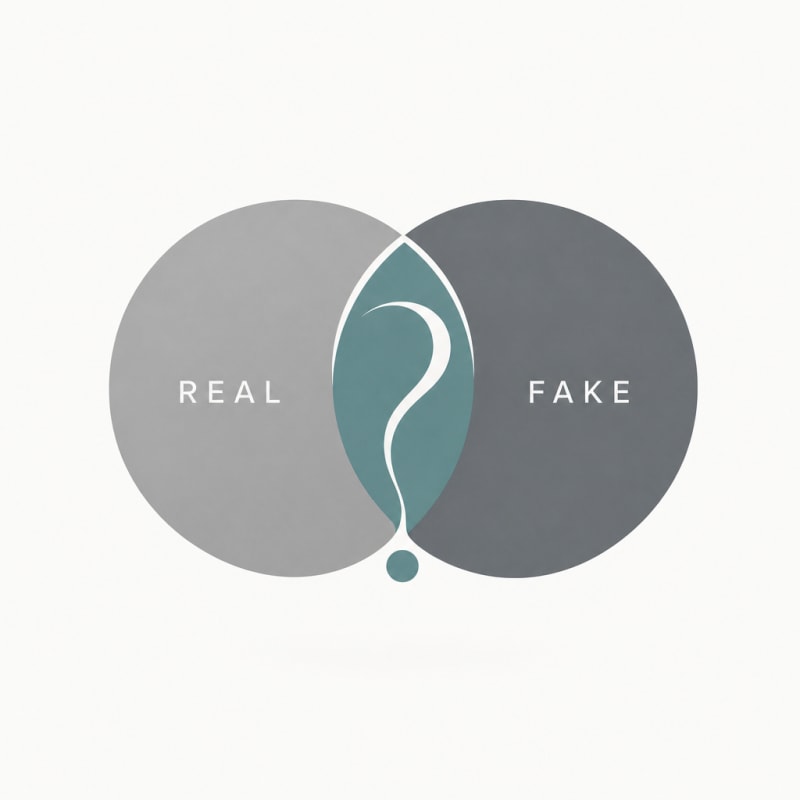
Labeling that photograph as "AI-generated" would be misleading. Labeling it as "authentic" without documenting its processing history would be incomplete. Binary detection offers no mechanism to capture what actually matters: the chain of modifications, the intent behind each change, and whether the final image accurately represents the scene as witnessed.
This is not a theoretical edge case. It describes the majority of professional content workflows today.
The Questions Organizations Actually Need Answered
When enterprises evaluate content authenticity, they are rarely asking whether AI was involved. They are asking whether the content can be trusted for a specific purpose.
A compliance officer reviewing marketing materials needs to know whether claims were verified, who approved final messaging, and whether any regulatory disclosures were altered after legal review. The presence or absence of AI in the workflow is secondary to understanding accountability and process integrity.
A newsroom publishing investigative reporting needs to document that quotes were not altered, that photos were not manipulated to misrepresent events, and that corrections were applied transparently. Knowing that an AI grammar tool was used is far less important than knowing no one edited the journalist's conclusions without attribution.
A legal team submitting evidence needs to demonstrate chain of custody, verify that exhibits were not tampered with, and prove that metadata has not been stripped or falsified. Binary classification provides none of this context.
What these scenarios share is a need for operational trust infrastructure—systems capable of documenting not just what content is, but what happened to it, who touched it, and whether those modifications align with organizational policies and legal requirements.
Why Provenance Became the Actual Requirement
Provenance is not a synonym for detection. It represents a fundamentally different approach to content authenticity.
Where detection attempts to classify content at a single point in time, provenance documents the lifecycle of that content across its entire existence. It records creation, modification, transformation, and distribution as a verifiable chain of events rather than a binary judgment.
This shift reflects how organizations actually use AI. Content is no longer created in a single moment by a single author. It is developed iteratively through workflows that blend human judgment, automated assistance, collaborative editing, and policy-driven validation. Understanding trust in this environment requires understanding process—not just output.
Provenance infrastructure captures the metadata, transformation records, and accountability signals needed to evaluate content within its operational context. It allows an auditor to see that a financial report was generated from verified data sources, reviewed by a human analyst, and approved through established governance controls. It allows a publisher to demonstrate that an article was fact-checked, that corrections were documented, and that editorial standards were maintained even when AI tools assisted in production.
Binary detection cannot provide this. It was never designed to.
The Accountability Gap Detection Cannot Close
One of the most significant limitations of binary AI detection is its inability to establish accountability.
When content is flagged as AI-generated, that label provides no indication of who created it, whether it was reviewed, or who is responsible for its accuracy. When content passes detection as human-created, that classification offers no assurance that it was produced ethically, that sources were verified, or that organizational policies were followed.
Accountability requires attribution, process documentation, and verifiable records of human oversight. These are governance requirements, not detection problems.
Organizations building trust infrastructure are increasingly focused on creating tamper-evident records that link content to creators, document approval workflows, and establish clear responsibility for each stage of production. This approach treats content authenticity as an operational discipline rather than a technical classification problem.
Detection tools will remain useful for specific applications—identifying wholly synthetic fraud attempts, flagging potential manipulation for human review, or providing preliminary screening in high-risk scenarios. But they cannot replace the governance infrastructure needed to operate responsibly in an AI-augmented environment.
What Post-Binary Trust Infrastructure Looks Like
The organizations moving beyond binary detection are building systems that capture richer signals about content integrity.
Instead of asking whether content is real or fake, they are documenting whether it meets specific trust criteria: whether it was created using approved tools, whether required reviews occurred, whether modifications were authorized, and whether the final output aligns with stated policies.
This requires integration across content workflows rather than post-production analysis. Trust signals are captured at the moment of creation, updated as content moves through editing and approval processes, and validated before publication or submission. The result is a verifiable record that travels with the content itself.
Some of this infrastructure is being built using cryptographic attestation, allowing organizations to prove that specific events occurred without revealing sensitive details about internal processes. Some relies on secure metadata schemas that record transformation history in standardized, interoperable formats. Some incorporates policy engines that automatically flag content requiring additional human review based on risk assessment rather than binary classification.
The common thread is a focus on process integrity and accountability rather than automated classification. These systems assume that AI will be used throughout content creation and focus instead on ensuring that its use is transparent, authorized, and aligned with organizational standards.
TrustOps as an Emerging Discipline
This shift is giving rise to a new operational discipline focused on building and maintaining trust infrastructure across AI-augmented workflows.
TrustOps—shorthand for the policies, tools, and practices that enable organizations to verify content integrity and demonstrate accountability—treats authenticity as a continuous operational requirement rather than a one-time verification check. It sits alongside existing disciplines like DevOps and SecOps, addressing a gap that binary detection was never designed to fill.
Organizations implementing TrustOps capabilities are defining what trust means within their specific context, establishing verification standards appropriate to their risk profile, and building systems that capture the evidence needed to demonstrate compliance with those standards.
For some, this means documenting that AI-generated marketing copy was reviewed by a human before publication. For others, it means proving that legal filings were not altered after attorney approval. For newsrooms, it may mean demonstrating that corrections were applied transparently and that original source material remains accessible.
These are operational requirements that extend far beyond whether content was created by a human or a machine. They require infrastructure designed to answer more nuanced questions about process, accountability, and fitness for purpose.
Final Thoughts
Binary AI detection provided a useful starting point when synthetic content was rare and workflows were simpler. But the environment has changed. AI is now embedded throughout content creation, transformation is continuous, and trust depends on understanding process rather than classifying output.
Organizations building for this reality are moving beyond real-versus-fake classification toward provenance systems that document what happened to content, who was responsible, and whether appropriate controls were maintained. They are treating authenticity as an operational discipline rather than a detection problem.
This does not mean detection tools become irrelevant. It means they are insufficient on their own. The actual challenge is building trust infrastructure capable of operating in an environment where AI augmentation is standard, workflows are collaborative, and accountability cannot be established through automated classification alone.
The question is no longer whether content is real or fake. It is whether organizations can demonstrate that their content—however it was created— and if it meets the trust requirements their stakeholders, regulators, and audiences increasingly expect.
SYNTHETIC PROOF
DETECTION IS ONLY ONE LAYER
Move From Suspicion to Evidence
Synthetic Proof provides independent Verification Audits designed to help teams evaluate suspicious media, provenance signals, and content risk.
Explore Verification AuditsSynthetic Proof
Verified — Editorial Layer
This content has passed editorial verification for clarity, accuracy, and trust alignment.
Editor-in-Chief: Kevin Marsh
Verification Status: PASSED
Verification Status: PASSED
Comments
Post a Comment