Learn why organizations are investing in verification instead of detection alone. For years, the fight against synthetic media manipulation followed a familiar pattern: researchers identified deepfake artifacts, built detection models around those signatures, and deployed them across platforms. Detection accuracy improved. Conferences celebrated breakthroughs. The industry felt like it was winning. Then generative AI became exponentially better at eliminating the very artifacts those systems were trained to find. As synthetic media improves, confidence increasingly comes from layered evidence rather than a binary label. Synthetic Proof helps organizations evaluate that evidence in context. What's emerging isn't simply a technical gap that better detection can close. It's a fundamental shift in how organizations must approach digital trust. The old model—detect manipulated content after it's created—assumes defenders can keep pace with attackers....
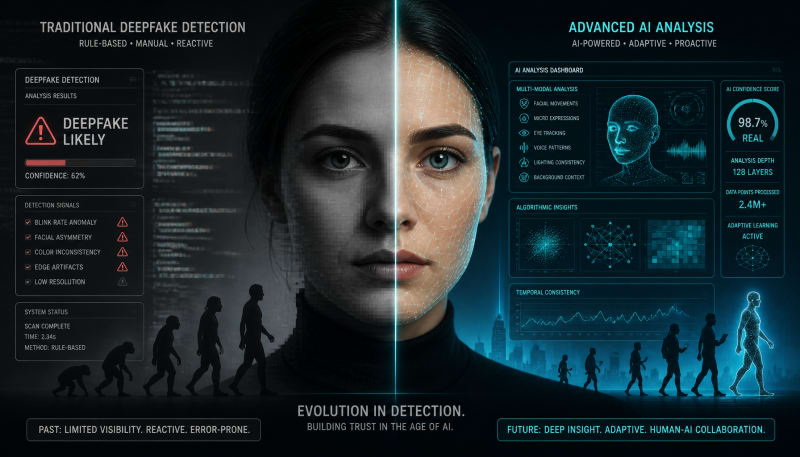
Learn why organizations are investing in verification instead of detection alone.
For years, the fight against synthetic media manipulation followed a familiar pattern: researchers identified deepfake artifacts, built detection models around those signatures, and deployed them across platforms. Detection accuracy improved. Conferences celebrated breakthroughs. The industry felt like it was winning.
Then generative AI became exponentially better at eliminating the very artifacts those systems were trained to find.
As synthetic media improves, confidence increasingly comes from layered evidence rather than a binary label. Synthetic Proof helps organizations evaluate that evidence in context.
What's emerging isn't simply a technical gap that better detection can close. It's a fundamental shift in how organizations must approach digital trust. The old model—detect manipulated content after it's created—assumes defenders can keep pace with attackers. That assumption no longer holds. Detection systems that worked against 2020-era deepfakes struggle against models trained on orders of magnitude more data with architectures designed specifically to evade pattern recognition.
The question isn't whether detection still matters. It's whether detection alone can anchor trust in an environment where synthetic content is increasingly indistinguishable from authentic media.
Detection Was Built for a Different Generation of Synthetic Media
Early deepfake detection succeeded because synthetic media carried identifiable flaws. Facial warping near boundaries. Inconsistent lighting across frames. Temporal discontinuities that revealed frame-by-frame generation. Unnatural eye movements. Compression artifacts unique to generative processes.
These weren't subtle. Detection models could be trained on known manipulation techniques, then deployed to spot similar patterns in new content. The approach worked well enough when deepfakes required specialized knowledge, expensive hardware, and hours of processing time.
But generative models evolved faster than detection infrastructure could adapt. Modern architectures incorporate adversarial training—essentially teaching generators to evade detection by pitting them against discriminators during training. Every artifact that once betrayed synthetic origin has been progressively eliminated. Diffusion models create images from noise without the telltale generative signatures that older GANs produced. Video models now maintain temporal consistency across longer sequences. Audio synthesis captures prosody, breathing patterns, and acoustic environments with precision that defeats traditional voice analysis.

The result is a detection landscape where accuracy degrades rapidly. A model trained on today's synthetic media performs measurably worse against next quarter's generative outputs. Organizations find themselves in a perpetual arms race, constantly retraining detection systems against adversaries who iterate faster and release publicly.
The Arms Race Has Structural Disadvantages for Defenders
Detection operates at an inherent disadvantage. Attackers need only one successful manipulation to cause damage. Defenders must catch every instance across every distribution channel. Attackers iterate privately, testing outputs against detection systems until they find approaches that evade classification. Defenders react to what's already been released.
This asymmetry compounds as generative AI becomes more accessible. What once required research labs now runs on consumer hardware. Manipulation techniques that were proprietary become open-source within months. The barrier to creating convincing synthetic media continues falling while the challenge of detecting it becomes more complex.
Consider the operational reality. An organization deploys a detection system trained on thousands of deepfake samples. That system achieves 95% accuracy in testing—impressive by research standards. But in production, where synthetic content may represent a fraction of total media processed, even high accuracy produces unacceptable false positive rates. A 5% error rate across millions of daily media assets creates operational chaos.
More fundamentally, detection offers no insight into what is authentic—only probabilistic assessments of what might be manipulated. A video flagged as "likely synthetic" with 78% confidence doesn't tell stakeholders what actually happened, who created the content, or whether the source is trustworthy. Detection identifies suspicion. It doesn't establish truth.
Authentication Requires Knowing What's Real, Not Just What's Fake
The limitation isn't technical sophistication. It's conceptual framing. Detection treats authenticity as the absence of manipulation. But proving content wasn't altered doesn't confirm its origin, context, or chain of custody. A video might pass every detection test and still misrepresent events through selective editing, staging, or misattribution.
What's needed is a different approach entirely—one that establishes positive proof of authenticity rather than attempting to identify every possible manipulation. This is where provenance becomes essential.
Provenance shifts the question from "Is this content fake?" to "Can we verify this content's origin and history?" Instead of analyzing media for manipulation artifacts, provenance systems create verifiable records at the moment of capture. Cryptographic signatures bind content to creation metadata—device identity, timestamp, location, creator attribution. Any subsequent modification breaks the signature, making tampering evident.
This isn't theoretical. The Coalition for Content Provenance and Authenticity (C2PA) has developed technical standards that major camera manufacturers, software platforms, and news organizations are beginning to implement. Media created with C2PA-compliant tools carries embedded credentials that persist through editing workflows, enabling downstream consumers to verify authenticity and understand modification history.
The distinction matters operationally. Detection requires processing every piece of content through analysis pipelines, generating probabilistic assessments that demand human review. Provenance enables instant verification of signed content without subjective interpretation. Detection degrades as manipulation techniques improve. Provenance remains valid as long as cryptographic standards hold.
Trust Infrastructure Is Becoming a Requirement, Not an Option
Organizations are recognizing that authenticity cannot be validated through spot-checks and post-hoc analysis alone. Media integrity needs to be established at creation and maintained through distribution. This requires infrastructure rather than tools—systems that create verifiable records, maintain chain of custody, and enable verification at scale.
We're seeing this shift across multiple sectors. News organizations are implementing content credentials to distinguish reported journalism from user-generated content. Financial institutions are requiring verified identity for video-based authentication. Legal teams are establishing provenance requirements for digital evidence. Insurance companies are demanding authenticated documentation for claims processing.
These aren't isolated experiments. They represent a broader recognition that digital trust cannot scale through human verification alone. As synthetic media becomes indistinguishable from authentic content, organizations need systematic ways to establish authenticity before content enters workflows.
This is where TrustOps emerges as an operational discipline. Just as DevOps transformed how organizations deploy software and SecOps formalized security practices, TrustOps provides frameworks for maintaining digital authenticity across creation, distribution, and verification. It encompasses content provenance, identity verification, audit trails, and compliance monitoring—all integrated into operational workflows rather than applied as afterthoughts.
The technical components are maturing. C2PA provides content credentials. Hardware-backed attestation enables device verification. Distributed ledgers create tamper-evident audit trails. Cryptographic standards ensure signature integrity. What's emerging is the operational maturity to implement these technologies systematically.
Detection Still Matters—But Within a Broader Framework
None of this suggests detection becomes irrelevant. Analysis tools remain valuable for identifying suspicious content, especially legacy media created before provenance standards existed. Detection helps flag potential manipulation in unverified content, prioritize human review, and identify emerging threat patterns.
But detection works best as one component within a broader trust architecture. Verified content with valid provenance requires no detection analysis. Unverified content gets flagged for scrutiny. Detection focuses resources where authenticity cannot be established through provenance alone.
This layered approach reflects how trust operates in physical systems. Currency uses serial numbers, watermarks, and security features that enable positive authentication—not just counterfeit detection. Legal documents carry notarization and chain of custody requirements. Pharmaceuticals use tamper-evident packaging and verification systems.
Digital media is moving toward similar frameworks. The technical foundation exists. The operational practices are being established. What remains is broader adoption and integration into content workflows.
Final Thoughts
The deepfake detection arms race hasn't been lost—it's revealed the limitations of reactive authentication. As generative AI eliminates detectable artifacts, organizations cannot rely solely on identifying what's fake. They need infrastructure that establishes what's real.
This transition is already underway. Provenance standards are being implemented. Hardware manufacturers are building authentication into capture devices. Platforms are adding verification capabilities. The shift from detection to authentication represents not just technological evolution but operational maturity.
For organizations navigating this transition, the strategic question isn't which detection system offers the highest accuracy. It's how to build trust infrastructure that combines provenance, verification, and selective detection into operational frameworks. Content authenticity is becoming a foundational requirement—one that requires systematic approaches rather than tactical tools.
The organizations that recognize this shift early will establish trust as a competitive advantage. Those that continue relying exclusively on detection will find themselves perpetually reacting to threats they can no longer reliably identify. Traditional deepfake detection served its purpose. What comes next requires thinking about digital trust differently.
The Practical Position
The detection paradigm assumes defenders can outpace generation—a premise no longer supported by the economics or architecture of modern AI. Organizations that anchor digital trust exclusively to forensic analysis will find themselves constantly behind. The shift required isn't better detection, but verification infrastructure that establishes authenticity at creation rather than attempting to prove manipulation after distribution.
— Kevin Marsh, Editor-in-Chief
SYNTHETIC PROOF
DETECTION IS ONLY ONE LAYER
Move From Suspicion to Evidence
Synthetic Proof provides independent Verification Audits designed to help teams evaluate suspicious media, provenance signals, and content risk.
Explore Verification AuditsSynthetic Proof
Verified — Editorial Layer
This content has passed editorial verification for clarity, accuracy, and trust alignment.
Editor-in-Chief: Kevin Marsh
Verification Status: PASSED
Verification Status: PASSED
Comments
Post a Comment