Learn why organizations are investing in verification instead of detection alone. For years, the fight against synthetic media manipulation followed a familiar pattern: researchers identified deepfake artifacts, built detection models around those signatures, and deployed them across platforms. Detection accuracy improved. Conferences celebrated breakthroughs. The industry felt like it was winning. Then generative AI became exponentially better at eliminating the very artifacts those systems were trained to find. As synthetic media improves, confidence increasingly comes from layered evidence rather than a binary label. Synthetic Proof helps organizations evaluate that evidence in context. What's emerging isn't simply a technical gap that better detection can close. It's a fundamental shift in how organizations must approach digital trust. The old model—detect manipulated content after it's created—assumes defenders can keep pace with attackers....
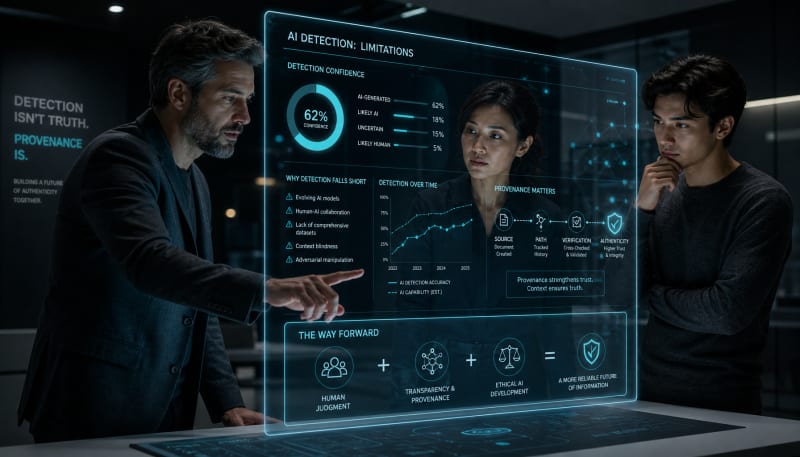
Explore why binary "real vs. fake" systems struggle against modern AI.
Organizations spent the last two years racing to detect AI-generated content. Now many are discovering that detection itself may be fighting the wrong battle.
The underlying problem isn't whether an image, document, or video was created by AI. It's whether the content is trustworthy, verifiable, and connected to a known origin. Detection tools attempt to answer this question after the fact—analyzing patterns, statistical anomalies, and artifacts to make probabilistic guesses about how something was created. But as generative models improve and outputs become indistinguishable from human work, this approach is collapsing under its own limitations.
Provenance is becoming one part of a larger operational trust question: can an organization verify its content, prompts, and AI workflows consistently? Synthetic Proof helps teams evaluate where those trust signals hold—and where gaps remain.
The industry is beginning to shift toward a fundamentally different model: provenance. Rather than trying to reverse-engineer authenticity from finished content, provenance establishes origin and modification history at the point of creation. It's a change from forensic analysis to verifiable lineage—and it represents a structural rethinking of how trust will function in an AI-saturated information environment.
Detection Was Built for a Different Problem
AI detection emerged as a response to early concerns about plagiarism, misinformation, and content authenticity. The tools were designed to identify telltale signs of machine generation: unusual word patterns, statistical regularities, compression artifacts, or features invisible to the human eye but detectable through algorithmic analysis.
This approach worked reasonably well when generative models were less sophisticated and their outputs displayed consistent signatures. But detection is inherently reactive. It assumes the content has already been created, distributed, and potentially consumed before anyone asks whether it's authentic. By that point, the damage—whether reputational, operational, or legal—may already be done.
More fundamentally, detection relies on the gap between AI-generated and human-created content remaining wide enough to measure. That gap is closing rapidly. Modern language models produce text indistinguishable from human writing. Image generators create photorealistic outputs with fewer detectable artifacts. Video synthesis is approaching similar fidelity. Detection tools are engaged in an arms race they cannot win indefinitely.
Even when detection works, it answers the wrong question. Knowing that a document was likely generated by AI doesn't tell you whether it's accurate, authorized, or appropriate for its context. A human-written fabrication can be more damaging than an AI-generated summary. Detection flags the tool, not the trustworthiness.
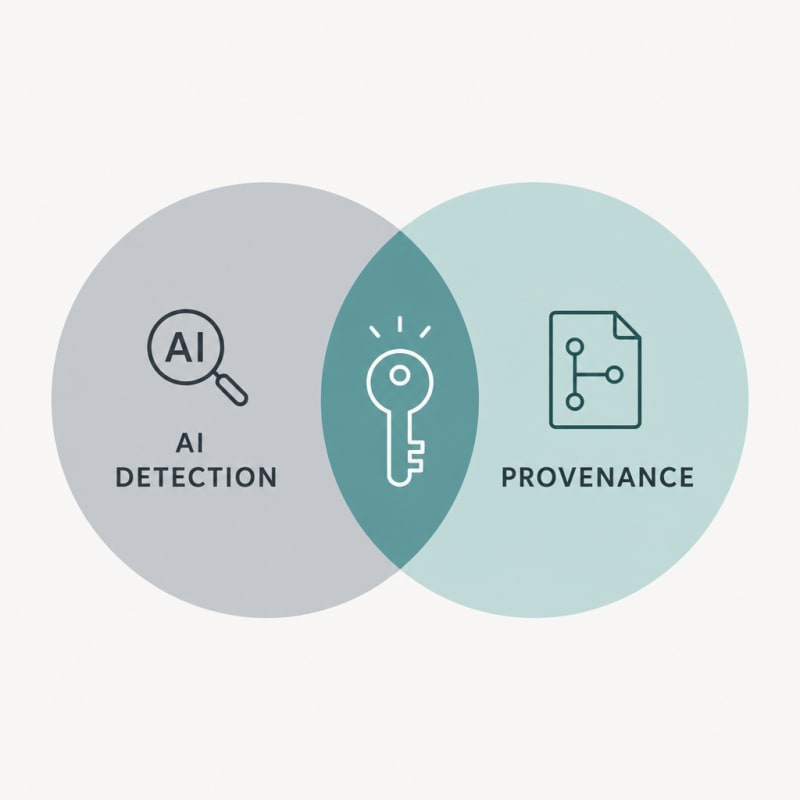
Provenance Begins at Creation, Not Analysis
Provenance flips the model. Instead of analyzing content after the fact, it embeds verifiable information about origin, authorship, and modification history directly into the asset or its metadata at the moment of creation.
This approach draws from traditions in art authentication, supply chain tracking, and digital forensics, but applies them to the specific challenges of AI-generated and AI-modified content. The goal is to create an unbroken chain of custody that allows anyone to verify where content came from, who created or authorized it, what tools were used, and what changes were made along the way.
Provenance doesn't eliminate the possibility of manipulation, but it makes manipulation detectable. If an image is edited, the provenance record can show what changed. If a document is created by AI, the record can indicate which model was used and under what parameters. If content is republished or remixed, the lineage remains intact.
The technical implementation varies, but the concept is consistent: cryptographic signatures, content credentials, immutable logs, and verifiable metadata that travel with the content itself. Some implementations use blockchain-style distributed ledgers. Others rely on centralized verification infrastructure. Still others combine cryptographic hashing with publicly accessible registries.
What matters is that provenance makes authenticity a property of the content rather than a conclusion drawn from analysis.
Why Organizations Are Moving Beyond Detection
The shift toward provenance is being driven by practical necessity. Organizations in regulated industries—finance, healthcare, legal services, government—are finding that detection tools don't meet their compliance or risk management requirements.
A bank needs to know that a loan application document is the one submitted by the applicant, unaltered and verifiably authentic. A probabilistic guess that the document "appears human-written" doesn't satisfy that requirement. Provenance that cryptographically links the document to a verified submission does.
Similarly, media organizations facing deepfake misinformation need more than tools that sometimes correctly identify synthetic video. They need systems that verify the source of footage, authenticate the chain of custody, and provide audiences with confidence that what they're seeing hasn't been manipulated. Provenance offers that pathway. Detection does not.
Enterprises deploying AI agents or automation workflows face a different problem: accountability. When an AI system drafts a contract, generates a report, or makes a recommendation, decision-makers need to know what inputs were used, what model produced the output, and whether the process followed established guidelines. Provenance creates an auditable record. Detection only flags that AI was involved.
The regulatory environment is accelerating this transition. Emerging frameworks around AI transparency, explainability, and accountability increasingly require organizations to demonstrate not just that content is authentic, but that its creation followed verifiable processes. Provenance infrastructure is designed to meet those requirements. Detection is not.
Provenance Requires New Infrastructure
Implementing provenance at scale introduces challenges that detection never had to solve. Detection tools operate on isolated pieces of content. Provenance requires infrastructure that spans creation tools, storage systems, distribution channels, and verification endpoints.
This means integration with content management systems, design tools, document processors, video editors, and publishing platforms. It means establishing standards for metadata schemas, cryptographic signing, and verification protocols. It means building registries or ledgers that can handle high-volume credential validation without creating bottlenecks.
The ecosystem is beginning to coalesce around initiatives like the Content Authenticity Initiative (CAI) and the Coalition for Content Provenance and Authenticity (C2PA), which are developing open standards for provenance metadata. Major technology companies, camera manufacturers, and software vendors are implementing support for these standards, creating the foundation for interoperable provenance infrastructure.
But adoption remains fragmented. Many organizations lack the technical capability to implement provenance across their content lifecycle. Others face legacy systems that weren't designed with verifiable metadata in mind. Still others struggle with the operational complexity of maintaining cryptographic key management and verification workflows.
The result is a transitional period where provenance exists in pockets—implemented by forward-thinking organizations or mandated in specific high-stakes contexts—but not yet ubiquitous across the digital ecosystem.
Detection and Provenance Will Coexist
The shift toward provenance doesn't make detection obsolete. The two approaches serve different purposes and will likely coexist for the foreseeable future.
Detection remains useful for analyzing content that enters an organization from untrusted sources—social media posts, open web content, third-party submissions. When provenance data is absent or unverifiable, detection offers at least a probabilistic assessment of authenticity.
Provenance, meanwhile, is most effective within trusted ecosystems where creators, platforms, and verifiers have implemented compatible infrastructure. It works when participants agree to embed and honor provenance metadata. It struggles when content moves outside those boundaries or when bad actors strip metadata before republishing.
The real value emerges when both approaches are used strategically. Organizations can require provenance for content they create or control, while using detection as a supplementary tool for external content. Verification workflows can prioritize provenance-verified assets and flag unverified content for additional scrutiny.
This layered approach acknowledges that no single solution addresses every trust challenge. Provenance establishes verifiable lineage where possible. Detection provides forensic analysis where necessary. Together, they create more resilient trust infrastructure than either could alone.
The Trust Layer Is Being Rebuilt
What's emerging isn't simply a new category of tools. It's a fundamental rethinking of how authenticity, accountability, and verification function in environments where AI can generate, modify, and distribute content at scale.
The old model assumed that content could be trusted by default and questioned when suspicious. The new model assumes content requires verification and that verification depends on cryptographic proof rather than human judgment or algorithmic analysis.
This shift has implications beyond content authenticity. It touches governance, compliance, legal accountability, and operational risk management. Organizations building AI systems will increasingly need to demonstrate not just that their outputs are accurate, but that their processes are verifiable. Provenance infrastructure makes that demonstration possible.
We're watching the construction of a new trust layer—one designed for an environment where the volume, velocity, and sophistication of synthetic content has made traditional verification methods insufficient. Detection was a bridge technology, useful for the moment when AI-generated content was novel and detectable. Provenance is the infrastructure being built for the world where AI is pervasive and indistinguishable.
Conclusion
The limitations of AI detection aren't simply technical—they're structural. Detection tries to solve a forward-looking problem with backward-looking analysis. Provenance inverts that model, establishing trust at the point of creation rather than attempting to reconstruct it through forensics.
Organizations that understand this difference are beginning to shift their trust strategies accordingly. They're investing in infrastructure that embeds verifiable metadata, implements cryptographic signing, and integrates with emerging provenance standards. They're moving from asking "Was this made by AI?" to asking "Can I verify where this came from and how it was created?"
The transition will take years. Standards need to mature. Integration needs to deepen. Adoption needs to expand beyond early movers. But the direction is increasingly clear. The next generation of trust infrastructure won't be built on detection. It will be built on provenance.
The Practical Position
Organizations fixating on whether AI created something are solving for the wrong variable. Provenance shifts the question from "Was this made by a machine?" to "Can I verify its origin and trust its chain of custody?" That distinction will separate institutions that control their information integrity from those perpetually reacting to it.
— Kevin Marsh, Editor-in-Chief
SYNTHETIC PROOF
FROM PROVENANCE TO OPERATIONAL TRUST
Understand Your AI Trust Gap
Synthetic Proof helps teams evaluate verification, provenance, prompt risk, and digital media trust through independent audits and structured findings.
Explore Synthetic ProofSynthetic Proof
Verified — Editorial Layer
This content has passed editorial verification for clarity, accuracy, and trust alignment.
Editor-in-Chief: Kevin Marsh
Verification Status: PASSED
Verification Status: PASSED
Comments
Post a Comment