Learn why organizations are investing in verification instead of detection alone. For years, the fight against synthetic media manipulation followed a familiar pattern: researchers identified deepfake artifacts, built detection models around those signatures, and deployed them across platforms. Detection accuracy improved. Conferences celebrated breakthroughs. The industry felt like it was winning. Then generative AI became exponentially better at eliminating the very artifacts those systems were trained to find. As synthetic media improves, confidence increasingly comes from layered evidence rather than a binary label. Synthetic Proof helps organizations evaluate that evidence in context. What's emerging isn't simply a technical gap that better detection can close. It's a fundamental shift in how organizations must approach digital trust. The old model—detect manipulated content after it's created—assumes defenders can keep pace with attackers....

Enterprise security framework showing how to validate incoming files
Most verification happens too late. Organizations verify outputs after they've been processed, decisions after they've been made, and content after it's been distributed. This reactive approach treats verification as quality control rather than foundational infrastructure. But the most consequential moment in any AI system isn't when something emerges—it's the instant something enters.
The API and edge boundary represents the last moment of certainty before processing begins. It's where external inputs cross into internal systems, where user requests become operational commands, where unverified data becomes the foundation for automated decisions. What happens at this boundary increasingly determines whether AI systems can be trusted at all.
Detection can identify warning signs. Independent verification helps determine what the wider evidence actually supports. Synthetic Proof provides that broader assessment layer.
This isn't about adding another security layer. It's about recognizing that verification architectures built around output inspection cannot address the fundamental challenge of operating AI systems at scale. When verification moves to the boundary—before processing, before transformation, before distribution—it changes from damage control to structural integrity.
The Boundary Is Where Trust Begins or Breaks
Every API call, every edge function, every external request carries information that will influence downstream behavior. A prompt submitted to an AI model. An image uploaded for processing. A data payload sent for transformation. Instructions passed to an autonomous agent. These inputs don't just trigger operations—they shape them.
Traditional security asks whether an input is malicious. Boundary verification asks something more fundamental: can this input be trusted as the basis for automated action? Is it authentic? Has it been tampered with? Does it carry verifiable provenance? Can its origin be confirmed?
The distinction matters because AI systems don't just execute—they interpret, generate, and propagate. A compromised input at the boundary becomes a compromised foundation for everything downstream. An unverified prompt becomes an unverifiable output. An image without provenance becomes content without lineage. A request without attestation becomes a decision without accountability.
When verification happens after processing, you're measuring consequences. When it happens at the boundary, you're establishing preconditions. One approach manages risk. The other prevents it from entering the system entirely.
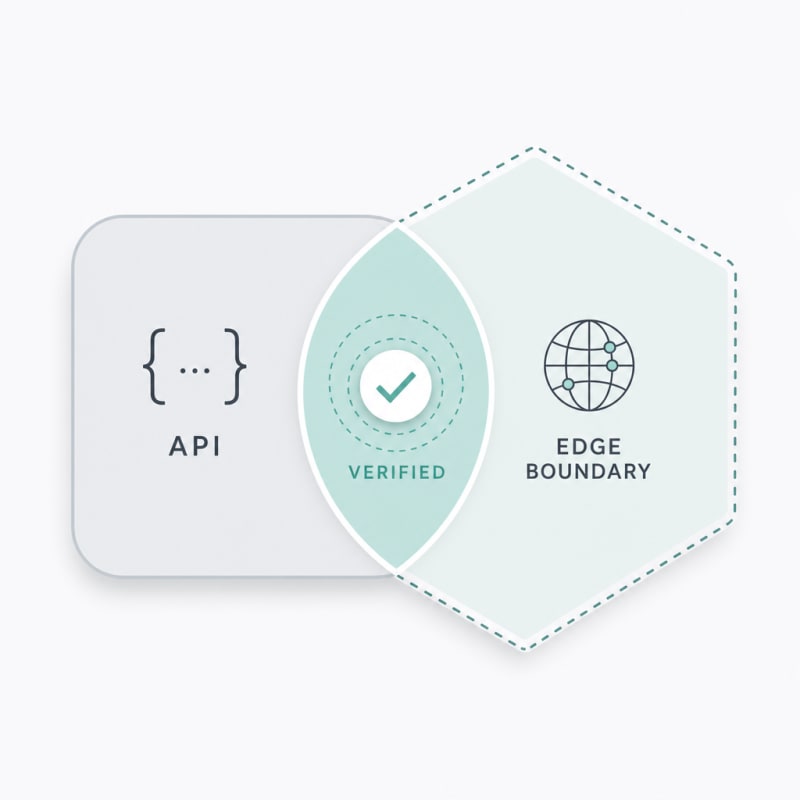
Processing Destroys the Evidence Verification Needs
Here's what makes post-processing verification inadequate: the act of processing transforms inputs in ways that make retroactive verification difficult or impossible. An AI model that accepts an unverified prompt and generates a response has already created downstream artifacts that inherit the uncertainty of their origin. A system that ingests an image without checking its provenance has already made that image part of its operational context.
By the time you verify the output, you're no longer verifying the input. You're verifying something derived, transformed, and combined with other data. The original context—the metadata, the cryptographic signatures, the provenance chain, the attestation markers—may have been stripped, altered, or lost during processing.
This isn't just a technical problem. It's an architectural one. Systems designed to verify outputs are fundamentally reactive. They can tell you something went wrong. They cannot prevent it from going wrong. They can flag problematic content after distribution. They cannot stop it from being generated.
Boundary verification operates on a different principle: immutability of verification state. When verification happens before processing, the determination is made on unaltered inputs with intact metadata, original signatures, and complete provenance chains. The evidence verification depends on hasn't been transformed yet. It still exists in its original, verifiable form.
The Edge Amplifies the Problem
Edge computing shifts processing closer to where data originates—geographically distributed, often outside centralized control, frequently operating with reduced oversight. This architecture offers speed and efficiency. It also creates verification gaps.
An edge function that accepts inputs without verification becomes a distributed trust problem. Each edge node becomes a potential entry point for unverified data. Each API endpoint becomes a boundary that must enforce verification independently. The more distributed your processing, the more critical boundary verification becomes.
Centralized systems can afford to verify outputs because there's a chokepoint where everything converges. Edge architectures eliminate that chokepoint. If you don't verify at the boundary, you may not get another opportunity until long after the input has influenced dozens of downstream operations across multiple nodes.
Immutable Verification Requires Immutable Evidence
Verification at the boundary only works if the evidence being verified cannot be altered during the verification process itself. This is where immutable verification becomes more than a technical preference—it becomes an operational requirement.
Immutable verification means the verification check operates on cryptographically secured, tamper-evident inputs. The provenance chain is signed. The metadata is hashed. The attestation markers are cryptographically bound to the content. Any modification to the input invalidates the verification state immediately.
This approach creates a binary determination at the boundary: either the input arrives with intact, verifiable proof of its origin and integrity, or it doesn't. Either it carries cryptographic attestation that can be independently validated, or it's treated as unverified. There's no ambiguity. No partial trust. No provisional acceptance pending later review.
When inputs arrive at an API or edge boundary with immutable verification markers, the system doesn't need to trust the sender. It doesn't need to trust the transport layer. It only needs to verify the cryptographic proof. The verification is self-contained, deterministic, and independent of external factors.
This is what makes boundary verification scalable. It's not about inspecting every input manually or routing everything through centralized approval. It's about architecting systems where verification is embedded in the input itself, cryptographically enforced, and validated at the moment of entry.
The Shift From Inspection to Enforcement
Traditional verification models assume inputs will be inspected after they arrive. Content moderation, compliance checks, security scans—these happen after ingestion, during processing, or before final output. The system accepts first, verifies later.
Boundary verification inverts this model. Verification becomes a precondition for processing. The API rejects inputs that don't carry verifiable attestation. The edge function refuses to execute on data without intact provenance. The AI model declines to process prompts that lack cryptographic verification of origin.
This shift has operational consequences. It means systems must be designed to handle verification failures at the boundary—not as edge cases, but as routine occurrences. It means APIs must respond differently to verified versus unverified inputs. It means edge functions must be capable of making verification determinations locally, without round-tripping to centralized services.
It also means the burden of proof shifts. Instead of the system being responsible for detecting problematic inputs after they arrive, the sender becomes responsible for providing verifiable inputs before they're accepted. The system's job isn't to inspect everything—it's to enforce verification requirements at the gate.
Where Boundary Verification Changes Operational Reality
The impact of boundary verification becomes clear in scenarios where AI systems operate with high autonomy, significant downstream consequences, or regulatory scrutiny.
An AI agent that accepts external instructions needs to verify those instructions came from an authorized source before executing them. Checking after execution is too late—the action has already occurred. Verification at the boundary means the agent never processes commands that lack cryptographic attestation of origin.
A content generation system that ingests user prompts needs to establish whether those prompts contain injection attacks, manipulated instructions, or adversarial inputs before the model processes them. Once the model has generated a response based on a compromised prompt, the damage is done. Verification at the boundary means malformed prompts never reach the model.
A synthetic media pipeline that processes uploaded images needs to confirm those images carry verifiable provenance before incorporating them into training data, automated workflows, or public-facing outputs. Once an image without provenance has been processed, its unknown origin propagates through every derivative work. Verification at the boundary means only verifiable inputs enter the pipeline.
These aren't hypothetical scenarios. They're emerging operational requirements as AI systems handle more consequential decisions with less human oversight.
Verification Infrastructure Is Becoming Boundary Infrastructure
The technical shift toward boundary verification is driving architectural changes across AI platforms, API gateways, edge computing frameworks, and autonomous systems. Verification is moving from optional post-processing to required pre-processing.
This means verification capabilities must operate at API speed—milliseconds, not seconds. They must function at edge scale—distributed, not centralized. They must make deterministic decisions—binary pass/fail, not probabilistic risk scores. And they must do all of this without introducing operational bottlenecks that undermine the performance benefits of edge and API-driven architectures.
The organizations building verification into boundary infrastructure aren't treating it as a compliance add-on. They're recognizing that as AI systems become more autonomous, the boundary is the only reliable point of control. Once an input crosses the boundary, it's already influencing behavior. The question isn't whether to verify—it's whether to verify early enough to matter.
Final Thoughts
The point of verification isn't wherever it's convenient to implement. It's wherever verification can still prevent problems rather than merely detect them. For AI systems operating at scale, that point is the boundary—the API, the edge, the moment before processing begins.
Verification that happens after processing is forensics. Verification that happens at the boundary is architecture. One tells you what went wrong. The other prevents inputs from entering your system unless they can prove they belong there.
As AI systems handle more autonomous operations, process more external inputs, and operate across more distributed infrastructure, the boundary isn't just where verification should happen. It's the last place it can happen and still matter. Organizations building AI infrastructure for production environments are learning this distinction the hard way. The ones building verification into their boundaries from the start won't need to.
The Practical Position
The industry's fixation on output monitoring has obscured a more fundamental principle: verification must occur where uncertainty enters, not where consequences emerge. As AI systems operate at increasing speed and scale, the architectural difference between pre-processing and post-processing verification will separate resilient organizations from those perpetually managing cascading failures. Trust isn't built by inspecting outputs—it's engineered at boundaries.
— Kevin Marsh, Editor-in-Chief
SYNTHETIC PROOF
INDEPENDENT AI TRUST INFRASTRUCTURE
Understand Your AI Trust Gap
Synthetic Proof helps teams evaluate prompts, digital media, verification signals, and operational trust through independent audits.
Explore Synthetic ProofSynthetic Proof
Verified — Editorial Layer
This content has passed editorial verification for clarity, accuracy, and trust alignment.
Editor-in-Chief: Kevin Marsh
Verification Status: PASSED
Verification Status: PASSED
Comments
Post a Comment