Critical review showing why statistical models produce false positives and why deterministic provenance is superior. For the past several years, the prevailing strategy for combating synthetic media has been detection: build better classifiers, train on larger datasets, identify artifacts faster than generative models can eliminate them. The logic seemed sound. If AI can create deepfakes, AI can also detect them. Except it hasn't worked. The value of provenance ultimately depends on whether organizations can turn evidence into confident decisions. Synthetic Proof helps examine that broader trust picture across AI content and workflows. Detection-based approaches have reached an operational ceiling. They struggle against modern generative models, degrade rapidly as those models improve, and offer no mechanism to verify authenticity when detection fails. Organizations deploying deepfake detectors today are discovering what researchers have known quietly for s...

Learn how Content Credentials document creation history and AI involvement.
A photograph surfaces online showing a political figure at a controversial event. Within hours, it's been shared millions of times. The image is technically authentic—the pixels are real, the lighting checks out, the metadata looks legitimate. But critical context is missing: the background was AI-generated, added by a third party, and the original photographer's work has been fundamentally altered without disclosure.
This scenario captures why traditional metadata is no longer sufficient. Digital content now moves through complex creation and editing chains where authorship, modification, and generation become increasingly difficult to track. The Coalition for Content Provenance and Authenticity—known as C2PA—was created to address exactly this problem.
Content Credentials and attestation can strengthen transparency, but they represent only part of the trust landscape. Synthetic Proof helps organizations evaluate how these signals interact with verification, prompts, and governance.
C2PA Content Credentials provide a technical standard for embedding persistent, tamper-evident records directly into digital media. These credentials document who created content, what tools were used, and what modifications occurred throughout its lifecycle. As generative AI makes synthetic media increasingly sophisticated and pervasive, the ability to track content provenance has shifted from optional transparency to operational necessity.
Why Traditional Metadata Falls Short
Most digital images, videos, and documents already contain metadata—information about camera settings, creation date, GPS coordinates, and software used. But traditional metadata has three fundamental weaknesses that make it inadequate for modern content ecosystems.
First, it's easily stripped or modified. Export an image through most social platforms and the metadata disappears. Run it through basic editing software and previous metadata is typically overwritten without preserving history. This makes traditional metadata unreliable for establishing authentic provenance chains.
Second, conventional metadata doesn't capture editing history. When an image passes through multiple tools—cropped in one application, color-corrected in another, then enhanced with AI—the original creation details are typically lost. The final file might show only the last software used, erasing the complete modification pathway.
Third, existing metadata standards weren't designed for AI-generated or AI-modified content. They can't distinguish between human photography and synthetic generation. They don't indicate which portions of an image were created by algorithms versus captured by cameras. And they provide no standardized way to document when AI tools participated in content creation or editing.
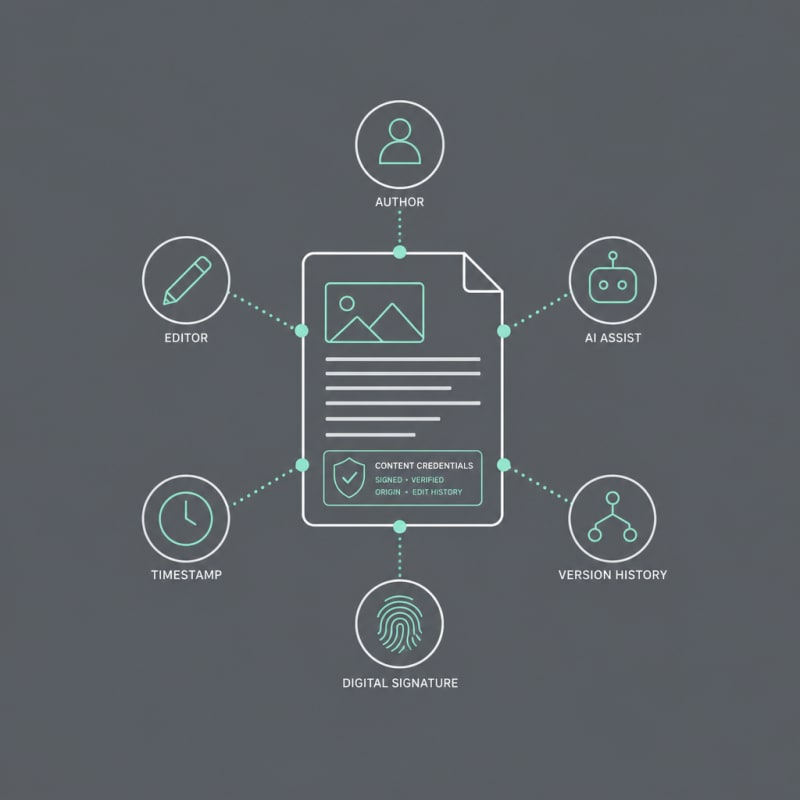
C2PA was built to solve these specific limitations through cryptographically signed credentials that persist across platforms and document complete content lifecycles.
How C2PA Credentials Actually Work
C2PA credentials function as a cryptographically signed manifest that travels with digital content. When an image, video, or document is created, the originating software can generate a credential containing specific assertions about that content's provenance.
These assertions include identity information about the creator or organization, technical details about capture or generation methods, and timestamps establishing when the content was produced. Critically, the credential is bound to the content file itself through cryptographic hashing—a mathematical process that creates a unique fingerprint of the file's contents.
The entire credential package is then digitally signed using public key cryptography, the same underlying technology that secures financial transactions and encrypted communications. This signature ensures that any subsequent tampering with either the credential or the content itself becomes mathematically detectable.
When content is edited, compliant software doesn't overwrite the original credential. Instead, it adds a new credential entry documenting what changed, which tools were used, and who made the modifications. This creates a verifiable chain of custody showing the complete editing history from original creation through final publication.
The technical implementation allows credentials to persist even when content is compressed, converted to different formats, or passed through social platforms—provided those platforms and tools maintain C2PA support. When properly implemented, credentials survive the typical distribution pathways that destroy traditional metadata.
What Credentials Reveal About AI Involvement
One of C2PA's most strategically important capabilities is distinguishing between human-created and AI-generated content. When an image is captured by a camera, the credential can assert that it represents photographic capture with specific device information. When content is generated by AI, compliant systems should indicate synthetic generation.
More nuanced scenarios become trackable as well. If a photographer captures an image and then uses AI tools to remove background objects, expand the frame, or enhance resolution, each AI-assisted edit can be documented in the credential chain. This provides transparency not just about whether AI was involved, but specifically how it participated in content creation.
This granular documentation matters because the implications of AI involvement vary dramatically by context. AI-enhanced color correction in architectural photography raises different questions than AI-generated backgrounds in news imagery. C2PA credentials provide the technical foundation for making these distinctions visible.
The Gap Between Specification and Adoption
C2PA represents a significant technical achievement—a workable standard backed by major technology companies including Adobe, Microsoft, Google, Intel, and others. But technical standards only deliver value when widely implemented across the content creation and distribution ecosystem.
Current adoption remains uneven. Professional creative tools from Adobe and others have integrated C2PA support, allowing content creators to attach credentials during production. Several camera manufacturers have announced or implemented hardware-level credential generation, embedding provenance data at the moment of capture.
Distribution platforms present the larger challenge. Social networks, content management systems, and media publishing platforms must actively preserve credentials as content moves through their infrastructure. Some platforms have committed to C2PA support. Others have not. And even committed platforms are implementing support gradually, typically starting with images before expanding to video and other media types.
Consumer awareness represents another adoption barrier. Most people viewing digital content today have no idea whether credentials exist, no easy way to inspect them, and no established mental model for interpreting what credentials reveal. Browser extensions and platform features for displaying credential information are emerging, but they're not yet mainstream.
The practical result is that C2PA currently functions more as emerging infrastructure than universal standard. Content with robust credential chains exists alongside content with no provenance documentation whatsoever. Organizations implementing content verification strategies cannot yet assume credential availability.
Why Organizations Are Implementing Credential Verification Now
Despite incomplete ecosystem adoption, organizations operating in specific sectors are already implementing C2PA verification capabilities. The business drivers are becoming sufficiently acute that waiting for universal adoption no longer feels viable.
News organizations face immediate pressure to distinguish authentic journalism from manipulated imagery. When AI-generated content is shared as factual documentation, the reputational and legal consequences can be severe. Implementing systems to verify credential chains and flag undocumented content provides measurable risk reduction even when many sources don't yet attach credentials.
Enterprise marketing and brand teams increasingly require provenance documentation for liability protection. When third-party creators submit assets for campaigns, verifying that content wasn't created with unlicensed AI tools trained on copyrighted material matters for legal compliance. C2PA credentials provide one mechanism for establishing creation methodology and tool usage.
Regulated industries—including financial services, healthcare, and government—are beginning to mandate provenance tracking for compliance purposes. When documentation must be verified as authentic and unmodified, cryptographically signed credentials provide substantially stronger assurance than traditional metadata approaches.
The pattern emerging across these sectors is that organizations aren't waiting for perfect ecosystem coverage. They're implementing credential verification for content that has it, while developing fallback processes for content that doesn't. This pragmatic approach acknowledges both the value of the standard and the reality of partial adoption.
The Limitations Credentials Don't Solve
C2PA credentials represent a meaningful technical advancement, but they don't solve every provenance challenge. Understanding what credentials can't do is as strategically important as understanding their capabilities.
Credentials document provenance—they don't verify truth. An image can have a perfect credential chain showing authentic capture by a verified photographer, but still be misleading through selective framing, deceptive cropping, or contextual misrepresentation. Provenance and accuracy are related but distinct concepts.
The standard relies on voluntary implementation by content creators and platforms. Nothing technically prevents someone from creating manipulated content without credentials, or from stripping credentials before distribution. C2PA makes provenance tracking possible and verifiable, but it doesn't make it mandatory. Bad actors can simply choose not to participate.
Credential verification requires technical infrastructure that many organizations haven't built. Extracting credentials from content files, cryptographically validating signatures, checking certificate chains, and interpreting assertion data requires specialized software and expertise. The standard provides the foundation, but organizations must still build or acquire verification capabilities.
Perhaps most significantly, credentials don't eliminate the need for human judgment. Even with complete provenance documentation, someone must still interpret what that documentation means in context. A credential showing extensive AI editing might be perfectly appropriate for commercial photography but problematic for photojournalism. The technical standard provides transparency—decision-making still requires domain expertise and editorial judgment.
Where Content Provenance Is Heading
Current C2PA adoption represents early infrastructure development, but several clear trajectories are emerging that will shape how provenance tracking evolves.
Hardware-level credential generation is expanding. When cameras, smartphones, and recording devices embed credentials at the moment of capture—secured by device-level cryptography—the provenance documentation becomes significantly more trustworthy than software-generated credentials applied after the fact. Major hardware manufacturers are moving in this direction.
Platform enforcement is becoming more likely. As regulatory pressure increases around synthetic media and AI-generated content, major distribution platforms may shift from optional credential support to required credential documentation for certain content types. European AI Act provisions and similar regulatory frameworks create incentives for platforms to implement and enforce provenance standards.
Verification is becoming embedded in workflows rather than performed manually. Organizations building content management systems, digital asset platforms, and publishing tools are integrating automated credential verification as a standard workflow step. This shifts provenance checking from specialized audit activity to routine operational practice.
The business model around credential verification is developing. Third-party verification services, trust infrastructure providers, and specialized platforms are emerging to handle the technical complexity of credential validation, certificate management, and provenance reporting for organizations that need verification capabilities without building them internally.
Conclusion
C2PA Content Credentials provide a technically robust foundation for tracking digital content provenance through complex creation and editing chains. The standard solves real limitations in traditional metadata approaches and creates new possibilities for documenting AI involvement in content generation. Organizations in sectors where content authenticity carries legal, reputational, or compliance implications are implementing credential verification now despite incomplete ecosystem adoption.
But credentials are infrastructure, not solution. They make provenance tracking possible and verifiable without making it universal or mandatory. They document what happened to content without determining whether that content is misleading, appropriate, or compliant with specific policies. As with most technical standards, C2PA's ultimate impact will depend less on the elegance of its specification and more on the breadth of its implementation and the intelligence with which organizations interpret what credentials reveal.
For professionals responsible for content verification, brand protection, compliance, or editorial integrity, understanding C2PA capabilities and limitations is becoming operationally necessary. The standard is imperfect, adoption is partial, and credentials alone don't solve authenticity challenges. But they represent the most significant technical development in content provenance tracking in decades, and they're already changing how organizations with serious verification requirements approach digital content.
SYNTHETIC PROOF
BEYOND A SINGLE TRUST SIGNAL
See the Wider Trust Picture
Synthetic Proof helps organizations assess trust signals across AI content, prompts, media, and operational workflows.
View Trust and Audit OptionsSynthetic Proof
Verified — Editorial Layer
This content has passed editorial verification for clarity, accuracy, and trust alignment.
Editor-in-Chief: Kevin Marsh
Verification Status: PASSED
Verification Status: PASSED
Comments
Post a Comment