Managing Execution Limits, Tool Scoping, and Delegated Authority in Multi-Agent Workflows Agentic AI systems—agents capable of planning, reasoning, and taking action with minimal human supervision—are moving from research labs into production environments. Unlike traditional AI models that generate text or images on demand, these agents interact with tools, execute commands, access databases, and modify digital assets. When multiple agents operate within the same environment, the governance challenge intensifies significantly. The principle of least-privilege access, a cornerstone of information security for decades, has never been more relevant—or more difficult to implement. In multi-agent systems, determining which agents should access which tools, under what conditions, and with what level of authority requires a fundamental rethinking of access control architectures. Related: If your workflow touches verification, provenance, or suspicious media, Synthetic...
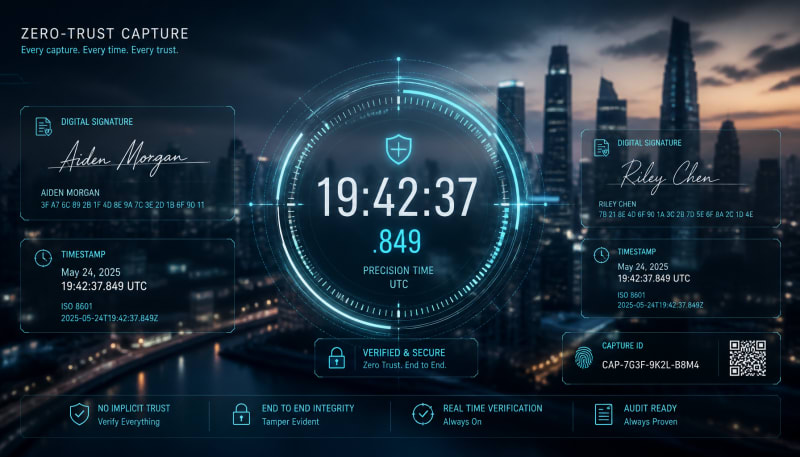
Stopping synthetic spoofing by anchoring real-world metadata to unalterable cryptographic chains.
The moment a camera shutter closes, a microphone captures sound, or a sensor records data, something fundamental changes. What was reality becomes representation. What was present becomes past. And in an era where synthetic content is indistinguishable from authentic capture, that moment—the millisecond of origin—is becoming the most contested boundary in digital trust.
Most discussions about content authenticity focus on detection after the fact. Can we identify deepfakes? Can we verify edited images? Can we trace manipulation? But there's a growing recognition that verification built on forensic analysis is fighting a losing battle. The real question isn't whether we can detect what's been altered. It's whether we can prove what hasn't been.
Provenance is becoming one part of a larger operational trust question: can an organization verify its content, prompts, and AI workflows consistently? Synthetic Proof helps teams evaluate where those trust signals hold—and where gaps remain.
That shift is driving a fundamental change in how trust infrastructure is being designed. Instead of attempting to verify content days, weeks, or months after creation, organizations are embedding cryptographic proof at the point of capture itself. The approach is called zero-trust capture, and it's redefining what digital provenance means.
The Window of Integrity Is Closing
Every piece of digital content has a lifecycle. It's captured, stored, transmitted, processed, displayed, and often modified dozens of times between origin and consumption. Each transition introduces opportunity for alteration—intentional or accidental, malicious or mundane.
Traditional content integrity models assume that verification can happen later. A journalist captures footage, uploads it to a server, an editor reviews it, a fact-checker examines metadata, and eventually the audience sees a finished product. Trust is established through institutional process, editorial oversight, and reputation.
That model worked when synthetic content required Hollywood-level resources. It breaks down when anyone with a laptop can generate photorealistic video, clone voices with seconds of audio, or manipulate imagery in ways that leave no forensic trace.
The countermeasure isn't better detection. It's earlier attestation. If you can cryptographically sign content at the instant of capture—before it touches a network, before it reaches cloud storage, before any processing pipeline has access to it—you create a verifiable anchor point. Everything that happens afterward can be traced against that origin.

The Technical Reality of Point-of-Capture Signing
Embedding cryptographic signatures at the millisecond of origin isn't a theoretical concept. It's happening inside camera sensors, recording devices, and IoT systems where hardware-level security modules generate digital signatures before pixel data even reaches the device's operating system.
The mechanism typically involves three components working in coordination. A secure element—often a dedicated chip isolated from the main processor—generates a cryptographic key pair. A trusted timestamp source provides verifiable proof of when capture occurred. And a signing protocol binds the raw sensor data, timestamp, device identity, and optional metadata into a signed attestation.
This happens in milliseconds, embedded in the capture pipeline itself. The result isn't just a file with metadata attached. It's a cryptographically sealed record of origin that can be independently verified without requiring trust in the capturing organization, the storage provider, or any intermediary in the chain of custody.
Timestamps Are Not Metadata
Most digital files include timestamps. Creation dates, modification dates, EXIF data in photos, file system attributes. All of it is trivially editable. An image claiming to be captured on a specific date can have that date changed in seconds using readily available tools.
Cryptographic timestamps are fundamentally different. They're not file attributes. They're attestations from a trusted time authority—typically a timestamping service that operates like a digital notary—proving that specific data existed at a specific moment.
In zero-trust capture systems, the timestamp isn't added after the fact. It's embedded during capture, bound to the sensor data through the same cryptographic signature that attests to device identity and content integrity. You can't change the timestamp without invalidating the signature. You can't forge the signature without access to private keys stored in hardware security modules.
The implication is profound. A signed timestamp at point of capture doesn't just tell you when something was recorded. It proves that the content existed in that specific form at that specific moment, before any processing, before any human intervention, before any opportunity for manipulation.
Why Hardware Matters More Than Policy
Software-based content authentication faces an inherent limitation: software runs in environments that can be compromised. An application that signs content after capturing it from a camera sensor is trusting that the operating system hasn't been tampered with, that the capture driver is authentic, that malware isn't intercepting the data stream.
Hardware-based capture signing moves the trust boundary deeper. When the signing operation happens inside a secure enclave on the sensor itself—or in a dedicated security chip between the sensor and main processor—the attack surface shrinks dramatically. Compromising that signature requires physical access to the device and sophisticated hardware attacks, not just malware or social engineering.
This is why media organizations, law enforcement agencies, and enterprises dealing with sensitive documentation are increasingly specifying hardware-level signing capabilities in procurement. It's not about preventing all possible attacks. It's about raising the bar high enough that casual manipulation becomes effectively impossible and sophisticated attacks leave evidence.
The shift also changes the economics of trust. When verification depends on institutional reputation, smaller organizations struggle to establish credibility. When it depends on cryptographic proof embedded at capture, a citizen journalist with a properly configured device can produce content with the same technical trustworthiness as a major news network.
The Chain Starts at Zero
Point-of-capture signing creates what's sometimes called a "chain of custody" for digital content, but that framing can be misleading. Traditional chain-of-custody documentation is a paper trail maintained by trusted parties. Digital provenance chains are cryptographic proofs that don't require trusting the parties who handle the content.
The chain starts at zero—the moment of capture. That first signature becomes the anchor. Every subsequent transformation, edit, or processing step can be logged and signed, creating a verifiable history. But the entire chain's credibility depends on that initial attestation being trustworthy.
If the first signature happens in software, after the image has already been processed by multiple layers of code, the chain documents what happened after an already-uncertain origin. If the first signature happens at the hardware level, during sensor readout, before any processing, the chain has a verifiable foundation.
This is why zero-trust capture focuses so intensely on that first millisecond. Everything downstream—content credentials, provenance metadata, editorial transparency—builds on the integrity of the origin point.
Beyond Detection, Toward Proof
The deepfake detection industry has grown rapidly, developing increasingly sophisticated tools for identifying synthetic or manipulated content. But it's a reactive game. As detection improves, generation techniques evolve. As forensic analysis becomes more sensitive, manipulation methods become more subtle.
Zero-trust capture inverts the model. Instead of asking "can we detect manipulation," it asks "can we prove authenticity." The burden of proof shifts. Content without point-of-capture signatures isn't necessarily fake, but it can't be cryptographically verified as authentic. Content with valid signatures and unbroken provenance chains carries mathematical proof of its origin and history.
That distinction matters in contexts where authenticity has legal, financial, or safety implications. Insurance claims documentation, legal evidence, financial compliance records, safety incident reports, medical imaging—these aren't contexts where "probably authentic" is sufficient. They require proof.
The infrastructure is still emerging, but the direction is clear. Trust is moving upstream, toward the point of origin, where cryptographic proof is strongest and attack surfaces are smallest.
Final Thoughts
Zero-trust capture represents a architectural shift in how digital provenance works. By embedding cryptographic signatures and trusted timestamps at the millisecond of origin—before content enters processing pipelines, before it reaches networks, before human intervention—it creates a verifiable anchor point that downstream verification can build on.
The technology exists. Hardware security modules, trusted timestamping services, and cryptographic signing protocols are mature. What's changing is the recognition that post-capture verification isn't enough. In an environment where synthesis is indistinguishable from reality, the only reliable proof of authenticity is evidence that something existed in a specific form at a specific moment, captured by a specific device, before any opportunity for manipulation.
Organizations building trust infrastructure are increasingly treating point-of-capture signing not as an optional enhancement but as a foundational requirement. The question isn't whether to embed proof at origin. It's how quickly it can become standard across devices, platforms, and workflows where authenticity matters.
The millisecond of origin is becoming the new trust boundary. Everything that comes after is just documentation.
The Practical Position
The distinction between forensic verification and cryptographic attestation represents a category shift in how trust scales. Organizations still treating provenance as a post-production audit are designing systems for an era that no longer exists. Zero-trust capture doesn't solve the deepfake problem—it creates a parallel infrastructure where authenticity is embedded, not inferred.
— Kevin Marsh, Editor-in-Chief
SYNTHETIC PROOF
FROM PROVENANCE TO OPERATIONAL TRUST
Understand Your AI Trust Gap
Synthetic Proof helps teams evaluate verification, provenance, prompt risk, and digital media trust through independent audits and structured findings.
Explore Synthetic ProofSynthetic Proof
Verified — Editorial Layer
This content has passed editorial verification for clarity, accuracy, and trust alignment.
Editor-in-Chief: Kevin Marsh
Verification Status: PASSED
Verification Status: PASSED
Comments
Post a Comment