Managing Execution Limits, Tool Scoping, and Delegated Authority in Multi-Agent Workflows Agentic AI systems—agents capable of planning, reasoning, and taking action with minimal human supervision—are moving from research labs into production environments. Unlike traditional AI models that generate text or images on demand, these agents interact with tools, execute commands, access databases, and modify digital assets. When multiple agents operate within the same environment, the governance challenge intensifies significantly. The principle of least-privilege access, a cornerstone of information security for decades, has never been more relevant—or more difficult to implement. In multi-agent systems, determining which agents should access which tools, under what conditions, and with what level of authority requires a fundamental rethinking of access control architectures. Related: If your workflow touches verification, provenance, or suspicious media, Synthetic...

Managing Execution Limits, Tool Scoping, and Delegated Authority in Multi-Agent Workflows
Agentic AI systems—agents capable of planning, reasoning, and taking action with minimal human supervision—are moving from research labs into production environments. Unlike traditional AI models that generate text or images on demand, these agents interact with tools, execute commands, access databases, and modify digital assets. When multiple agents operate within the same environment, the governance challenge intensifies significantly.
The principle of least-privilege access, a cornerstone of information security for decades, has never been more relevant—or more difficult to implement. In multi-agent systems, determining which agents should access which tools, under what conditions, and with what level of authority requires a fundamental rethinking of access control architectures.
Related: If your workflow touches verification, provenance, or suspicious media, Synthetic Proof can help audit content and reduce trust risk.
Why Tool Access Control Matters for Agentic AI
Traditional application security focuses on human users accessing defined interfaces. Agentic AI introduces a different threat model. Agents operate at machine speed, make autonomous decisions based on contextual reasoning, and can chain multiple tool calls together in ways that may not have been anticipated during system design.
Consider a content production environment where multiple AI agents manage different aspects of digital asset creation and distribution. One agent might generate marketing copy, another optimizes images, a third schedules social media posts, and a fourth manages file storage and archival. Each agent requires access to specific tools—but granting broad permissions creates cascading risk.
If the copywriting agent gains access to the file deletion API, a reasoning error or prompt injection attack could result in permanent data loss. If the scheduling agent can modify original source files rather than just posting copies, content integrity becomes compromised. The challenge isn't theoretical—it reflects the operational reality facing organizations deploying multi-agent systems in production.
The Digital Asset Management Challenge
Digital asset management systems have historically relied on role-based access control designed for human users. These systems assume that permissions are assigned to people with job functions, organizational context, and accountability. Agents don't fit this model cleanly.
An agent's "role" may shift dynamically based on the task it's executing. A research agent might need read access to a content library when gathering information, but should never have write or delete permissions. A publishing agent requires write access to distribution channels but shouldn't be able to modify master files. A quality assurance agent may need broad read access but limited modification capabilities.
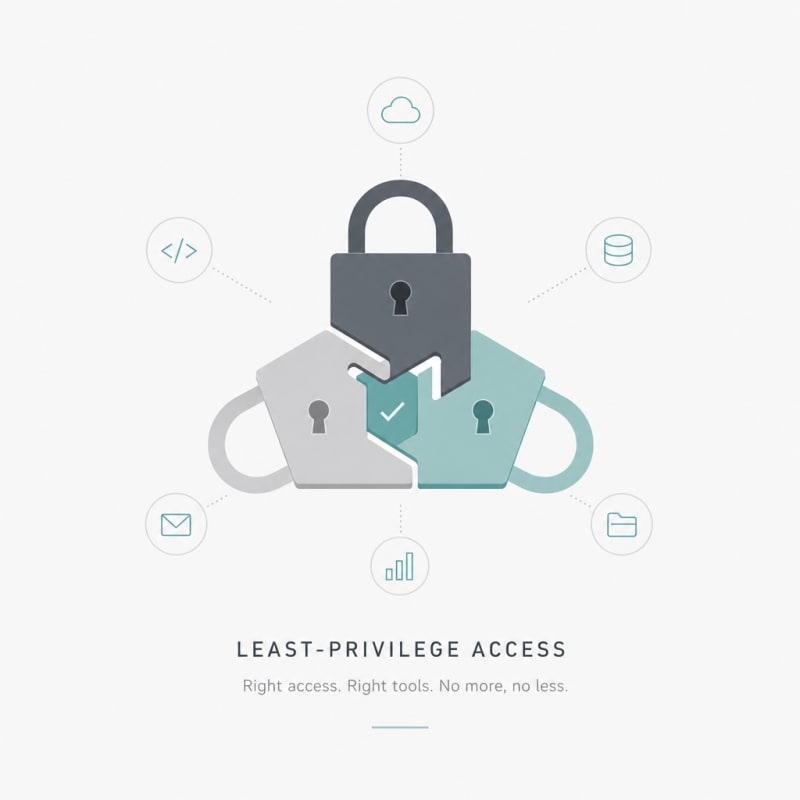
The complexity increases when agents collaborate. In a multi-agent workflow, one agent's output becomes another's input. Permissions must account for these dependencies without creating vulnerabilities. If Agent A can write to a shared workspace and Agent B automatically processes anything that appears there, the security boundary effectively collapses to whichever agent has the weakest controls.
Context-Aware Permission Models
Implementing least-privilege access for agentic systems requires moving beyond static role assignments toward context-aware permission models. This means evaluating tool access requests based on multiple factors: the agent's intended function, the specific task being executed, the sensitivity of the resources involved, and the current state of the system.
For example, an agent authorized to optimize images for web delivery might receive different permissions when processing user-uploaded content versus when handling archived brand assets. The tool it can access, the modifications it can make, and the destinations it can write to should all adapt to context.
This level of granular control introduces new operational challenges. Organizations need visibility into which agents are requesting which permissions, mechanisms to audit whether those permissions align with intended use cases, and the ability to revoke or modify access as requirements evolve.
Multi-Agent Coordination and Permission Boundaries
When multiple agents operate within a shared environment, permission boundaries become particularly critical. Agents may be developed by different teams, trained on different datasets, and optimized for different objectives. Without clear governance frameworks, this heterogeneity creates risk.
One emerging pattern involves permission brokers—dedicated components that mediate between agents and tools. Rather than granting direct access, agents request capabilities from the broker, which evaluates whether the request aligns with policy. This architecture provides a centralized point for logging, auditing, and enforcement, but requires careful design to avoid becoming a performance bottleneck or single point of failure.
Another approach involves permission tokens that encode specific capabilities with built-in constraints. An agent might receive a time-limited token granting read access to a particular folder, with the token automatically expiring after the task completes. This pattern borrows from OAuth and similar human-facing authentication systems, adapted for machine-to-machine interactions.
The Audit and Accountability Gap
Traditional access control systems log who accessed what and when. For agentic systems, this level of detail is necessary but insufficient. Organizations also need to understand why an agent requested access, what reasoning process led to the tool invocation, and whether the outcome aligned with expectations.
This requirement connects directly to broader questions of AI accountability and governance. When an agent makes an unexpected modification to a digital asset, was it following instructions correctly but operating on flawed inputs? Was it exhibiting emergent behavior not anticipated during development? Or was it responding to a manipulated prompt designed to abuse its permissions?
Answering these questions requires comprehensive logging of agent behavior, tool access patterns, and decision-making context. But collecting this information at scale, storing it securely, and making it available for retrospective analysis introduces significant operational complexity.
TrustOps and the Evolution of Access Governance
The challenges of governing tool access in multi-agent systems reflect a broader shift in how organizations must approach AI operations. Traditional DevOps practices focus on deploying and maintaining software systems. TrustOps extends this discipline to include verification, provenance, accountability, and ongoing governance of AI behavior.
In the context of digital asset management, TrustOps capabilities become essential for maintaining confidence in automated workflows. This includes verifying that agents are operating within their authorized scope, maintaining provenance records that document which agents modified which assets, and creating audit trails that support accountability when issues arise.
These capabilities aren't simply enhanced logging—they represent a systematic approach to building and maintaining trust in AI-driven operations. As organizations deploy more sophisticated agent systems, the ability to answer questions about tool access, permission enforcement, and behavioral boundaries becomes a prerequisite for responsible deployment.
Building for Long-Term Governance
Organizations implementing agentic AI systems today are making architectural decisions that will shape their governance posture for years. Retrofitting access controls and audit capabilities after deployment is significantly more difficult than building them into the system from the beginning.
This reality is driving increased interest in independent trust infrastructure—platforms and frameworks designed specifically to address verification, governance, and accountability requirements for AI systems. Rather than treating these capabilities as optional features or afterthoughts, forward-looking organizations are positioning them as foundational elements of their AI architecture.
The shift mirrors the evolution of security practices in traditional software development. Two decades ago, security was often treated as a separate concern, addressed through perimeter defenses and periodic audits. Today, security is understood as an integral part of the development lifecycle. AI governance, including least-privilege tool access, is following a similar trajectory.
Final Thoughts
Least-privilege tool access represents one of the most immediate governance challenges facing organizations deploying agentic AI and multi-agent systems. As these systems move from controlled experiments to production environments managing real digital assets, the consequences of inadequate access controls become material.
For organizations working in digital asset management, content production, or any domain where AI agents interact with valuable resources, developing robust tool access governance isn't optional—it's foundational. The operational patterns, technologies, and best practices are still emerging, but the strategic direction is clear. Independent trust infrastructure that can verify permissions, maintain provenance, and support accountability will become increasingly essential as agentic AI adoption accelerates.
The organizations that treat access governance as a core architectural concern today will be better positioned to scale their AI operations safely and sustainably. Those that defer these questions will find themselves managing systems they can't fully trust or explain—a position that becomes increasingly untenable as AI agents take on more consequential responsibilities.
The Practical Position
NextLayer Editorial Perspective
The shift from managing human users to governing autonomous agents reveals a category difference, not just a scaling problem. Traditional access control assumed intentionality and organizational context; agents operate with neither, making every permission grant a potential systemic vulnerability. The organizations that will deploy multi-agent systems safely aren't those with the most sophisticated tools—they're the ones that recognize access governance as an architectural decision, not a configuration task. Trust at...
— Kevin Marsh, Editor-in-Chief
SYNTHETIC PROOF
Verify What You See
Synthetic media is getting harder to identify. Get verification-focused analysis for suspicious content.
Run a Synthetic Proof AuditSynthetic Proof
Verified — Editorial Layer
This content has passed editorial verification for clarity, accuracy, and trust alignment.
Editor-in-Chief: Kevin Marsh
Verification Status: PASSED
Verification Status: PASSED
Comments
Post a Comment