Managing Execution Limits, Tool Scoping, and Delegated Authority in Multi-Agent Workflows Agentic AI systems—agents capable of planning, reasoning, and taking action with minimal human supervision—are moving from research labs into production environments. Unlike traditional AI models that generate text or images on demand, these agents interact with tools, execute commands, access databases, and modify digital assets. When multiple agents operate within the same environment, the governance challenge intensifies significantly. The principle of least-privilege access, a cornerstone of information security for decades, has never been more relevant—or more difficult to implement. In multi-agent systems, determining which agents should access which tools, under what conditions, and with what level of authority requires a fundamental rethinking of access control architectures. Related: If your workflow touches verification, provenance, or suspicious media, Synthetic...
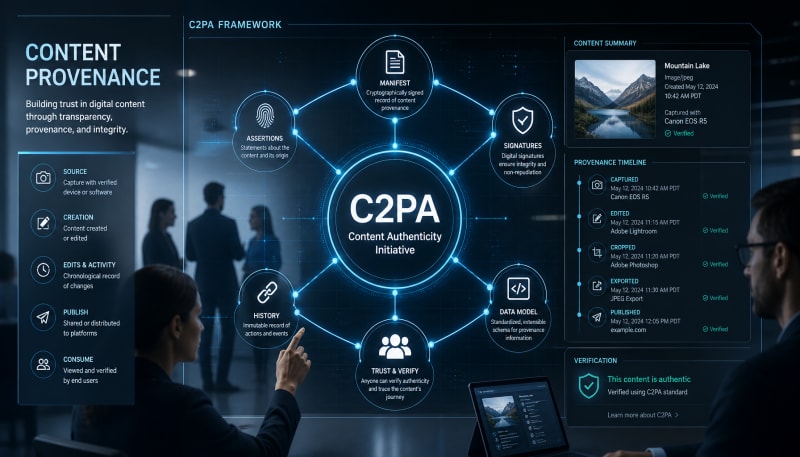
Understanding the open specification reshaping digital authenticity across Adobe, Google, and Microsoft.
The internet was built without a trust layer. For decades, this didn't matter much. But as synthetic media becomes indistinguishable from reality and AI-generated content floods every platform, a fundamental infrastructure gap has emerged: there's no reliable way to know where digital content came from or whether it's been altered.
The Coalition for Content Provenance and Authenticity—C2PA—represents the most serious industry effort to solve this problem. It's an open technical standard that embeds cryptographically signed metadata into digital content, creating a verifiable chain of custody from creation through distribution.
Content Credentials and attestation can strengthen transparency, but they represent only part of the trust landscape. Synthetic Proof helps organizations evaluate how these signals interact with verification, prompts, and governance.
Understanding C2PA matters because it's rapidly moving from technical specification to operational infrastructure. Major platforms, camera manufacturers, AI companies, and enterprise software providers are implementing it. The standard is becoming the de facto mechanism for establishing content authenticity in an era when trust can no longer rely on human judgment alone.
Why Content Provenance Became an Infrastructure Problem
Content provenance wasn't always critical infrastructure. When images required expensive cameras and specialized skills, authenticity was less of a concern. The barrier to creating convincing fake content was high enough that most organizations could rely on traditional verification methods.
That barrier collapsed. Modern AI systems can generate photorealistic images, convincing audio, and coherent video in seconds. The cost of producing synthetic media dropped to nearly zero while quality improved exponentially. This created what security researchers call an "authenticity crisis"—the point at which distinguishing real from fabricated content becomes impossible through observation alone.
The problem extends beyond deepfakes and misinformation. Newsrooms need to verify user-submitted footage. Insurance companies need to authenticate claims documentation. Legal proceedings depend on establishing whether evidence has been manipulated. Marketing teams need to prove their content adheres to disclosure requirements. E-commerce platforms face liability for fraudulent product imagery.
These aren't edge cases. They're daily operational requirements across industries that suddenly lack a reliable verification mechanism. C2PA emerged from this reality—not as a speculative technology, but as critical infrastructure for environments where content authenticity directly impacts trust, compliance, and liability.
How C2PA Actually Works
C2PA operates on a straightforward principle: embed verifiable metadata directly into content files using cryptographic signatures that reveal tampering.
When content is created—whether by a camera, design application, or AI system—the originating device or software generates a manifest. This manifest contains information about how the content was produced: the device that captured it, the software that created it, the date and location, and any edits applied. The manifest is cryptographically signed and bound to the content file itself.
If the content is subsequently edited, compliant software adds a new manifest layer documenting the change. Each edit creates a new signed entry, building a verifiable chain showing exactly how the content evolved from creation to its current state. The signatures ensure that any undocumented modification breaks the chain, making tampering evident.
This approach differs fundamentally from traditional watermarking. Watermarks can be removed or survive editing. C2PA manifests are cryptographically bound to content—they either verify completely or fail entirely. There's no ambiguous middle state.
The standard supports what's called "hard binding" for images and "soft binding" for video, reflecting different technical constraints across media types. It also includes ingredient assertions, which track when multiple pieces of content are combined—critical for understanding composite images or AI-generated works trained on existing material.
The Technical Standard Behind the Coalition
C2PA isn't a single company or product. It's a joint development foundation hosted by the Linux Foundation, with members including Adobe, Microsoft, Google, Intel, Sony, the BBC, and hundreds of other organizations. The coalition publishes open technical specifications that anyone can implement.
The standard builds on earlier work by the Content Authenticity Initiative (CAI), which Adobe and others launched in 2019. C2PA formalized and expanded those concepts into a comprehensive specification covering multiple media types, diverse creation workflows, and cross-platform verification.
Being open matters. Proprietary provenance systems create vendor lock-in and limit interoperability. If only Adobe products could verify Adobe signatures, or only Canon cameras worked with Canon verification tools, the system would fragment. C2PA's openness means any compliant tool can read and verify manifests created by any other compliant tool.
The specification includes technical details around cryptographic algorithms, manifest structure, trust anchors, and validation procedures. But implementation remains flexible. Organizations can build C2PA support into cameras, editing software, content management systems, publishing platforms, or verification services—wherever provenance information adds value in their workflow.
Adoption Is Accelerating Across the Content Stack
C2PA implementation is expanding rapidly across hardware manufacturers, software platforms, and distribution channels.
Camera manufacturers including Leica, Nikon, and Sony are shipping devices with native C2PA support, embedding signed manifests at the moment of capture. Adobe integrated C2PA across Creative Cloud applications, allowing creators to preserve provenance through complex editing workflows. Microsoft added support to Edge and Bing, enabling users to verify content authenticity directly in their browser.
News organizations are particularly active adopters. The BBC, CBC, and New York Times are implementing C2PA to authenticate published content and verify user submissions. The Associated Press and Reuters are exploring integration across their distribution infrastructure.
AI companies face mounting pressure to implement provenance. OpenAI, Google, and others committed to C2PA adoption as part of voluntary AI safety agreements. Some jurisdictions are moving beyond voluntary commitments—the European Union's AI Act includes provisions around synthetic media labeling that C2PA is well-positioned to support.
Social media platforms represent the critical distribution layer. Without platform support for displaying and preserving C2PA data, provenance information dies at publication. Early implementations are emerging, though adoption remains uneven. The challenge isn't technical—it's operational and strategic.
What C2PA Doesn't Solve
C2PA establishes that content hasn't been altered since creation. It doesn't establish that content is truthful, ethical, or contextually accurate.
A photographer could capture a genuine image of a staged scene designed to mislead. An AI system could generate synthetic content with perfect provenance metadata. A reputable news organization could inadvertently publish accurate but decontextualized imagery. C2PA would verify the technical chain of custody in all three cases while saying nothing about editorial judgment, intent, or appropriateness.
The standard also doesn't solve the trust anchor problem. Cryptographic signatures only work if you trust the signing entity. If an unknown device or unverified software signs content, the signature may be technically valid but meaningless for verification purposes. C2PA includes mechanisms for trust lists and certificate validation, but these require organizational policy decisions beyond the specification itself.
Platform cooperation remains essential. If social media sites strip metadata during upload—as most currently do—provenance information disappears. If search engines don't surface verification status, users can't access it. If operating systems don't display C2PA data, the information exists but remains invisible to most people.
Finally, C2PA doesn't prevent content manipulation. It makes tampering evident, but determined actors can still edit content and simply remove the provenance data. The standard raises the cost and visibility of manipulation—it doesn't eliminate the possibility.
Provenance Is Moving From Project to Infrastructure
Early C2PA implementations treated provenance as a feature—something users could optionally enable. That's changing. Leading organizations increasingly view provenance as foundational infrastructure, comparable to HTTPS for web security.
This shift reflects growing recognition that content authenticity can't be retrofitted as an afterthought. Just as encryption needs to be built into communication protocols from the start, provenance needs to be embedded at the point of content creation. Anything added later becomes optional, which means it becomes unreliable.
Enterprise adoption is accelerating this transition. Organizations implementing AI governance frameworks need provenance to track model outputs, demonstrate compliance, and manage liability. Marketing teams need it to prove disclosure compliance. Legal departments need it to establish evidence integrity. Operations teams need it to verify supply chain documentation.
These requirements are driving C2PA deeper into content workflows. It's no longer sufficient to add provenance at publication. Organizations need it embedded in creation tools, preserved through collaboration platforms, verified during review processes, and maintained through distribution channels.
The technology is also expanding beyond images. While initial implementations focused on photography, C2PA now covers video, audio, and documents. Future versions will likely extend to 3D assets, streaming media, and interactive content. As the standard matures, it's becoming the universal mechanism for content provenance across digital media.
The Trust Infrastructure That C2PA Enables
C2PA solves the technical provenance problem. But verifying a signature and interpreting its meaning are different challenges. This gap is creating demand for trust infrastructure—the operational layer that turns cryptographic validation into business decisions.
Organizations need systems that automatically verify C2PA manifests at scale, evaluate trust anchors against policy requirements, flag suspicious patterns, and integrate provenance status into existing workflows. They need audit trails showing what content was verified when, by whom, and with what result. They need reporting that demonstrates compliance with regulatory requirements and internal governance policies.
This operational layer is what emerging disciplines like TrustOps address—the processes, tools, and practices that translate technical verification into organizational confidence. It's the difference between knowing a signature is cryptographically valid and knowing whether to publish the content in a news article or admit it as legal evidence.
Building this infrastructure requires expertise beyond C2PA implementation. It requires understanding of trust models, policy frameworks, risk assessment, and operational integration. Most organizations lack these capabilities internally and are turning to specialized platforms that provide verification infrastructure as a service.
This creates an emerging market structure: open standards like C2PA define how provenance data is created and embedded, while independent verification platforms provide the operational infrastructure to validate, interpret, and act on that data across enterprise workflows.
Final Thoughts
C2PA represents the most credible path toward establishing content authenticity as reliable digital infrastructure. Its open specification, broad industry support, and technical approach position it to become the standard mechanism for content provenance across platforms and media types.
But technical standards alone don't solve trust problems. C2PA creates the foundation—the ability to verify content hasn't been altered since creation. What organizations build on that foundation determines whether provenance becomes meaningful infrastructure or simply more metadata that most people ignore.
The Practical Position
The question isn't whether your organization will encounter content authenticity challenges—it's whether you'll have infrastructure in place when verification failures create operational, legal, or reputational consequences. C2PA represents the moment content provenance shifts from theoretical concern to fundamental infrastructure requirement, comparable to how encryption became non-negotiable once digital transactions involved liability.
— Kevin Marsh, Editor-in-Chief
SYNTHETIC PROOF
BEYOND A SINGLE TRUST SIGNAL
See the Wider Trust Picture
Synthetic Proof helps organizations assess trust signals across AI content, prompts, media, and operational workflows.
View Trust and Audit OptionsSynthetic Proof
Verified — Editorial Layer
This content has passed editorial verification for clarity, accuracy, and trust alignment.
Editor-in-Chief: Kevin Marsh
Verification Status: PASSED
Verification Status: PASSED
Comments
Post a Comment