Strategies for ensuring your asset’s chain of custody remains verifiable across any channel. A photograph appears in a news report. A legal document crosses a negotiation table. A research dataset underpins a policy decision. In each case, the same question arises: where did this content actually come from? For decades, that question was answerable through metadata, file properties, and institutional trust. But generative AI has fundamentally altered the equation. Content can now be created, modified, and redistributed at scale with minimal effort and near-perfect fidelity. The result is a provenance crisis that affects everything from newsrooms to courtrooms to corporate data operations. A credential can explain part of an asset’s history. Independent evaluation helps determine how much confidence the available evidence should support. Synthetic Proof is built for that wider trust assessment. The industry's response has largely centered on two technologies...
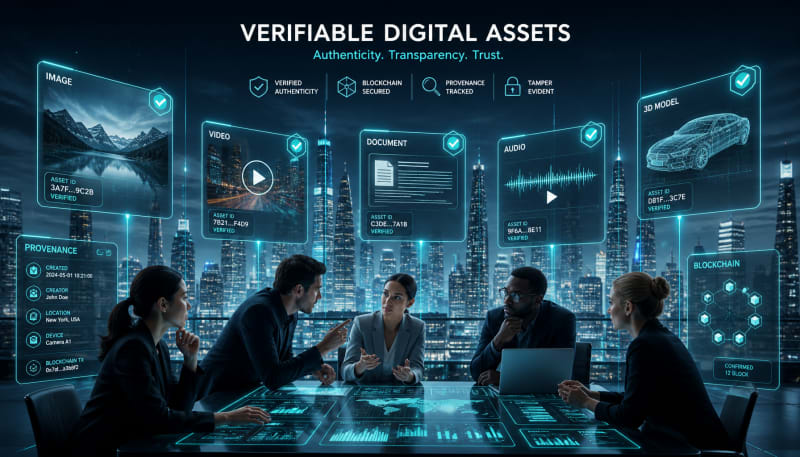
How open standards and cryptographic protocols are turning static files into self-authenticating assets.
Every image, video, and audio file now carries an implicit question: is this real? The explosion of generative AI has fundamentally altered the relationship between digital media and trust. What once required forensic analysis to fake can now be generated in seconds. What previously demanded studio equipment can be synthesized on a laptop. The technological barrier to creating convincing synthetic media has collapsed, and with it, the default assumption that digital content represents reality.
The response emerging across technology companies, standards bodies, and enterprises isn't to stop AI generation—that ship has sailed. Instead, the focus has shifted to a different question: how do we build infrastructure that allows authentic media to prove its authenticity, and synthetic media to declare its origins?
As AI becomes operational infrastructure, trust must become operational too. Synthetic Proof helps organizations understand where verification and accountability need to mature.
This is where verifiable digital assets enter the picture. Not as a theoretical framework, but as an infrastructure layer being built right now to restore signal in an increasingly noisy information ecosystem.
Digital Assets Have Always Relied on Context, Not Proof
For decades, the authenticity of digital media depended entirely on distribution context. A photograph mattered because it appeared in The New York Times. A video carried weight because a news organization vouched for it. An audio recording was credible because of who published it and where.
This model worked when creation and distribution were expensive. Professional media organizations controlled both, and their reputation provided the trust layer. Audiences didn't verify individual assets—they trusted institutional gatekeepers.
Generative AI demolished this equilibrium. Creation is now trivially cheap. Distribution is instant and global. A synthetic image can move from generation to viral spread in minutes, and by the time verification occurs, the damage is done. Context alone cannot scale to meet the volume and velocity of modern media.
The question isn't whether a photograph appeared in a trusted publication. It's whether the photograph itself can carry verifiable information about its origins, creation process, and modification history—regardless of where it appears.

Verification Requires More Than Metadata
The instinctive response to this problem has been metadata. If every image carried information about how, when, and where it was created, verification would be straightforward. Several industry initiatives have moved in this direction, embedding provenance information directly into media files.
But metadata alone is insufficient. Standard metadata can be stripped, altered, or forged. An image can be edited and its metadata rewritten. A video can be re-encoded and its embedded information lost. Without cryptographic binding between the asset and its provenance claims, metadata becomes just another piece of information competing for trust.
Verifiable digital assets solve this through cryptographic attestation. The provenance information isn't simply attached to the file—it's cryptographically signed and anchored in ways that make tampering detectable. The asset carries proof of its origins, and that proof can be independently verified without relying on the platform that hosts it or the organization that published it.
This shifts verification from a centralized, context-dependent process to a decentralized, asset-level capability. The media itself becomes the source of truth.
Provenance Must Survive the Asset's Journey
Digital media rarely stays in one place. An image gets cropped, compressed, and reposted. A video is clipped, re-encoded, and shared across platforms. An audio file is transcoded to different formats. Each transformation can strip embedded information, breaking the chain of provenance.
For verifiable digital assets to work at internet scale, provenance mechanisms must be resilient to normal media workflows. This creates a technical tension: cryptographic signatures typically break when content is modified, but content modification is routine and often necessary.
The infrastructure being built addresses this through several approaches. Some systems create provenance anchors that survive common transformations—compression, format conversion, cropping within defined parameters. Others maintain provenance chains that track each modification, creating a verifiable history rather than a single static signature. Still others separate the asset from its provenance record, linking them cryptographically while allowing the media file itself to change.
The goal isn't to prevent editing or redistribution. It's to maintain verifiable provenance through the asset's lifecycle, so a viewer encountering that asset anywhere can trace its origins and understand what has changed.
Cameras and Sensors Are Becoming Trust Anchors
The most powerful form of provenance begins at capture. If a camera cryptographically signs an image at the moment of creation, that signature becomes strong evidence that the content was photographed rather than generated. If a recording device attests to the time, location, and sensor data associated with a video, that attestation provides a foundation for authenticity claims.
This is already happening. Camera manufacturers are building hardware-based signing capabilities into professional equipment. Smartphones are beginning to embed provenance metadata at capture. Sensor arrays in autonomous vehicles and industrial systems are creating signed telemetry alongside visual data.
Hardware-anchored provenance doesn't eliminate the possibility of manipulation—a photograph can still be edited after capture—but it establishes a verifiable starting point. The difference between "this image was captured by a camera at this time and location, then edited" and "this image has no verifiable origin" is significant, especially in contexts where authenticity matters: journalism, legal proceedings, insurance claims, scientific documentation.
As this capability becomes standard in capture devices, the absence of provenance may itself become meaningful. An image without attestation won't automatically be dismissed, but it will carry less inherent credibility than one with cryptographic provenance from a trusted sensor.
Standards Are Converging, But Fragmentation Remains
Multiple industry efforts are working toward interoperable provenance standards. The Coalition for Content Provenance and Authenticity (C2PA) has emerged as a leading framework, backed by major technology companies and media organizations. Other initiatives focus on specific use cases: photojournalism, scientific imaging, legal evidence, intellectual property.
Progress is real, but fragmentation persists. Different sectors have different requirements. A news organization's provenance needs differ from those of a medical imaging system or a creative studio. Some implementations prioritize privacy, minimizing what information gets embedded. Others prioritize comprehensive audit trails. Technical approaches vary in how they balance security, performance, and compatibility with existing workflows.
The infrastructure challenge isn't just creating standards—it's ensuring those standards can coexist and interoperate. A verifiable asset created in one system needs to remain verifiable when it moves to another. Provenance information needs to be readable across platforms, devices, and organizational boundaries.
This interoperability is gradually improving, but it's not yet seamless. Organizations implementing verification capabilities today must navigate a landscape of competing approaches, incomplete tooling, and evolving standards. The infrastructure exists, but it's still maturing.
Verification Infrastructure Needs Independent Validators
For verifiable digital assets to create trust, the verification process itself must be trustworthy. If only the creator can verify their own attestations, or if verification depends entirely on platforms with vested interests, the system doesn't solve the trust problem—it relocates it.
This is driving demand for independent verification infrastructure: systems that can validate provenance claims without being controlled by content creators, platforms, or publishers. Think of it as similar to how certificate authorities function in web security—independent entities that validate identity claims and provide verification services that others can rely on.
Some of this infrastructure is emerging through industry consortiums. Some through specialized verification services. Some through open protocols that allow anyone to run validation nodes. The architecture varies, but the principle is consistent: verification trust shouldn't depend entirely on the entity making the claim.
This also creates new operational requirements. Organizations that publish or rely on digital media increasingly need capabilities to verify provenance, validate attestations, and make trust decisions based on asset-level evidence rather than purely contextual signals. These capabilities are becoming part of content management systems, digital asset platforms, and editorial workflows.
Not Every Asset Will Be Verifiable, and That's Intentional
The vision of universal provenance—where every digital image, video, and audio file carries cryptographic proof of its origins—is compelling but incomplete. Many legitimate use cases exist for media without embedded provenance.
Privacy is one. An individual photographing a protest may not want their device signature embedded in published images. A whistleblower recording video may need to strip all identifying metadata. A journalist protecting sources may deliberately remove provenance information that could compromise safety.
Creative expression is another. Artists routinely synthesize, composite, and manipulate media in ways that intentionally obscure origins. The value isn't in provenance transparency—it's in the creative result. Requiring verifiable provenance for all digital media would constrain legitimate creative and editorial practices.
The infrastructure being built needs to accommodate this reality. Verifiable digital assets aren't about mandatory disclosure. They're about making provenance possible when it matters—for contexts where authenticity claims need backing, where synthetic content should be disclosed, where origin and modification history affect trust and decision-making.
The goal is to make provenance available as a signal, not to eliminate media that lacks it. In many contexts, the absence of provenance will be perfectly acceptable. In others—breaking news, legal evidence, scientific data—it will become increasingly expected.
Final Thoughts
The infrastructure for verifiable digital assets is being built in response to a simple reality: we can no longer rely on context alone to determine whether media is authentic. The tools to create convincing synthetic content are too accessible, the velocity of distribution too fast, and the consequences of misinformation too severe.
What's emerging isn't a complete solution to digital trust—no single technology could be. It's a foundational layer that makes provenance verifiable at the asset level, independent of where that asset appears or who publishes it. It shifts some portion of trust from institutional gatekeepers to cryptographic evidence, from contextual signals to embedded attestation.
This infrastructure is already operational in specific sectors and use cases. It's expanding as standards mature, hardware capabilities improve, and organizations build verification into their workflows. The question for enterprises isn't whether this infrastructure will exist—it already does. The question is how quickly it becomes expected, which contexts demand it, and what happens to content that doesn't carry provenance when everyone else's content does.
The Practical Position
The fundamental shift isn't technical—it's philosophical. We're moving from a world where institutions vouched for content to one where content vouches for itself. Organizations that recognize verification as infrastructure rather than feature work will define what credible media distribution looks like. The question isn't whether to adopt cryptographic provenance, but whether you're building for an internet where proof travels with...
— Kevin Marsh, Editor-in-Chief
SYNTHETIC PROOF
INDEPENDENT AI TRUST INFRASTRUCTURE
Understand Your AI Trust Gap
Synthetic Proof helps teams evaluate prompts, digital media, verification signals, and operational trust through independent audits.
Explore Synthetic ProofSynthetic Proof
Verified — Editorial Layer
This content has passed editorial verification for clarity, accuracy, and trust alignment.
Editor-in-Chief: Kevin Marsh
Verification Status: PASSED
Verification Status: PASSED
Comments
Post a Comment