Learn why organizations are investing in verification instead of detection alone. For years, the fight against synthetic media manipulation followed a familiar pattern: researchers identified deepfake artifacts, built detection models around those signatures, and deployed them across platforms. Detection accuracy improved. Conferences celebrated breakthroughs. The industry felt like it was winning. Then generative AI became exponentially better at eliminating the very artifacts those systems were trained to find. As synthetic media improves, confidence increasingly comes from layered evidence rather than a binary label. Synthetic Proof helps organizations evaluate that evidence in context. What's emerging isn't simply a technical gap that better detection can close. It's a fundamental shift in how organizations must approach digital trust. The old model—detect manipulated content after it's created—assumes defenders can keep pace with attackers....

Learn why durable provenance is becoming essential for enterprise AI.
An AI-generated image passes through three editing tools, gets embedded in a marketing workflow, moves through a content management system, and appears in six different formats across four platforms. At each step, the file is modified, compressed, resized, and reformatted. By the time it reaches an audience, the original metadata has been stripped away entirely.
This isn't a hypothetical scenario. It's the reality of modern content operations. And it presents a fundamental challenge: if digital provenance can't survive the ordinary operations of content workflows, it can't serve as a trust layer.
As content history becomes a governance concern, organizations need more than another metadata field. Synthetic Proof provides an independent way to assess provenance, verification, and wider AI trust risk.
The problem isn't that provenance standards don't exist. It's that they weren't designed for environments where content is continuously transformed, remixed, and redistributed. Most early provenance approaches treated content as static artifacts that would be created once and distributed unchanged. But AI content workflows operate differently. Files move through multiple systems, get processed by automated tools, and are adapted for different channels—often dozens of times before reaching their final audience.
The question organizations now face isn't whether to implement provenance. It's whether the provenance they implement can actually survive their operational reality.
Provenance Was Built for Publishing, Not Workflows
Early digital provenance initiatives emerged from publishing and photojournalism, where the workflow model was relatively straightforward: capture, edit, publish. The assumption was that content would move through a small number of controlled steps before reaching its final form.
AI content workflows don't follow this model. Content enters a workflow as one thing and emerges as many. A single AI-generated asset might be cropped for social media, compressed for email, reformatted for different screen sizes, embedded in presentations, incorporated into composite images, and translated into video thumbnails—all automatically, often within minutes.
Traditional provenance mechanisms struggle in this environment because they were designed around file integrity rather than workflow continuity. When a file is modified, most provenance systems either break entirely or create a new provenance record that doesn't connect to the original. The result is fragmentation: by the third or fourth transformation, the connection to the source is lost.
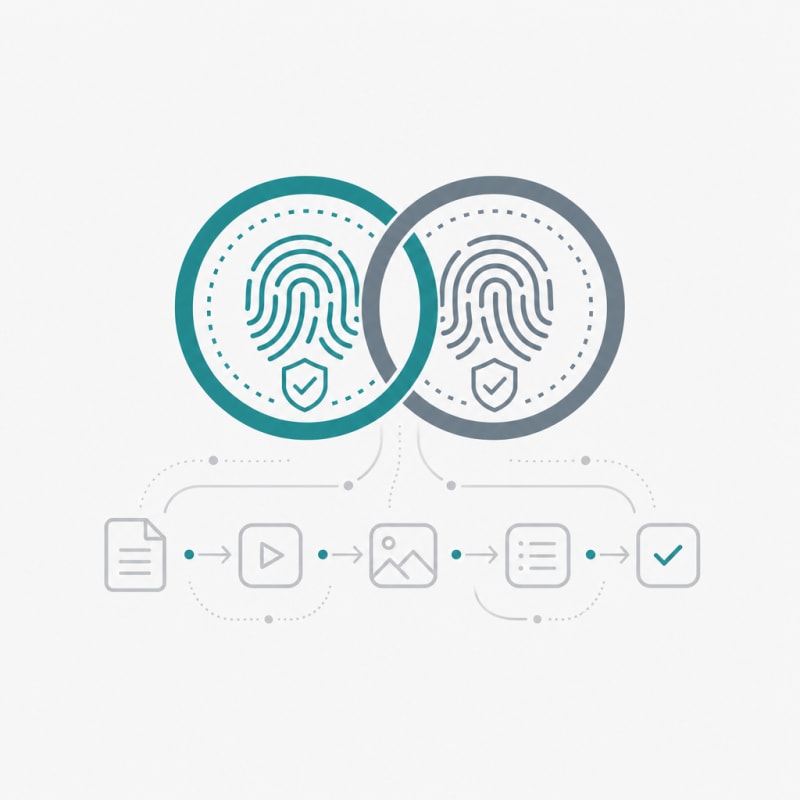
This creates a practical problem for organizations trying to maintain trust signals across their content operations. If provenance only survives until the first resize operation, it's not infrastructure—it's decoration.
The Real Threat Isn't Transformation, It's Disconnection
The challenge isn't that content changes. Change is intrinsic to content workflows. The challenge is maintaining a verifiable connection between transformed content and its provenance record even after that content has been edited, reformatted, or embedded in new contexts.
Most provenance systems fail here because they rely on metadata embedded directly in files. Embedded metadata works well when files remain unchanged, but it's fragile in the face of common operations. Image compression removes EXIF data. Format conversion strips custom fields. Content management systems overwrite metadata during ingest. Social platforms discard nearly everything except pixel data.
This fragility has real consequences. An organization might implement provenance at the point of creation, only to discover that none of that provenance data survives past their asset management system. The content is authentic, but there's no way to prove it by the time it reaches an audience.
The alternative isn't to prevent transformation. It's to build provenance systems that expect it.
Resilient Provenance Treats Files as Derivative Instances
Resilient provenance architectures operate on a different principle: instead of embedding trust signals in the content itself, they maintain an external record that can be referenced regardless of how the content changes.
This means treating each transformed version of a file not as a break in provenance, but as a derivative instance connected to a persistent provenance record. When an image is resized, the resized version carries a reference—often a cryptographic fingerprint or identifier—that points back to the authoritative provenance data. That data lives outside the file, in a system designed specifically for provenance continuity.
This architectural shift solves several problems at once. Compression doesn't destroy provenance because provenance isn't stored in compressible metadata. Format conversion doesn't break the chain because the chain exists independently of file format. Even significant edits can maintain a connection to the original provenance record, with the ability to document what changed and why.
The key is separation: content and provenance live in different layers, connected by references that survive transformation.
Fingerprinting Bridges the Gap Between File and Record
The mechanism that makes this work is perceptual fingerprinting—the ability to generate a stable identifier for a piece of content based on its perceptual characteristics rather than its exact binary structure.
Traditional file hashing breaks as soon as a single bit changes. Perceptual fingerprinting generates identifiers that remain stable across transformations that don't fundamentally change what the content depicts. A resized image produces the same fingerprint. A compressed video maintains the same identifier. Even minor edits can be recognized as variations of the same source material.
This allows provenance systems to maintain continuity across workflows without requiring every intermediate system to understand or preserve provenance metadata. The content management system doesn't need to know about provenance. The image processor doesn't need special configuration. The social platform can strip metadata as aggressively as it wants. As long as the content itself remains recognizably similar, the fingerprint connects it back to the provenance record.
This doesn't mean provenance becomes invisible to legitimate users. It means provenance becomes resilient to the ordinary operations of content distribution.
Provenance Needs to Flow Where Content Flows
Resilience also requires that provenance data itself is accessible where verification happens. If provenance records only exist in an internal database, they can't support public verification. If they're only available through proprietary APIs, they can't integrate with external trust systems.
This is pushing provenance infrastructure toward more open, federated models. Instead of each organization maintaining isolated provenance databases, resilient provenance systems are beginning to support cross-organizational verification. A piece of content created in one system can carry verifiable provenance into another, even when those systems don't share infrastructure.
The technical implementation varies—some approaches use distributed ledgers, others use federation protocols, still others rely on public registries with cryptographic verification. What matters is that provenance can be verified without requiring access to the originating system.
This isn't purely a technical preference. It reflects the reality that content workflows increasingly cross organizational boundaries. An agency creates content for a brand. That brand distributes it to partners. Those partners adapt it for their channels. Provenance that can't flow across these boundaries effectively stops at the first organizational edge.
Workflow Integration Determines Whether Provenance Scales
The difference between provenance systems that organizations actually use and those that remain theoretical often comes down to workflow integration. If adding provenance requires manual steps, special tools, or changes to established processes, adoption stalls.
Resilient provenance systems integrate into existing workflows rather than replacing them. This means working with the tools organizations already use—AI generation platforms, content management systems, digital asset managers, publishing tools. Provenance becomes part of the content creation process, not an additional step that creators need to remember.
Automation is critical here. When an AI system generates an image, provenance should be recorded automatically. When that image is edited, the edit should update the provenance record without requiring manual intervention. When content is published, verification information should be available without requiring the publisher to take additional action.
This level of integration requires that provenance systems operate as infrastructure—APIs that other tools can build against, not standalone applications that require separate workflows.
Organizations Are Moving From Experimentation to Expectation
The shift happening now is that provenance is moving from a "nice to have" capability in controlled pilot projects to an expected property of content in regulated and reputation-sensitive environments.
Media organizations are implementing provenance to distinguish authenticated journalism from synthetic content. Enterprises are requiring it for content used in regulated communications. Platforms are beginning to surface provenance signals to users. In each case, the expectation isn't that provenance will be perfect—it's that it will be present and verifiable.
This changes the requirements. Provenance systems built for demonstration projects could rely on simplified workflows and controlled environments. Provenance systems built for operational use need to handle the messy reality of how content actually moves through organizations: across teams, through multiple tools, into systems that weren't designed with provenance in mind.
Resilience becomes the differentiator. Organizations implementing provenance today are increasingly asking not just "can we add provenance data?" but "will that provenance data still be verifiable after our content goes through normal operations?"
Final Thoughts
The future of digital provenance isn't about creating perfect, immutable records for content that never changes. It's about building systems that maintain verifiable connections between content and its origins even as that content moves through the complex, automated, multi-platform workflows that define modern content operations.
This requires a shift in architecture—from embedded metadata to external records, from fragile file hashing to resilient fingerprinting, from isolated databases to federated verification. It also requires a shift in expectations: provenance systems need to be judged not by how well they work in controlled environments, but by how well they survive in operational ones.
Organizations implementing provenance today should be asking whether their approach can handle transformation, compression, and cross-platform distribution. Because if it can't, they're not building trust infrastructure. They're building trust theater that disappears the moment content enters a real workflow.
The Practical Position
Organizations that assume provenance can live inside the file will watch it disappear at the first resize. The architecture that survives is the one that treats content as ephemeral and provenance as external—connected by reference, not embedded by faith. Trust infrastructure must outlast the content it describes.
— Kevin Marsh, Editor-in-Chief
SYNTHETIC PROOF
FROM PROVENANCE TO OPERATIONAL TRUST
Understand Your AI Trust Gap
Synthetic Proof helps teams evaluate verification, provenance, prompt risk, and digital media trust through independent audits and structured findings.
Explore Synthetic ProofSynthetic Proof
Verified — Editorial Layer
This content has passed editorial verification for clarity, accuracy, and trust alignment.
Editor-in-Chief: Kevin Marsh
Verification Status: PASSED
Verification Status: PASSED
Comments
Post a Comment