Learn why organizations are investing in verification instead of detection alone. For years, the fight against synthetic media manipulation followed a familiar pattern: researchers identified deepfake artifacts, built detection models around those signatures, and deployed them across platforms. Detection accuracy improved. Conferences celebrated breakthroughs. The industry felt like it was winning. Then generative AI became exponentially better at eliminating the very artifacts those systems were trained to find. As synthetic media improves, confidence increasingly comes from layered evidence rather than a binary label. Synthetic Proof helps organizations evaluate that evidence in context. What's emerging isn't simply a technical gap that better detection can close. It's a fundamental shift in how organizations must approach digital trust. The old model—detect manipulated content after it's created—assumes defenders can keep pace with attackers....
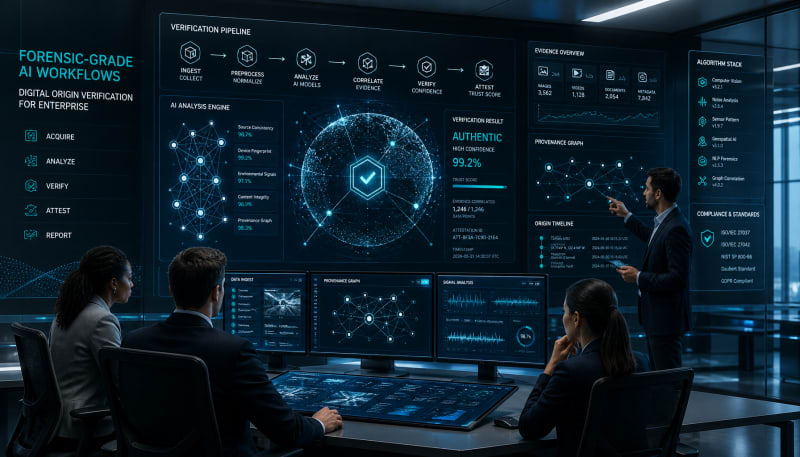
Discover how organizations are preparing for evidence-grade AI provenance.
Enterprise organizations are discovering that verifying digital origin isn't a single checkpoint—it's an entire operational workflow. A legal team needs to confirm that an AI-generated contract clause originated from an approved model version. A compliance officer must trace how a document moved through review stages without alteration. A security analyst requires proof that a customer support interaction came from an authorized system rather than a deepfake voice.
These aren't isolated verification requests. They're recurring enterprise operations that demand repeatable, auditable processes built on forensic-grade standards.
As content history becomes a governance concern, organizations need more than another metadata field. Synthetic Proof provides an independent way to assess provenance, verification, and wider AI trust risk.
The emerging answer isn't simply better verification technology. It's forensic-grade workflows—structured operational processes that embed digital origin verification into the systems where content is created, reviewed, approved, and archived. Where traditional verification asks "Is this authentic?" at a single moment, forensic-grade workflows establish continuous chains of custody that answer "How did this content move from origin to delivery, and can we prove it?"
This shift from point-in-time verification to continuous workflow verification represents one of the most significant operational changes in how enterprises will manage AI-generated and AI-influenced content over the next several years.
Why Point-in-Time Verification Is Breaking Down
Most digital verification systems operate as single checkpoints. A user uploads content, the system analyzes it, and delivers a verdict: authentic or suspicious. This model works reasonably well for isolated authenticity questions—confirming a photograph's origin or detecting a manipulated video.
But enterprises don't operate in isolated moments. A marketing asset passes through concept development, AI-assisted drafting, legal review, executive approval, localization, and publication. A financial forecast incorporates data from multiple AI models, human adjustments, compliance checks, and board presentation formatting. A customer interaction might involve AI routing, human agent assistance, AI-suggested responses, and quality assurance review.
Each stage introduces questions that single-checkpoint verification cannot answer. Did this contract clause exist in the original draft, or was it added during legal review? Which model version generated the financial projection that informed this quarter's guidance? Was this customer support transcript captured in real-time, or reconstructed from notes?
Point-in-time verification tells you about a moment. It cannot reconstruct a history.
Forensic-grade workflows solve this by treating verification as a continuous operational layer rather than a discrete event. Every transformation, every contributor, every system interaction becomes part of an auditable chain that enterprises can reconstruct when trust questions emerge—and they always emerge.
What Makes a Workflow Forensic-Grade
The term "forensic-grade" carries specific implications. It suggests standards rigorous enough to withstand legal scrutiny, regulatory audit, and adversarial challenge. In practice, this means workflows designed around four operational principles.
First, cryptographic origin anchoring. Content receives a cryptographically signed attestation at creation that binds it to a specific source—whether that's a particular AI model, a human author, or a system process. This attestation becomes the foundation for everything that follows. Without cryptographic anchoring, downstream verification becomes assertion rather than proof.
Second, immutable chain of custody. Every modification, review, approval, or transformation generates a new record that references the previous state. These records cannot be retroactively altered without detection. The workflow doesn't just track changes—it creates an immutable history that demonstrates exactly how content evolved from origin to final form.
Third, contextual metadata preservation. Forensic-grade workflows capture not just what changed, but why, when, who authorized it, and under what conditions. A contract revision includes the approver's identity, timestamp, the model that suggested the language, and the compliance framework that required the change. This contextual layer transforms raw audit logs into interpretable evidence.
Fourth, independent verification infrastructure. The systems that create content cannot be the sole validators of their own provenance claims. Forensic-grade workflows route verification through independent infrastructure that operates separately from production systems—creating the separation necessary for trustworthy attestation.
These principles sound straightforward, but implementing them across enterprise operations requires rethinking how content moves through organizations.
Where Forensic Workflows Are Emerging First
Not every organizational process requires forensic-grade verification. Email threads, brainstorming documents, and internal drafts rarely need immutable audit trails. But several operational categories are driving early adoption precisely because trust failures carry significant consequences.
Regulated communications present the clearest immediate use case. Financial services firms face strict requirements around customer communications, trade confirmations, and disclosure documents. Healthcare organizations must maintain auditable records of clinical documentation and patient communications. These sectors cannot afford ambiguity about content origin when regulators or litigants demand proof.
AI-assisted legal operations are becoming another early adopter category. Law firms using AI to draft contracts, analyze case law, or generate discovery responses need verifiable records of which content originated from AI systems versus human attorneys. As AI-generated legal work becomes routine, the profession is recognizing that attorney work product carries different liability implications than AI-suggested language—and the distinction must be provable.
Brand protection and synthetic media defense represent a third category. Organizations increasingly face synthetic impersonation—deepfake executive videos, fabricated press releases, or AI-generated customer service interactions that never occurred. Forensic-grade workflows that establish authentic content provenance create a defensive capability: the ability to prove what your organization actually produced versus what adversaries fabricated.
Enterprise AI governance operations are emerging as a fourth driver. Organizations implementing responsible AI programs need operational proof that deployed models match approved versions, that outputs undergo required review processes, and that high-risk decisions include appropriate human oversight. Governance policies without verification infrastructure remain aspirational rather than enforceable.
The Architecture Beneath Forensic Workflows
Implementing forensic-grade workflows requires infrastructure that most enterprises don't currently operate. The technology isn't theoretical—it exists today in various forms—but integration into operational systems remains early stage.
Content signing at origin requires AI systems, authoring tools, and creation platforms to generate cryptographic attestations as content is produced. This isn't simply metadata tagging. It's cryptographic binding that links content to its source in ways that cannot be forged without access to private signing keys.
Workflow orchestration systems must integrate verification checkpoints without disrupting operational velocity. A legal review workflow that takes three days without verification cannot become a seven-day process because forensic logging adds complexity. The infrastructure must be transparent to users while remaining rigorous in its evidence collection.
Independent verification infrastructure provides the external validation layer. This typically involves third-party services that maintain cryptographic registries, timestamp services, and verification APIs that operate separately from the systems being verified. The independence creates the trust separation necessary for forensic credibility.
Audit interfaces allow authorized users to reconstruct content history without exposing sensitive operational data. A compliance officer needs to confirm that a particular disclosure followed required approval processes, but shouldn't access unrelated content or internal deliberations. Forensic systems must balance transparency with appropriate access controls.
This infrastructure doesn't replace existing enterprise systems. It wraps around them, creating a verification layer that operates parallel to operational workflows rather than replacing them.
Why Enterprises Are Building This Now
Forensic-grade workflows aren't emerging because verification technology suddenly improved. They're emerging because enterprise risk profiles are changing in ways that make digital origin verification operationally necessary rather than theoretically valuable.
Regulatory expectations are shifting from "implement reasonable controls" to "demonstrate verifiable compliance." Regulators increasingly expect organizations to prove their AI governance claims with auditable evidence rather than policy documents. The EU AI Act, financial services AI guidance, and healthcare AI frameworks all signal movement toward verification-based compliance rather than attestation-based compliance.
Litigation risk around AI-generated content is escalating. Early lawsuits involving AI output attribution, liability for AI-generated advice, and intellectual property disputes over AI training data are establishing precedents where organizations that cannot prove content provenance face significant liability exposure. Legal teams are recognizing that forensic-grade workflows create defensive capabilities that traditional documentation cannot provide.
Synthetic media threats have moved from theoretical concern to operational reality. Every organization with a public presence now faces potential deepfake impersonation. The only effective defense is the ability to prove what you actually produced—which requires forensic workflows that establish authentic content provenance before impersonation occurs.
AI adoption velocity is outpacing traditional governance mechanisms. Organizations deploying dozens or hundreds of AI applications cannot manually audit every output. Forensic workflows offer a path to scale governance through automated verification infrastructure rather than human review bottlenecks.
What Implementation Actually Requires
Organizations exploring forensic-grade workflows face a common question: where do you start when the ultimate vision requires enterprise-wide infrastructure?
The practical answer involves identifying high-stakes content workflows where verification failure carries immediate consequences. Most organizations begin with regulated communications, executive communications, or legal operations—categories where trust failures are expensive and verification requirements are already partially defined.
Early implementations focus on establishing cryptographic origin for AI-generated content before expanding to full chain-of-custody tracking. An organization might begin by ensuring that every AI-generated contract clause receives a signed attestation indicating which model produced it, who reviewed it, and when it was approved. This creates foundational provenance without requiring immediate transformation of entire document workflows.
Pilot deployments typically integrate with existing systems rather than replacing them. A forensic workflow layer wraps around current document management, communication platforms, or content creation tools—adding verification infrastructure without disrupting operational practices that already work.
Organizations are discovering that forensic-grade workflows require new operational roles. Someone must define which content requires forensic verification, establish audit access policies, respond to verification inquiries, and maintain the infrastructure that supports chain-of-custody operations. This operational layer is emerging as part of the broader TrustOps discipline—the practice of managing verification, provenance, and digital authenticity as ongoing enterprise operations rather than occasional security projects.
The Market Is Still Defining Itself
Forensic-grade workflows represent an emerging category rather than an established market. The technology exists, early adopters are deploying it, and regulatory pressure is building—but standardization remains incomplete.
No universal standard yet defines what "forensic-grade" means for digital content workflows. Different industries are developing different requirements based on their specific regulatory contexts and risk profiles. Financial services firms emphasize regulatory audit readiness. Legal organizations focus on attorney work product distinction. Healthcare systems prioritize clinical documentation integrity.
This fragmentation isn't necessarily problematic. It reflects the reality that different operational contexts require different verification standards. But it does mean organizations implementing forensic workflows today are partly defining the category rather than following established playbooks.
The technology providers supporting this space range from established enterprise software vendors adding verification features to specialized trust infrastructure platforms built specifically for provenance and chain-of-custody operations. The market hasn't consolidated around dominant approaches, which suggests both opportunity and uncertainty as the category matures.
Conclusion
Forensic-grade workflows represent a fundamental shift in how enterprises approach digital origin verification—from isolated authenticity checks to continuous operational processes that establish and maintain provenance throughout content lifecycles.
This transition is being driven by regulatory pressure, litigation risk, synthetic media threats, and the operational realities of scaling AI governance across increasingly complex content operations. Organizations that establish forensic-grade workflows early are building defensive capabilities that will become harder to retrofit as regulatory expectations solidify and trust failures become more costly.
The shift from point-in-time verification to continuous chain-of-custody operations won't happen overnight. But the direction is becoming clear: enterprises increasingly need the ability to prove not just what content is authentic, but how it moved from origin to delivery with verifiable integrity at every stage. That's not a verification problem. It's a workflow architecture challenge—and the organizations solving it now are establishing the operational foundations for trustworthy AI adoption at scale.
The Practical Position
Digital origin is no longer a yes-or-no question answered once—it's a chain of custody maintained across every transformation. Organizations that treat verification as continuous workflow infrastructure rather than periodic checkpoints will separate themselves from those still asking "Is this real?" long after the answer stopped mattering. Forensic thinking is becoming operational thinking.
— Kevin Marsh, Editor-in-Chief
SYNTHETIC PROOF
FROM PROVENANCE TO OPERATIONAL TRUST
Understand Your AI Trust Gap
Synthetic Proof helps teams evaluate verification, provenance, prompt risk, and digital media trust through independent audits and structured findings.
Explore Synthetic ProofSynthetic Proof
Verified — Editorial Layer
This content has passed editorial verification for clarity, accuracy, and trust alignment.
Editor-in-Chief: Kevin Marsh
Verification Status: PASSED
Verification Status: PASSED
Comments
Post a Comment