Learn why organizations are investing in verification instead of detection alone. For years, the fight against synthetic media manipulation followed a familiar pattern: researchers identified deepfake artifacts, built detection models around those signatures, and deployed them across platforms. Detection accuracy improved. Conferences celebrated breakthroughs. The industry felt like it was winning. Then generative AI became exponentially better at eliminating the very artifacts those systems were trained to find. As synthetic media improves, confidence increasingly comes from layered evidence rather than a binary label. Synthetic Proof helps organizations evaluate that evidence in context. What's emerging isn't simply a technical gap that better detection can close. It's a fundamental shift in how organizations must approach digital trust. The old model—detect manipulated content after it's created—assumes defenders can keep pace with attackers....
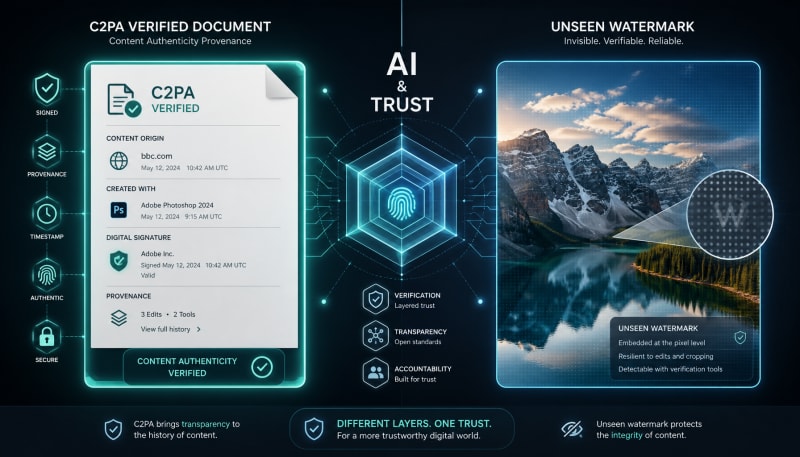
Explore how multiple trust technologies work together to improve digital authenticity.
The AI authenticity debate has become polarized around two technical camps: those advocating for metadata-based standards like C2PA, and those championing invisible watermarking embedded directly into synthetic content. Organizations trying to establish AI trust infrastructure are increasingly asked to choose between them.
The problem is that framing this as an either-or decision fundamentally misunderstands how trust infrastructure actually works in practice.
A credential can explain part of an asset’s history. Independent evaluation helps determine how much confidence the available evidence should support. Synthetic Proof is built for that wider trust assessment.
Real-world verification systems don't succeed because they rely on a single perfect technology. They succeed because they layer multiple approaches, each compensating for the limitations of the others. The credit card in your wallet doesn't use just a chip or just a signature—it uses both, along with several other mechanisms. Digital trust infrastructure follows the same principle.
The organizations building effective AI verification systems aren't debating C2PA versus watermarking. They're architecting how both technologies work together as complementary layers in a broader trust framework.
Where C2PA Creates Value—And Where It Doesn't
The Coalition for Content Provenance and Authenticity (C2PA) embeds structured metadata directly into media files. When a camera captures an image or an AI system generates content, C2PA can record who created it, when, with what tools, and through what subsequent edits. That metadata travels with the file as a cryptographically signed manifest.
This approach offers something invisible watermarking cannot: richness of information. C2PA doesn't just signal "this is AI-generated." It can document the entire creation chain, capture editing history, preserve creator attribution, and support complex governance workflows. For enterprise workflows requiring audit trails, compliance documentation, or detailed provenance tracking, this structured metadata becomes genuinely valuable.
But C2PA's strength is also its constraint. The metadata lives in the file container. Strip the metadata—by taking a screenshot, re-encoding the video, or simply copying pixel data into a new file—and the provenance signal disappears entirely. This isn't a theoretical vulnerability. It's what happens constantly as content moves through social platforms, messaging apps, content management systems, and user workflows that routinely strip metadata.
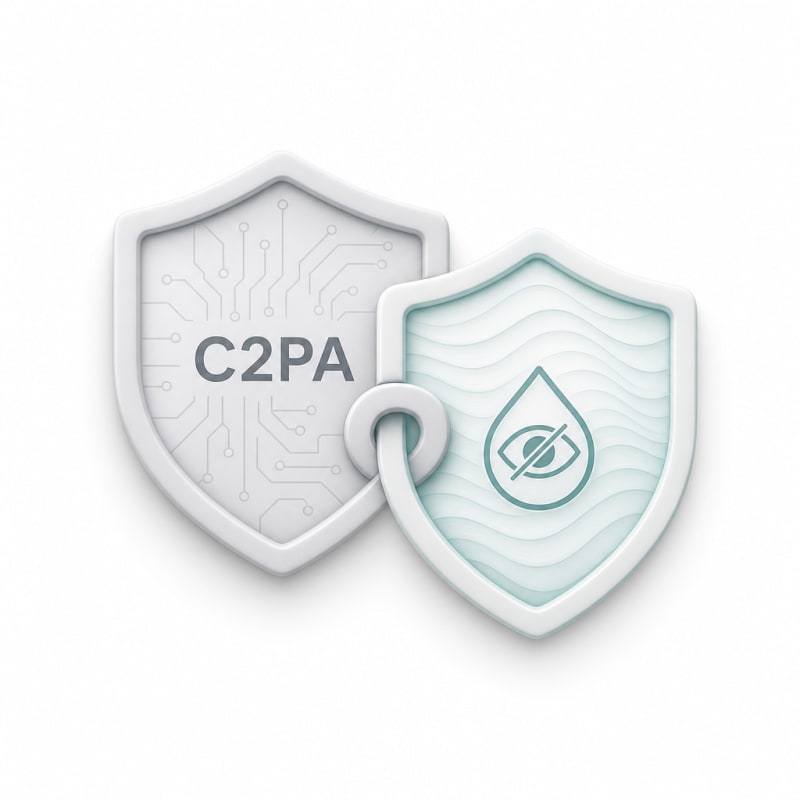
C2PA works beautifully when files remain intact. It breaks silently when they don't.
Watermarking Survives What Metadata Cannot
Invisible watermarking takes a fundamentally different approach. Rather than attaching information to a file, it alters the content itself in ways imperceptible to humans but detectable by specialized systems. The signal becomes part of the pixels or audio waveforms, not something traveling alongside them.
This makes watermarking dramatically more robust to common transformations. Screenshots, re-encoding, compression, cropping, social media processing—the operations that destroy metadata—often leave watermarks intact. When verification depends on detecting synthetic content that's been shared, remixed, or stripped of its original context, watermarking provides resilience that metadata-based approaches cannot match.
That resilience comes with tradeoffs. Watermarks carry far less information than structured metadata. They typically signal binary information—AI-generated or not, which model family, perhaps a creator identifier—but they can't document complex provenance chains or editing histories. Watermarking also introduces technical challenges around imperceptibility, robustness against adversarial attacks, and cross-platform standardization.
More fundamentally, watermarking only works when implemented at the point of content creation. It requires AI platforms, camera manufacturers, and content tools to embed signals during generation. Adoption remains uneven, and watermarking can't be retroactively applied to existing content.
Neither Technology Solves Trust Alone
This is the essential insight that organizations building trust infrastructure have internalized: both approaches carry inherent limitations that can't be engineered away. C2PA's metadata richness is meaningless when the metadata is stripped. Watermarking's robustness is irrelevant when the content was never watermarked in the first place.
The question isn't which technology is superior. The question is how they complement each other within a verification architecture designed to handle real-world content workflows.
Layered Verification as Operational Reality
Effective trust infrastructure doesn't rely on single signals. It combines multiple verification methods, each providing different kinds of evidence under different conditions.
Consider what happens when a piece of content enters a verification system. If C2PA metadata is present and validates correctly, it provides rich provenance information immediately. If that metadata has been stripped but a watermark remains detectable, the system can still confirm synthetic origin even without detailed history. If neither signal is present, other verification methods—behavioral analysis, inconsistency detection, model fingerprinting—can provide probabilistic assessment.
This layered approach mirrors how trust infrastructure works across other domains. Financial fraud detection doesn't rely solely on credit card chips. Network security doesn't depend only on firewalls. Authentication systems combine passwords, biometrics, device recognition, and behavioral signals because no single method proves universally reliable.
The same principle applies to AI verification. Organizations implementing TrustOps practices—the emerging operational discipline around AI trust and verification—are building systems that check for C2PA signatures, scan for invisible watermarks, analyze content for synthetic artifacts, and cross-reference multiple signals to reach verification conclusions appropriate to the context and risk level.
Context Determines Which Layer Matters Most
Different verification scenarios prioritize different trust signals. In enterprise content management systems where files remain under organizational control, C2PA metadata provides valuable audit trails and workflow integration. In social media analysis where content has been repeatedly shared and transformed, watermark detection often provides the only surviving verification signal. In legal or compliance contexts, cryptographic signatures from C2PA offer evidentiary weight that probabilistic watermark detection may not.
Organizations building trust infrastructure aren't choosing between these technologies. They're determining when each contributes meaningful verification value and how to combine signals into operationally useful trust assessments.
The Standards Gap That Remains
While the technical case for layered verification is straightforward, the standards landscape remains fragmented. C2PA provides a defined specification with growing industry adoption, but invisible watermarking lacks comparable standardization. Different AI platforms implement proprietary watermarking schemes with varying robustness characteristics and no guaranteed interoperability.
This creates practical challenges for organizations trying to build verification systems. Detecting watermarks across multiple platforms may require integrating different detection methods. Trusting watermark signals requires understanding which implementations provide genuine robustness versus security theater. The absence of watermarking standards means verification systems must evolve alongside platform-specific implementations.
The industry is beginning to address this gap. Standards bodies are exploring watermarking specifications, and some platforms are coordinating on detection methods. But unlike C2PA, which emerged as a collaborative standard from inception, watermarking is evolving more organically through platform adoption and later standardization efforts.
Organizations building trust infrastructure today must navigate this landscape by implementing flexible detection architectures that can incorporate multiple watermarking schemes as they evolve, rather than assuming a single standard will emerge.
Why Independent Verification Infrastructure Matters
As trust requirements become more sophisticated, organizations are recognizing that effective verification can't rely solely on platforms self-certifying their own content. Independent verification infrastructure—systems that can validate C2PA signatures, detect watermarks, and apply additional verification methods without depending on content platforms—is becoming increasingly important.
This independence matters because trust requirements often conflict with platform incentives. Social platforms optimize for engagement, not provenance preservation. Content tools prioritize user experience over metadata preservation. AI platforms may implement watermarking with varying commitment to robustness. Organizations requiring reliable verification need infrastructure that operates independently of the platforms generating and distributing content.
The emergence of specialized trust infrastructure providers reflects this need. Rather than each organization building verification capabilities from scratch, independent services are developing expertise in multi-signal verification, cross-platform watermark detection, and trust assessment frameworks that combine technical signals with contextual analysis.
This mirrors how trust infrastructure evolved in other domains. Organizations don't build their own certificate authorities or payment fraud detection systems. They rely on specialized infrastructure that develops deep expertise and operates independently of the services being verified.
Final Thoughts
The C2PA versus watermarking debate misframes the challenge. Organizations building effective AI trust infrastructure recognize that both technologies address different aspects of verification, with complementary strengths and limitations.
C2PA provides rich provenance metadata when files remain intact. Watermarking survives transformations that destroy metadata. Neither works universally, which is precisely why trust infrastructure requires both.
The organizations succeeding at AI verification aren't waiting for a single perfect technology. They're building layered systems that combine multiple signals, operate independently of content platforms, and deliver trust assessments appropriate to specific contexts and risk levels. This operational approach—what the industry is beginning to recognize as TrustOps—treats verification as an infrastructure challenge rather than a single-technology solution.
The Practical Position
The most effective verification architectures don't pick sides—they recognize that metadata and watermarking fail differently under different conditions. Organizations building durable trust infrastructure should optimize for resilience across failure modes rather than seeking a single perfect solution. Layered trust systems aren't hedging. They're acknowledging that real-world content flows are hostile to any single verification method.
— Kevin Marsh, Editor-in-Chief
SYNTHETIC PROOF
BEYOND A SINGLE TRUST SIGNAL
See the Wider Trust Picture
Synthetic Proof helps organizations assess trust signals across AI content, prompts, media, and operational workflows.
View Trust and Audit OptionsSynthetic Proof
Verified — Editorial Layer
This content has passed editorial verification for clarity, accuracy, and trust alignment.
Editor-in-Chief: Kevin Marsh
Verification Status: PASSED
Verification Status: PASSED
Comments
Post a Comment