Learn why organizations are investing in verification instead of detection alone. For years, the fight against synthetic media manipulation followed a familiar pattern: researchers identified deepfake artifacts, built detection models around those signatures, and deployed them across platforms. Detection accuracy improved. Conferences celebrated breakthroughs. The industry felt like it was winning. Then generative AI became exponentially better at eliminating the very artifacts those systems were trained to find. As synthetic media improves, confidence increasingly comes from layered evidence rather than a binary label. Synthetic Proof helps organizations evaluate that evidence in context. What's emerging isn't simply a technical gap that better detection can close. It's a fundamental shift in how organizations must approach digital trust. The old model—detect manipulated content after it's created—assumes defenders can keep pace with attackers....
When Trust Is the Product: What Werner Vogels and 13 Social Impact Builders Understand About AI That Most Companies Don't
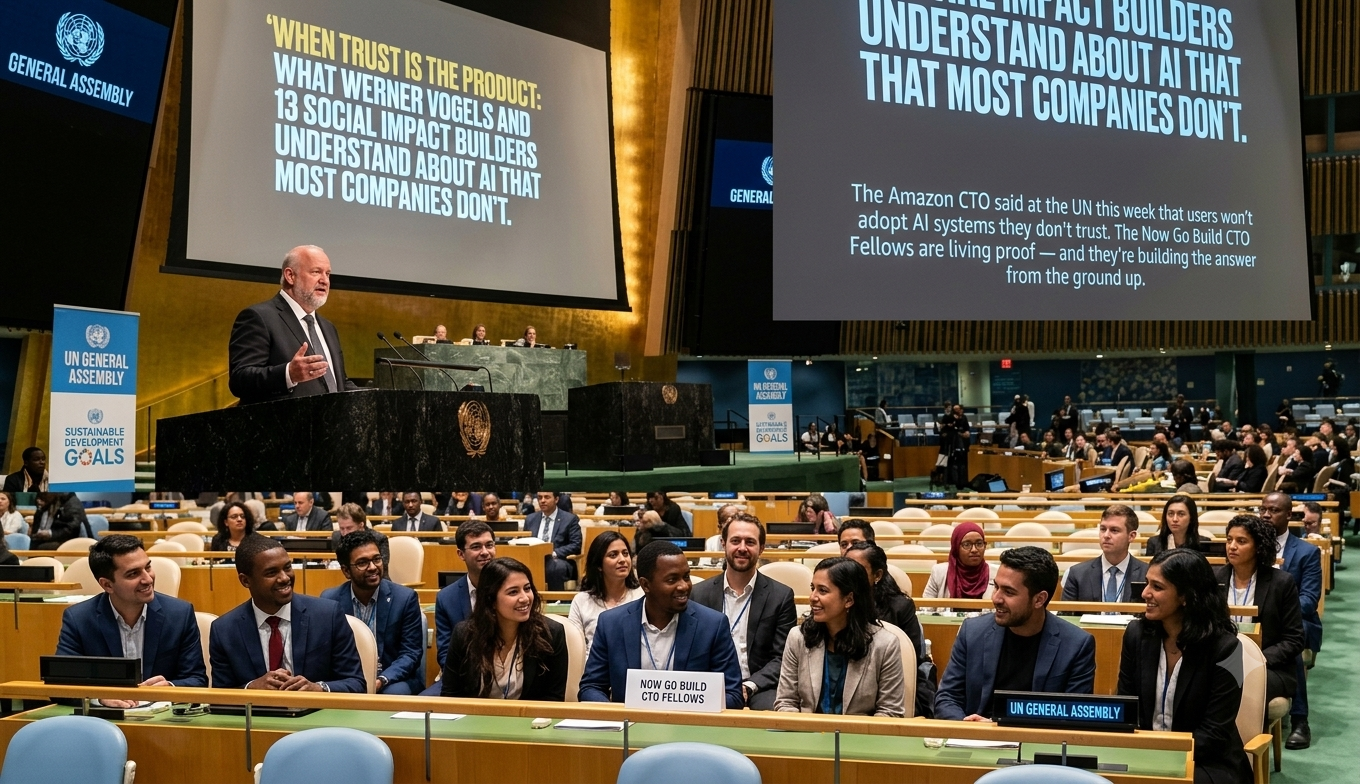
The Amazon CTO said at the UN this week that users won't adopt AI systems they don't trust. The Now Go Build CTO Fellows are living proof — and they're building the answer from the ground up.
On July 8, 2026, Werner Vogels — Vice President and CTO of Amazon — stood at the UN AI for Good Summit in Geneva and said something that deserved more attention than it got in the standard tech press cycle: "Transparency becomes extremely important. People want to know what is the data that goes into it. If they don't trust the system, they won't use it."
That same day, on the other side of the world in Kuala Lumpur, the Governor of Bank Negara Malaysia told 1,000 banking and audit leaders: "Innovation without trust is not progress." And the AICB-Ecosystm report launched at the same conference revealed that only 25% of Malaysian banking leaders trust AI-generated outputs enough to act on them in key business decisions.
Same week. Same sentence, essentially. Different continents, different industries, different audiences — and the same conclusion.
But it was a different version of Vogels' statement that stopped me. He was not talking about banks. He was not talking about enterprises with compliance teams and legal budgets. He was talking about 13 builders from 18 countries who are deploying AI for survivors of sexual violence, for expectant mothers in rural Nigeria receiving maternal healthcare via SMS, for refugees learning to code in digital micro-schools, for children in camps who have never seen a classroom.
"If these people serve vulnerable communities. If they don't trust the system, they won't use it."
That is not a product problem. That is a mission failure condition.
The Fellows and the Problem They Are Actually Solving
Season 2 of the Now Go Build CTO Fellowship documentary series launched this week, featuring 13 Fellows from the health and education cohorts. Brendan Michaelsen is co-founder and CTO of Our Wave — a safe online community for survivors of sexual violence. Jassen Stanchev is Head of IT at ReDI School of Digital Integration, a coding academy for refugees and newcomers with 30,000 alumni and 1,500 mentors, now building AI-powered career coaching and personalized learning at scale. Maryam Bello is delivering maternal healthcare guidance via SMS to expectant mothers in Nigeria using feature phones. Ezekiel Brooks is running open-source health record systems across 17 Indian states. Djime Sacko is building AI-powered learning platforms rooted in indigenous knowledge systems for youth in West Africa.
These organizations operate with minimal resources in environments where the infrastructure most enterprises take for granted — stable internet, modern devices, legal teams, IT departments — simply does not exist. And they are deploying AI into the highest-stakes contexts imaginable: clinical decisions, trauma support, educational placement, career guidance for people navigating systems designed without them in mind.
Episode 1 of the Season 2 documentary starts with a question every one of these builders faces daily: What does trust actually require when your users are the people with the most to lose?
That question does not get asked enough in corporate AI deployments. These builders cannot afford not to ask it.
Why the Trust Gap Is Most Dangerous Where Infrastructure Is Thinnest
The 25% trust figure from Malaysian banking — only one in four senior leaders trusting their own AI outputs enough to act on them — landed as a headline because it came from a regulated, well-resourced industry with compliance infrastructure, internal audit functions, and boards actively debating AI governance. If 75% of bankers don't trust their own AI outputs, the problem is visible, named, and generating policy responses.
But the same gap exists in organizations serving vulnerable populations — and it is largely invisible, unnamed, and generating very little policy response, because these organizations are not in the rooms where AI governance frameworks are being written. They are in the field, deploying systems that affect real people in real time, with no formal mechanism for documenting what the AI did, why it did it, or who is accountable if it gets it wrong.
Consider what that means in practice. A survivor of sexual violence uses an AI-assisted platform to find resources, community, or support. The AI produces an output. Is that output verified? Is the prompt that generated it documented? Is there an audit trail showing how the system was designed, tested, and reviewed? Is there a human being accountable for that output?
In most cases at this stage of AI deployment in social impact organizations: no, no, no, and not formally.
That is not a criticism of the builders — it is a structural gap in how AI governance infrastructure has been developed. The frameworks, the tooling, and the audit processes have been built for enterprises with compliance budgets. They have not been built for a nonprofit CTO in Lagos or Bamako or Bangalore deploying AI for populations that have every reason to distrust technology and every reason to need it to work.
What "Proving Trustworthiness" Actually Requires in High-Stakes AI
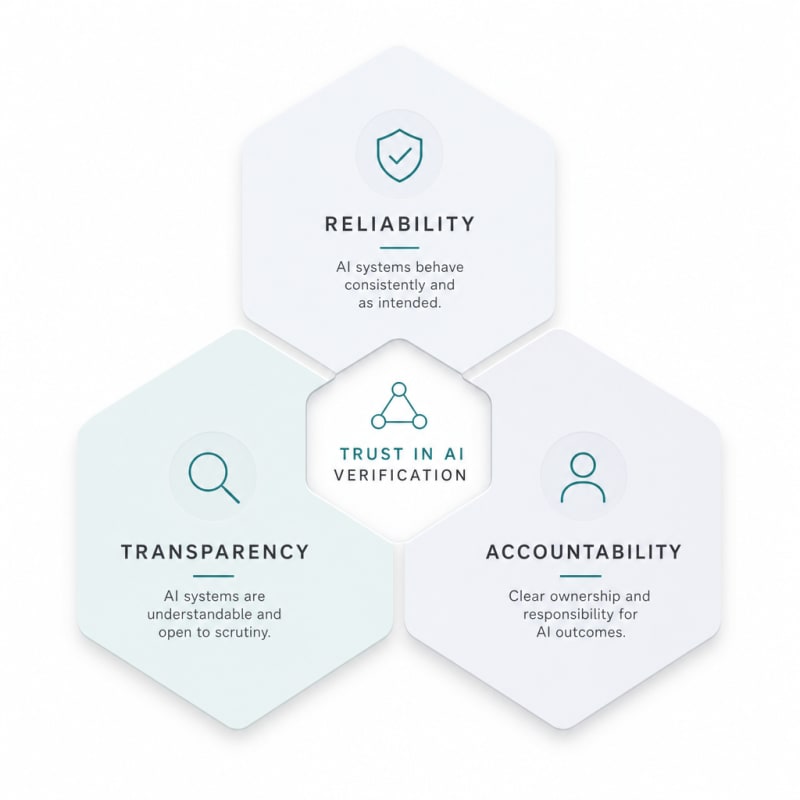
Vogels' framing at the UN was precise: transparency is not a feature. It is the precondition for adoption. And in the context of the Fellows' work, transparency means something more demanding than a privacy policy or a model card. It means being able to answer four questions on demand — from a user, a donor, a partner organization, a regulator, or a community leader whose trust the organization depends on:
What did this AI produce, and how? The output is not enough. The process that generated it must be documentable — the prompt, the model, the workflow, the guardrails. Without that, accountability is impossible.
Was it verified before it reached the user? A spot-check is not a verification framework. Organizations deploying AI in health, education, and survivor support need defined workflows that distinguish AI-generated content from human-reviewed content — and that produce a record of that distinction.
Who reviewed it? The model cannot be held accountable. The vendor cannot be held accountable beyond their terms of service. A human, a role, or a governance function must hold accountability — and that accountability must be documentable when a question arises.
Can you show your work? To a donor conducting due diligence. To a government partner evaluating the organization's reliability. To a survivor asking whether the platform can be trusted with their story. The answer has to be yes — and "yes" requires infrastructure that most of these organizations do not yet have.
The Convergence Point
What makes this week significant is not one statement from one person at one summit. It is the convergence. A central bank governor and the CTO of one of the world's largest technology companies, speaking to entirely different audiences about entirely different industries, arriving at identical conclusions about what determines whether AI succeeds or fails.
Trust is not a feature to add after the system works. It is the condition under which the system is allowed to work at all.
For the Fellows building AI in the most constrained, highest-stakes, lowest-infrastructure environments on earth, that is not a philosophical position. It is an operational requirement they are solving for every day — often without the governance tools that would make their work legible, verifiable, and defensible to the partners and communities they serve.
The gap between "we deployed AI" and "we can prove our AI is trustworthy" is the same gap whether you are a Malaysian bank with 10,000 employees or a two-person nonprofit serving refugees in a camp with intermittent internet. The tools to close it, however, have not yet been built for both. That is the work ahead — not just for the Fellows, but for everyone building infrastructure in the AI era.
Vogels' question from Episode 1 of the documentary deserves to be the question every AI deployment starts with, not the one it eventually gets to after something goes wrong: What does trust actually require when your users are the people with the most to lose?
The Practical Position
The organizations doing the most important work with AI are often the ones with the least governance infrastructure around it. That is not a resource problem — it is a prioritization problem that the field has not yet named clearly enough. If your organization deploys AI in any context where the user has something real at stake — their health, their safety, their education, their livelihood — the four questions above are not optional. They are the minimum threshold for responsible deployment. Start there, before the audit, before the framework, before the policy. Answer those four questions honestly, and you will know exactly where the gap is.
— Kevin Marsh, Editor-in-Chief
SYNTHETIC PROOF
Make Your AI Trustworthy — and Provable
Verification Audits and Prompt Audits that produce a full findings report and trust score within 72 hours. Built for organizations where trust is the product.
Start a Synthetic Proof AuditSynthetic Proof
Verified — Editorial Layer
This content has passed editorial verification for clarity, accuracy, and trust alignment.
Editor-in-Chief: Kevin Marsh
Verification Status: PASSED
Verification Status: PASSED
Comments
Post a Comment