Learn why organizations are investing in verification instead of detection alone. For years, the fight against synthetic media manipulation followed a familiar pattern: researchers identified deepfake artifacts, built detection models around those signatures, and deployed them across platforms. Detection accuracy improved. Conferences celebrated breakthroughs. The industry felt like it was winning. Then generative AI became exponentially better at eliminating the very artifacts those systems were trained to find. As synthetic media improves, confidence increasingly comes from layered evidence rather than a binary label. Synthetic Proof helps organizations evaluate that evidence in context. What's emerging isn't simply a technical gap that better detection can close. It's a fundamental shift in how organizations must approach digital trust. The old model—detect manipulated content after it's created—assumes defenders can keep pace with attackers....
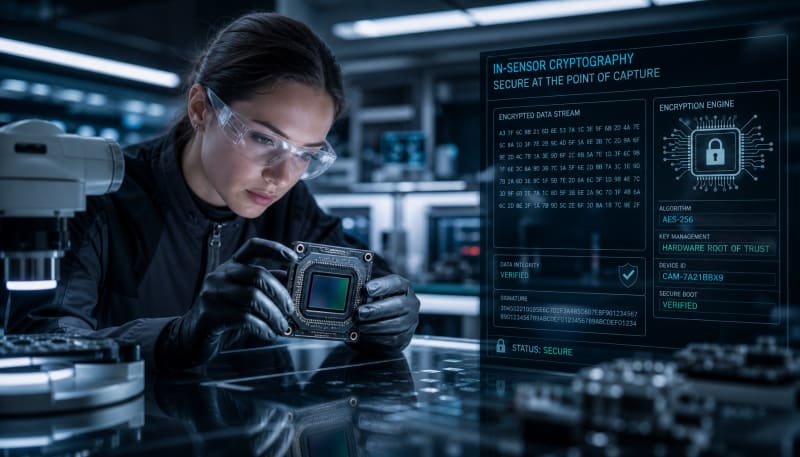
Explore how cryptographic verification is moving directly into capture devices.
Every image captured by a modern camera passes through dozens of processing stages before it becomes a file. Color correction, noise reduction, compression—these transformations happen invisibly, in milliseconds, before the photograph ever reaches storage. This pipeline has been optimized for decades to produce better-looking images. Now it's being redesigned for something entirely different: trust.
In-sensor cryptography represents a fundamental shift in how digital content establishes authenticity. Rather than adding verification layers after capture, these systems embed cryptographic signatures directly within the sensor hardware itself. The content is signed at the moment light hits silicon, before any downstream system can alter, manipulate, or fabricate the record.
The move from AI policy to operational trust requires independent evidence. Synthetic Proof helps organizations understand where their current trust posture stands.
The timing matters because the deepfake problem has evolved beyond detection. Organizations no longer need better tools to spot synthetic media after it spreads. They need infrastructure that proves authenticity before content enters any workflow.
The Verification Problem Starts at the Source
Traditional content authentication operates retroactively. An image circulates, questions arise, and forensic analysis attempts to determine whether the content is genuine. This approach worked when manipulation required specialized skill and tools left detectable artifacts. Neither assumption holds anymore.
Generative AI has made high-quality image synthesis accessible to anyone with a text prompt. At the same time, editing tools have become sophisticated enough that tampering no longer leaves obvious traces. Forensic analysis can identify some manipulations, but it's a reactive measure applied after trust has already been compromised.
The fundamental challenge is provenance. Once a digital file exists, it can be copied perfectly. Metadata can be stripped, rewritten, or forged. Without a secure chain of custody beginning at capture, there's no reliable way to distinguish an authentic photograph from a generated one, or an original recording from an edited version.
In-sensor cryptography addresses this by moving verification upstream. Instead of trying to prove authenticity after the fact, the hardware itself creates a cryptographic record at the moment of capture. This record becomes part of the content's immutable identity, traveling with it through every subsequent system.

How Hardware-Level Signing Actually Works
In-sensor cryptography integrates secure cryptographic modules directly into imaging hardware. When the sensor captures light and converts it to digital data, the system immediately generates a cryptographic hash of that raw sensor output. This hash is then signed using a private key stored in tamper-resistant hardware within the camera itself.
The signature is bound to the image data before any processing occurs. This means the cryptographic record reflects the unaltered sensor output—the closest digital representation to what the lens actually captured. Any subsequent modification, even legitimate edits like exposure adjustment, would break the signature's validity unless properly documented through additional cryptographic layers.
The private signing key never leaves the secure hardware module. This isolation is critical because it prevents any software-based attack from extracting the key and forging signatures. The camera can sign content, but nothing else can impersonate that specific device.
Each signed image includes metadata specifying when and where it was captured, what device created it, and the camera's hardware attestation. This information is cryptographically bound to the image data itself, creating a verifiable chain of custody that begins at the point of capture.
The system relies on public key cryptography. The camera's public key can be registered with certificate authorities or published in public registries, allowing anyone to verify that a signature came from a specific trusted device without ever accessing the private key. This creates a verification model that scales across organizations and platforms.
Where Authentication Becomes Infrastructure
The real value of in-sensor cryptography isn't just proving that a specific image is authentic. It's establishing content provenance as a foundational layer of digital infrastructure rather than an afterthought.
News organizations are already experimenting with cryptographically signed photojournalism. When a reporter captures images in the field using hardware with embedded cryptographic capabilities, editors can verify that the images haven't been altered since capture. This doesn't prevent all forms of journalistic manipulation—framing and context still matter—but it does eliminate questions about whether the photograph itself was doctored.
Legal proceedings represent another domain where capture-level authentication is becoming necessary. Courts have always required chains of custody for physical evidence. Digital evidence is increasingly held to similar standards, but without hardware-backed provenance, demonstrating that a video or photograph hasn't been altered becomes nearly impossible. In-sensor cryptography provides the technical foundation for digital chain of custody that begins at the moment of capture.
Enterprise security and compliance applications are emerging as well. Organizations in regulated industries need to document that surveillance footage, inspection photographs, or compliance records haven't been tampered with. Software-based solutions can be compromised by the systems they run on. Hardware-level signing provides a root of trust that exists independent of the surrounding software stack.
What these use cases share is a requirement for trust that begins at the source rather than being applied retroactively. Once content enters a workflow without cryptographic provenance, establishing its authenticity becomes an investigation rather than a verification.
The Hardware Supply Chain Becomes a Trust Problem
Moving cryptographic signing into hardware solves the software trust problem but creates a new dependency: the integrity of the hardware itself. If a camera manufacturer embeds compromised cryptographic modules or fails to properly secure private keys during manufacturing, the entire chain of trust breaks before any content is even captured.
This shifts content authenticity from a software challenge to a hardware supply chain challenge. Organizations adopting in-sensor cryptography must evaluate not just the cryptographic protocols but the manufacturing practices, key management procedures, and hardware attestation capabilities of their imaging devices.
Trusted hardware manufacturers are implementing secure boot processes, hardware-based key generation, and tamper-evident packaging to address these concerns. The goal is to create a manufacturing-to-deployment pipeline where the cryptographic integrity of each device can be independently verified before it's deployed into production environments.
Industry consortiums are working to establish standards for hardware-based content authentication. These efforts aim to create interoperable verification systems where content signed by different manufacturers' devices can be validated through common protocols and trust frameworks. Without such standards, in-sensor cryptography risks fragmenting into incompatible proprietary systems.
What Cryptographic Signing Doesn't Solve
Hardware-level authentication secures the technical chain of custody, but it doesn't address context, intent, or interpretation. A cryptographically authentic photograph can still be misleading if it's presented with false context. A genuine video can be selectively edited to misrepresent events even if each clip is individually authenticated.
In-sensor cryptography proves that specific content came from a specific device at a specific time. It doesn't prove that the content accurately represents reality or that it should be trusted for any particular purpose. Those judgments still require human evaluation and editorial oversight.
The technology also doesn't prevent someone from photographing a synthetic image displayed on a screen or capturing a deepfake video playing on another device. The camera faithfully records what the sensor sees, but if what it sees is itself fabricated, the cryptographic signature simply confirms that the camera captured the fabrication.
These limitations don't diminish the value of capture-level authentication. They clarify its role. In-sensor cryptography solves the technical provenance problem—proving that digital content hasn't been altered since capture and establishing which device created it. The broader questions of truth, context, and appropriate use remain human responsibilities that no cryptographic system can automate.
Verification Is Moving Into Silicon
The shift toward hardware-based content authentication reflects a broader recognition that software-only verification has fundamental limitations. When the device capturing content and the systems verifying it run on the same general-purpose computing platform, the platform itself becomes the attack surface.
Moving cryptographic operations into dedicated secure hardware creates a trust boundary that's independent of the operating system, applications, or network environment. This architectural separation is becoming standard practice in other security domains—payment processing, identity authentication, and secure communications all increasingly rely on hardware security modules to establish roots of trust.
Content authenticity is following the same path. As the cost of generating synthetic media approaches zero and the capability becomes universally accessible, the economic value of provably authentic content increases proportionally. Hardware manufacturers are responding by building cryptographic capabilities directly into sensors rather than treating authentication as a software layer.
This evolution will likely accelerate as regulatory frameworks begin requiring verifiable content provenance in specific contexts. When legal compliance depends on demonstrating that evidence hasn't been tampered with, software-based verification becomes insufficient. Hardware-backed provenance transitions from a technical enhancement to a necessary infrastructure component.
Final Thoughts
In-sensor cryptography addresses a problem that software alone cannot solve: establishing trust at the point where digital content first exists. By embedding cryptographic signing directly into imaging hardware, these systems create a foundation for content authenticity that begins before any downstream system has an opportunity to alter or fabricate the record.
The approach won't eliminate misinformation or make every authenticated image trustworthy by default. But it does establish a technical basis for distinguishing content captured by trusted hardware from everything else. As synthetic media becomes indistinguishable from authentic content, that distinction increasingly matters.
The Practical Position
The authentication crisis isn't a detection problem anymore—it's an infrastructure problem. Organizations that treat verification as a reactive forensics exercise will spend the next decade chasing synthetic content they can't catch. The strategic question is whether your imaging pipeline creates trusted evidence by default, or simply produces files that require defending later.
— Kevin Marsh, Editor-in-Chief
SYNTHETIC PROOF
TURN TRUST INTO AN OPERATIONAL CAPABILITY
Evaluate Where Trust Breaks Down
Synthetic Proof helps teams identify trust gaps across prompts, digital media, verification practices, and emerging AI workflows.
Assess Your Trust ReadinessSynthetic Proof
Verified — Editorial Layer
This content has passed editorial verification for clarity, accuracy, and trust alignment.
Editor-in-Chief: Kevin Marsh
Verification Status: PASSED
Verification Status: PASSED
Comments
Post a Comment