Workflow optimization piece for digital asset management (DAM) administrators and media archivists. Digital assets rarely stay still. They're edited, reformatted, republished, reassembled into new compositions, distributed across platforms, and eventually archived. At each stage, something changes—sometimes intentionally, sometimes not. The question isn't whether assets evolve. It's whether organizations can prove how they evolved. Most digital asset management systems track where files live and who touched them last. Far fewer can demonstrate an unbroken chain of custody from creation through archive. That gap is becoming a problem—not just for media companies worried about authenticity, but for regulated industries, enterprises managing AI training data, and anyone who might need to defend the integrity of their digital records in court or audit. Provenance is becoming one part of a larger operational trust question: can an organization verify its...
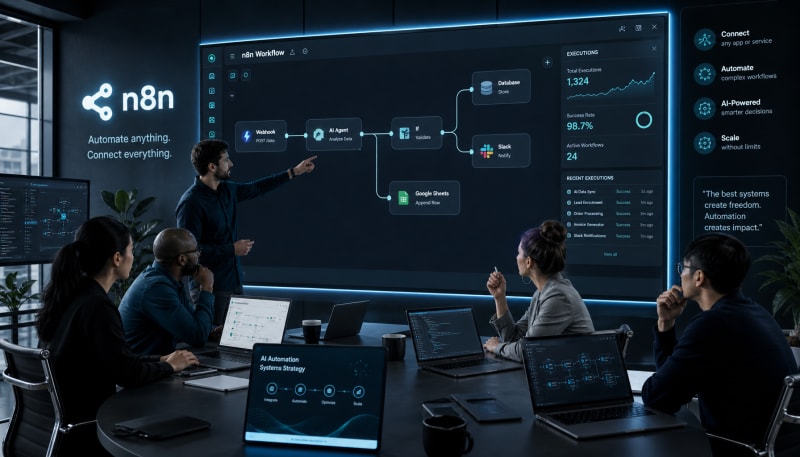
Bringing AI behind the firewall: Why self-hosted orchestration is replacing cloud-dependent black boxes for critical workflows.
The promise of AI automation has always been greater than its practical implementation. Organizations invest in sophisticated language models, computer vision systems, and machine learning platforms, only to discover that connecting these capabilities into reliable, maintainable workflows requires substantial engineering effort. The gap between individual AI capabilities and operational systems that deliver consistent business value remains one of the most significant barriers to AI adoption.
N8n, an open-source workflow automation platform, has emerged as a notable force in addressing this challenge. Unlike traditional integration platforms designed primarily for connecting cloud services, n8n was built with a fundamentally different architecture—one that treats AI models, data sources, and business logic as composable elements within unified workflows. This design philosophy is reshaping how organizations approach AI automation, particularly those seeking alternatives to proprietary platforms or vendor-locked ecosystems.
Related: If you want the full operating system for AI workflows, prompts, ideation, and execution, Snapse OS brings the pieces together.
The Workflow Automation Gap in AI Systems
Modern AI applications rarely consist of a single model generating a single output. They involve orchestration: retrieving context from vector databases, passing data through multiple models, applying business rules, handling errors, logging decisions, and integrating outputs into existing systems. Each step introduces complexity, failure points, and maintenance overhead.
Traditional approaches to building these workflows typically fall into three categories. Custom code provides maximum flexibility but requires ongoing engineering resources and becomes difficult to modify as business requirements evolve. Enterprise integration platforms offer visual workflow builders but often lack native AI capabilities or require expensive licensing. Proprietary AI platforms provide integrated environments but lock organizations into specific vendors and limit architectural flexibility.
N8n occupies a different position. As an open-source platform with native support for hundreds of integrations—including major AI providers, databases, communication tools, and business applications—it enables teams to build sophisticated AI workflows without committing to a single vendor's ecosystem or writing everything from scratch.
Visual Orchestration for Complex AI Operations
The platform's visual workflow editor addresses one of the most persistent challenges in AI automation: making complex logic visible and modifiable by people who understand business requirements but may not be software engineers. Workflows appear as connected nodes, each representing a discrete operation—calling an AI model, transforming data, making a decision, or triggering an action.
This visual approach matters more as AI workflows become more complex. A content moderation system might involve image analysis, text classification, similarity searches against known violations, confidence scoring, and routing decisions based on multiple factors. Representing this logic as a visual graph makes the system's behavior explicit, facilitates collaboration between technical and non-technical teams, and simplifies modifications as policies evolve.
N8n's architecture supports both simple linear workflows and complex branching logic with conditional paths, loops, error handling, and parallel execution. This flexibility enables organizations to start with straightforward automations and progressively add sophistication without architectural rewrites.
Multi-Model Coordination and Vendor Flexibility
One of n8n's most significant contributions to AI automation is its model-agnostic design. The platform includes native integrations for OpenAI, Anthropic, Google's AI services, Hugging Face, and open-source models that can be called through APIs or deployed locally. This architecture reflects an important reality: organizations increasingly use multiple models for different tasks rather than relying on a single AI provider.
A customer support automation might use a specialized classification model to route inquiries, a general-purpose language model to generate responses, and a different model to assess sentiment and escalation risk. N8n workflows can coordinate these models, pass context between them, and apply business logic to their outputs—all within a unified system that remains independent of any single AI vendor.
This vendor flexibility has strategic implications. As AI capabilities evolve rapidly, organizations need the ability to swap models, compare approaches, or route different workloads to different providers based on cost, performance, or data sensitivity requirements. Workflows built in n8n maintain this optionality rather than embedding dependencies on specific platforms.
Self-Hosted Deployment and Data Control
N8n's open-source architecture enables self-hosted deployment, a capability that matters significantly for organizations handling sensitive data or operating in regulated industries. While the platform offers a cloud-hosted option, teams can run n8n entirely within their own infrastructure, ensuring that data processed through AI workflows never leaves their control.
This deployment flexibility addresses a common barrier to AI adoption: the tension between leveraging external AI services and maintaining data governance standards. Organizations can build workflows that use external AI APIs while keeping sensitive data local, or they can integrate with self-hosted open-source models entirely within private infrastructure.
The self-hosted model also provides transparency into how workflows operate. Teams can inspect logs, audit decision paths, and understand exactly what data flows where—capabilities that become increasingly important as AI systems handle more consequential decisions and face growing scrutiny from regulators, auditors, and stakeholders.
The Economics of AI Workflow Development
The economic model behind n8n represents a meaningful shift from traditional enterprise integration platforms. The core platform is open-source and free to use, with revenue generated through optional cloud hosting and enterprise features rather than per-seat licensing or usage-based pricing. This approach changes the cost structure of AI automation in ways that matter for organizations experimenting with AI or scaling deployments.
Teams can build and test workflows without upfront licensing costs, deploy them across as many processes as they need without incremental fees, and scale infrastructure based on actual computational requirements rather than artificial licensing constraints. For organizations building dozens or hundreds of AI automations, this model can substantially reduce the total cost of AI adoption compared to proprietary alternatives.
The open-source nature also creates a different innovation dynamic. A global community contributes integrations, templates, and improvements, accelerating the platform's evolution and ensuring that support for new AI services appears quickly. Organizations benefit from collective development rather than depending entirely on a single vendor's roadmap.
Emerging Challenges in Automated AI Workflows
As n8n and similar platforms make AI automation more accessible, they also surface challenges that organizations must address regardless of the tools they use. Automated AI workflows introduce new operational considerations that differ meaningfully from traditional software systems.
AI models produce variable outputs, even with identical inputs. This non-determinism complicates traditional quality assurance approaches. Workflows that perform reliably during testing may behave differently in production as they encounter edge cases, evolving data patterns, or subtle prompt variations. Organizations need mechanisms to monitor AI workflow behavior continuously, detect drift or degradation, and understand when outputs deviate from expected patterns.
The composability that makes n8n powerful also creates complexity. A workflow that chains multiple AI models, each with its own failure modes and output variations, can produce unexpected results that are difficult to debug. Understanding why a particular workflow produced a specific output requires tracing through multiple steps, each involving opaque model decisions.
Logging and observability become critical—not just for debugging but for governance, compliance, and continuous improvement. Organizations need visibility into which models were called, what prompts were used, how data was transformed between steps, and what business rules influenced final outputs. Without this visibility, AI workflows become black boxes that are difficult to audit, optimize, or trust with consequential decisions.
The Trust Infrastructure Gap
These operational challenges point to a broader gap in how organizations approach AI automation. Building workflows is increasingly straightforward—platforms like n8n handle the technical orchestration effectively. But ensuring those workflows operate reliably, transparently, and accountably over time requires capabilities that most workflow automation platforms don't provide.
Traditional monitoring tells you whether a workflow executed successfully in a technical sense. It doesn't tell you whether the AI models within that workflow are performing as intended, whether outputs are consistent with policies, whether prompts are being manipulated in unexpected ways, or whether the workflow's decisions can be explained to auditors or customers.
As AI automation moves from experimental projects to production systems handling customer interactions, content decisions, and business processes, these trust and verification capabilities become operational requirements rather than nice-to-have features. Organizations need to know not just that their automated workflows ran, but that they ran correctly, produced appropriate outputs, and operated within defined boundaries.
This represents an emerging category of capability that complements workflow automation platforms rather than competing with them. Just as organizations use separate observability tools to monitor applications built on cloud platforms, they will increasingly require independent trust infrastructure to verify, audit, and govern the AI workflows running on automation platforms.
Where AI Workflow Automation Is Heading
The changes n8n represents extend beyond a single platform. The broader shift is toward treating AI capabilities as composable elements that organizations can orchestrate independently rather than adopting monolithic AI platforms that bundle models, infrastructure, and workflows into proprietary ecosystems.
This architectural approach enables several important capabilities. Organizations maintain flexibility to use the best models for specific tasks rather than being constrained to a single provider's offerings. They can evolve workflows as requirements change without rewriting entire systems. They can integrate AI capabilities into existing business processes incrementally rather than requiring wholesale platform migrations.
But this flexibility comes with responsibility. When organizations build their own AI workflows rather than using fully managed AI services, they assume responsibility for ensuring those workflows operate reliably, safely, and in compliance with policies and regulations. The tools for building AI workflows have matured significantly. The tools for governing, verifying, and trusting those workflows are still catching up.
Conclusion
N8n's impact on AI automation stems from making sophisticated AI orchestration accessible without requiring organizations to commit to proprietary ecosystems or invest heavily in custom development. Its model-agnostic architecture, visual workflow design, and open-source foundation align with how organizations actually want to adopt AI—incrementally, flexibly, and with control over their data and infrastructure.
The platform exemplifies a broader maturation in AI tooling. As AI capabilities become more commoditized, competitive advantage shifts from access to models toward the ability to orchestrate them effectively within specific business contexts. Workflow automation platforms that support this orchestration will play an increasingly central role in AI adoption.
Yet the same accessibility that accelerates AI adoption also accelerates the need for robust trust infrastructure. As organizations build more AI workflows, automate more decisions, and route more customer interactions through AI systems, they will need corresponding capabilities to verify those systems operate as intended, audit their decisions, and maintain accountability as complexity grows. The workflow automation layer is maturing. The trust and verification layer that sits alongside it is still taking shape—and will become increasingly essential as AI workflows move from experiments to operational foundations.
The Practical Position
The enthusiasm around individual AI capabilities has consistently outpaced the discipline required to connect them into systems that matter. N8n represents something more significant than another automation tool—it's evidence that the workflow layer, not the model layer, is where most organizations will actually capture value from AI.
— Kevin Marsh, Editor-in-Chief
SNAPSE OS
Build Your Full AI Workflow System
Get the full Snapse OS bundle with Prompt OS, ideation systems, and freelancer workflow tools in one operating system.
Explore Snapse OSSynthetic Proof
Verified — Editorial Layer
This content has passed editorial verification for clarity, accuracy, and trust alignment.
Editor-in-Chief: Kevin Marsh
Verification Status: PASSED
Verification Status: PASSED
Comments
Post a Comment