Learn how digital provenance evolved from research into a cornerstone of AI governance and enterprise trust. A decade ago, provenance was mostly a concern for art collectors and archivists. Today, it's becoming foundational infrastructure for organizations deploying AI at scale. The shift happened quietly, then suddenly—driven not by technology alone, but by a collision of regulatory pressure, reputational risk, and the uncomfortable realization that most organizations cannot answer basic questions about their AI systems. Digital provenance—the verifiable record of an asset's origin, transformations, and custody—has evolved from a niche technical capability into a governance requirement. The reasons are straightforward: AI systems are being deployed in consequential settings, regulators are demanding accountability, and the penalties for getting it wrong are no longer theoretical. Provenance is becoming one part of a larger operational trust question: ca...
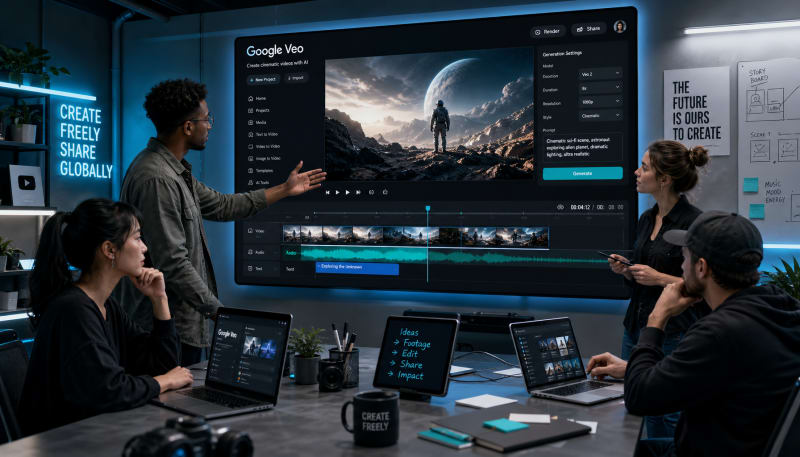
See how independent creators are leveraging Google's video generation tools to increase output.
Google Veo has emerged as a transformative tool for independent creators looking to expand their video production capabilities without the traditional overhead of equipment, crew, or extensive post-production time. As AI-generated video technology matures, freelancers across the creator economy are integrating Veo into their workflows to deliver more content, faster turnarounds, and competitive pricing to clients.
The shift represents more than just efficiency gains. Freelancers are fundamentally rethinking how they approach video projects, moving from labor-intensive production models to AI-assisted creation that maintains creative control while scaling output exponentially.
Related: If your work depends on client delivery, handoffs, and repeatable execution, The Freelancer & Contractor Hub helps structure the process.
Why Freelancers Are Turning to Veo
The appeal of Google Veo for freelance creators centers on three core advantages: speed, cost efficiency, and creative flexibility. Traditional video production requires coordination of multiple elements—location scouting, talent booking, filming, and editing. Veo collapses these stages into prompt-based generation that produces high-quality video footage in minutes rather than days.
For freelancers operating on tight margins, this changes the economic equation entirely. Projects that previously required thousands in production costs can now be executed with nothing more than a well-crafted text prompt and creative direction. This democratization of video production allows solo creators to compete with larger studios on visual quality while maintaining their independence.
Common Veo Workflows for Independent Creators
Freelancers have developed distinct workflows that maximize Veo's capabilities while addressing its current limitations. These approaches vary by project type but share common patterns that optimize for quality and efficiency.
Concept Visualization and Client Pitches
Many freelancers use Veo early in the client relationship to generate concept videos that illustrate creative direction. Instead of presenting static mood boards or written treatments, they create short video sequences that demonstrate the look, feel, and pacing of a proposed project. This approach reduces revision cycles and helps clients visualize the final product before committing to full production.
B-Roll Generation and Stock Replacement
One of the most practical applications involves generating custom B-roll footage that would otherwise require expensive stock licenses or original shooting. Freelancers prompt Veo to create specific scenes—urban landscapes, abstract transitions, product environments—tailored exactly to project needs rather than settling for generic stock footage that never quite fits.

Hybrid Production Models
Rather than replacing traditional video entirely, sophisticated freelancers blend Veo-generated content with live-action footage. They might shoot primary content with talent or products, then use Veo to create establishing shots, backgrounds, or transition elements that would be impractical or expensive to film conventionally. This hybrid approach delivers production value that appears far more resource-intensive than it actually is.
Optimizing Veo Prompts for Professional Output
The quality of Veo output depends heavily on prompt engineering—a skill freelancers are rapidly developing. Effective prompts balance specificity with creative latitude, providing enough direction to achieve the desired result while allowing the AI to leverage its capabilities.
Successful freelancers structure prompts to include camera movement, lighting conditions, mood descriptors, and specific visual elements. Rather than simply requesting "a city street," they specify "tracking shot moving through a rain-slicked urban street at dusk, neon reflections on wet pavement, cinematic color grading, shallow depth of field." This level of detail produces results that feel intentionally directed rather than randomly generated.
Iterative refinement is also critical. Freelancers rarely accept first-generation output, instead treating Veo as a collaborative tool that requires multiple passes to achieve professional quality. They generate variations, test different prompt formulations, and build libraries of effective prompt structures for recurring project types.
Addressing Client Concerns About AI-Generated Content
Transparency remains a consideration as freelancers integrate Veo into client work. While some creators initially hesitated to disclose AI usage, the trend is moving toward open communication about tools and methods, focusing on results rather than process.
Professional freelancers position Veo as a production tool equivalent to editing software or camera equipment—a means to achieve creative vision efficiently. They emphasize that AI handles execution while human creativity drives concept, direction, and final curation. This framing helps clients understand that they're still receiving professional creative services, delivered through evolved technology.
Economic Impact on the Creator Economy
Veo's availability is reshaping pricing structures and competitive dynamics within freelance markets. Creators who adopt AI video tools can underbid competitors on certain project types while maintaining or improving profit margins. This creates pressure on traditional video freelancers to adapt or risk losing ground to more technologically agile competitors.
At the same time, Veo enables freelancers to pursue projects they would have previously declined due to budget constraints. A creator can now accept smaller contracts that wouldn't justify traditional production costs, expanding their accessible market and creating opportunities for volume-based business models.
The technology also lowers barriers to entry for new freelancers. Someone with strong creative vision but limited technical video skills can produce professional output without mastering complex editing software or camera operation. This democratization is introducing fresh talent to the creator economy while challenging established professionals to demonstrate value beyond technical execution.
Limitations and Practical Considerations
Despite its capabilities, Veo has constraints that freelancers must navigate. The technology excels at certain visual styles and subject matter while struggling with others. Human faces, specific brand elements, and complex physical interactions can produce inconsistent results that require extensive iteration or prove impractical for certain applications.
Freelancers working with Veo develop intuition about which projects suit AI generation and which still require traditional approaches. They learn to recognize when a client's needs fall outside Veo's reliable output range and adjust their workflow accordingly, sometimes declining projects that would compromise quality.
Rights and licensing also require attention. Freelancers must understand the terms under which they can use Veo-generated content commercially and ensure clients receive appropriate usage rights. As the legal landscape around AI-generated content evolves, staying informed about licensing implications becomes part of professional due diligence.
Conclusion
Google Veo represents a fundamental shift in how freelance creators approach video production. By dramatically reducing the time, cost, and technical barriers associated with creating professional video content, it enables independent creators to scale their operations and compete in markets previously accessible only to larger production companies.
The freelancers finding greatest success with Veo treat it as a powerful tool within a broader creative skillset rather than a complete replacement for traditional production methods. They invest time in mastering prompt engineering, develop hybrid workflows that combine AI and conventional techniques, and maintain focus on creative direction as their core value proposition.
As AI video technology continues advancing, the competitive advantage will increasingly belong to creators who can effectively direct these tools toward compelling creative outcomes. For freelancers in the creator economy, Veo offers an opportunity to expand capabilities, improve efficiency, and access new markets—provided they approach it strategically and integrate it thoughtfully into their existing creative practice.
SNAPSE
Run Client Work More Smoothly
Use structured systems for delivery, handoff, and repeatable execution.
Explore Freelancer & Contractor HubSynthetic Proof
Verified — Editorial Layer
This content has passed editorial verification for clarity, accuracy, and trust alignment.
Editor-in-Chief: Kevin Marsh
Verification Status: PASSED
Verification Status: PASSED
Comments
Post a Comment