Learn why organizations are investing in verification instead of detection alone. For years, the fight against synthetic media manipulation followed a familiar pattern: researchers identified deepfake artifacts, built detection models around those signatures, and deployed them across platforms. Detection accuracy improved. Conferences celebrated breakthroughs. The industry felt like it was winning. Then generative AI became exponentially better at eliminating the very artifacts those systems were trained to find. As synthetic media improves, confidence increasingly comes from layered evidence rather than a binary label. Synthetic Proof helps organizations evaluate that evidence in context. What's emerging isn't simply a technical gap that better detection can close. It's a fundamental shift in how organizations must approach digital trust. The old model—detect manipulated content after it's created—assumes defenders can keep pace with attackers....
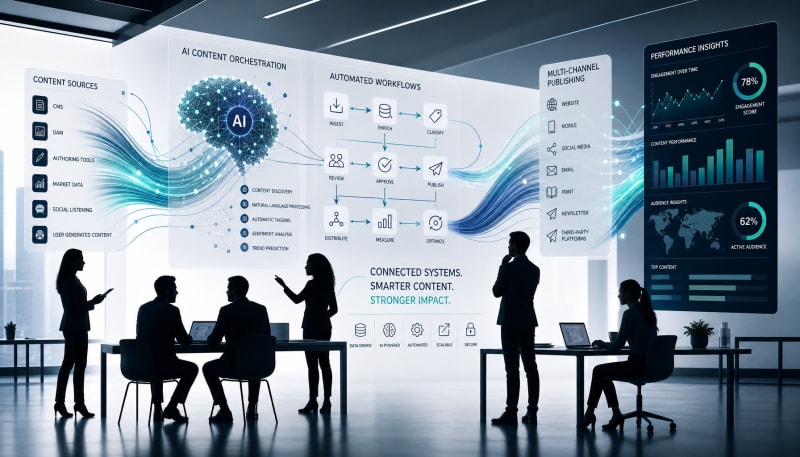
Learn how modern teams are orchestrating content creation, knowledge management, and distribution through AI.
Modern content operations have become impossibly complex. Marketing teams juggle dozens of tools—content management systems, DAMs, analytics platforms, AI writing assistants, and workflow software—each operating in its own silo. The result is friction at every step: duplicated work, inconsistent messaging, and content that takes weeks to reach audiences who expect updates in hours.
Content orchestration solves this problem by creating intelligent connections between the systems that create, manage, and distribute content. Rather than forcing teams to manually bridge gaps between platforms, orchestration layers automate workflows, synchronize knowledge across systems, and let AI operate on unified data instead of fragmented inputs.
Related: If you want the full operating system for AI workflows, prompts, ideation, and execution, Snapse OS brings the pieces together.
What Content Orchestration Actually Means
Content orchestration is the systematic coordination of content processes across multiple platforms and tools. It differs from simple automation because it maintains context and decision-making logic throughout the content lifecycle, not just at individual task levels.
Where basic automation might schedule a social post or trigger an email, orchestration manages the entire flow: pulling approved assets from a DAM, routing drafts through the right approval chains based on content type, updating metadata across systems when changes occur, and triggering distribution through appropriate channels based on audience and timing rules.
The orchestration layer sits between your existing tools, translating data formats, maintaining workflow state, and applying business logic that would otherwise require manual intervention at every handoff point.
The Three Pillars of Modern Content Orchestration
AI Integration as a First-Class Citizen
Effective orchestration treats AI as a production partner, not an afterthought. This means building workflows where AI systems can access the same knowledge repositories, style guides, and brand assets that human team members use. When an AI writing tool generates content, the orchestration layer ensures it references current product information, applies the latest brand voice guidelines, and adheres to compliance requirements—all automatically.
The system also routes AI-generated content through appropriate review processes, flagging outputs that deviate from established patterns or require legal review based on content analysis, not arbitrary rules.

Knowledge Systems as the Single Source of Truth
Content orchestration fails without centralized knowledge management. This doesn't mean forcing everything into one database, but rather creating a unified knowledge graph that connects information across systems. When product specifications update in your PIM, that change should propagate to content repositories, update relevant drafts in progress, and flag published pieces that need revision.
Modern orchestration platforms use knowledge graphs and semantic linking to maintain these connections, ensuring that a change in one system triggers appropriate updates elsewhere without manual tracking.
Publishing Systems as Endpoints, Not Starting Points
Traditional publishing workflows start with the CMS and work backward. Orchestration inverts this model. The CMS becomes one of many potential publishing endpoints, selected based on content type, audience, and distribution strategy rather than organizational habit.
A single orchestrated workflow might simultaneously publish to your website, update your mobile app content, generate PDF documentation, and create social media variants—all from the same source content, each formatted appropriately for its destination without duplicate effort.
How Workflow Orchestration Handles Real Complexity
The value of orchestration becomes clear when dealing with content scenarios that span multiple systems and decision points. Consider a product launch: specifications live in your PIM, legal requirements in a compliance database, visual assets in your DAM, customer data in your CRM, and publication schedules in your marketing calendar.
Without orchestration, coordinating these inputs requires dozens of manual touchpoints. Someone extracts data from each system, assembles content in a document, routes it through reviews, makes changes in multiple places when feedback arrives, and manually updates each publishing system.
Orchestrated workflows automate these connections while preserving necessary human oversight. The system pulls current data from source systems, applies templates that ensure consistency, routes drafts based on content rules rather than ad-hoc decisions, synchronizes feedback across systems, and handles publication across channels. Humans focus on creative and strategic decisions; the orchestration layer handles coordination.
Building Orchestration Into Existing Infrastructure
Most organizations can't replace their entire content stack. Effective orchestration works with existing tools through APIs, webhooks, and integration platforms. The goal isn't tool consolidation—it's connection.
Start by mapping your current content workflows end-to-end, identifying handoff points where content moves between systems or waits for human intervention. These transitions are orchestration opportunities. Each one represents a place where the system could maintain context, apply rules, or automate coordination.
Modern integration platforms and workflow engines provide the infrastructure for orchestration without requiring custom development for every connection. They handle authentication, data transformation, error handling, and state management, letting teams focus on defining business logic rather than building plumbing.
Orchestration Enables AI That Actually Helps
AI writing tools promise productivity gains but often create new problems: outputs that don't match brand voice, content that contradicts existing materials, or AI-generated text that requires as much editing as writing from scratch.
These problems stem from disconnection. AI tools operate on limited context—maybe a prompt and a few examples—while human writers draw on comprehensive knowledge of brand, audience, existing content, and strategic goals.
Orchestration closes this gap by connecting AI systems to the same knowledge infrastructure that informs human writers. When AI generates content within an orchestrated workflow, it accesses current brand guidelines, references existing content to maintain consistency, and applies constraints based on publication destination and audience. The result is AI output that requires refinement rather than reconstruction.
The Shift from Content Management to Content Operations
Content orchestration represents a fundamental shift in how organizations think about content infrastructure. Traditional CMS-centric approaches assume content creation, management, and publication happen in one system. This worked when websites were the primary digital channel and updates happened weekly.
Current reality demands different architecture. Content appears across dozens of channels, updates constantly, and must remain consistent despite being managed by distributed teams using various tools. This requires operational infrastructure that coordinates across systems rather than trying to consolidate everything into one platform.
Organizations embracing this shift invest in orchestration capabilities—integration platforms, workflow engines, knowledge graphs, and API-first tools—rather than searching for a single system that does everything. They treat content as a supply chain that requires coordination, not a library that requires organization.
Conclusion
Content orchestration transforms disconnected tools into a coordinated production system. By connecting AI capabilities, centralized knowledge, and distributed publishing platforms through intelligent workflows, organizations can scale content operations without proportionally scaling headcount or complexity.
The shift requires rethinking content infrastructure—moving from tool consolidation to system coordination, from manual handoffs to automated workflows, and from siloed platforms to connected ecosystems. Organizations that make this transition gain speed, consistency, and the ability to leverage AI effectively rather than fighting against tool limitations.
As content volumes increase and audience expectations for personalization and timeliness grow, orchestration evolves from a nice-to-have optimization to a fundamental requirement for competitive content operations. The question isn't whether to implement orchestration, but how quickly you can connect the systems you already have into a workflow that actually works.
The Practical Solution
Map your actual content handoffs. Pick the most painful one and build a single automated bridge there, connecting just two tools with clear triggers and outputs. Don't try to orchestrate everything at once. Once that handoff works reliably, add the next connection point and let your orchestration layer grow around real workflow friction, not theoretical efficiency.
— Kevin Marsh, Editor-in-Chief
SNAPSE OS
Build Your Full AI Workflow System
Get the full Snapse OS bundle with Prompt OS, ideation systems, and freelancer workflow tools in one operating system.
Explore Snapse OSSynthetic Proof
Verified — Editorial Layer
This content has passed editorial verification for clarity, accuracy, and trust alignment.
Editor-in-Chief: Kevin Marsh
Verification Status: PASSED
Verification Status: PASSED
Comments
Post a Comment