Learn why organizations are investing in verification instead of detection alone. For years, the fight against synthetic media manipulation followed a familiar pattern: researchers identified deepfake artifacts, built detection models around those signatures, and deployed them across platforms. Detection accuracy improved. Conferences celebrated breakthroughs. The industry felt like it was winning. Then generative AI became exponentially better at eliminating the very artifacts those systems were trained to find. As synthetic media improves, confidence increasingly comes from layered evidence rather than a binary label. Synthetic Proof helps organizations evaluate that evidence in context. What's emerging isn't simply a technical gap that better detection can close. It's a fundamental shift in how organizations must approach digital trust. The old model—detect manipulated content after it's created—assumes defenders can keep pace with attackers....
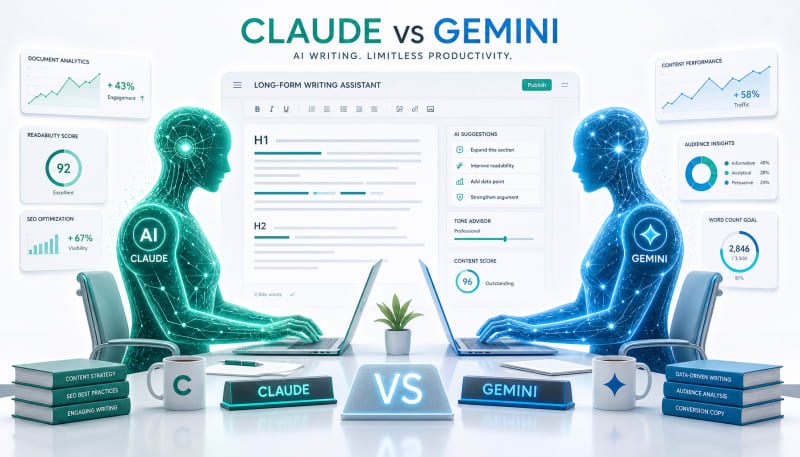
Stylistic Nuance vs. Massive Context: The actual winner when drafting deep-dive content, whitepapers, and books.
For freelancers and content creators producing long-form work, choosing the right AI assistant has become as important as selecting the right word processor. Two models dominate the conversation: Anthropic's Claude and Google's Gemini. Both have evolved beyond simple text generation into capable writing partners, but they approach long-form content differently enough that the choice matters.
The decision isn't academic. Freelancers working on articles, reports, white papers, and extended narratives need models that can maintain consistency across thousands of words, understand complex instructions, and produce output that requires minimal rewriting. The difference between a model that accelerates your work and one that creates more editing overhead can directly impact your productivity and income.
Related: If your work depends on client delivery, handoffs, and repeatable execution, The Freelancer & Contractor Hub helps structure the process.
Understanding Model Capabilities for Extended Content
Long-form writing places different demands on AI models than quick responses or code generation. Context retention matters enormously—the model needs to remember character details introduced in paragraph three when writing paragraph thirty. Stylistic consistency becomes visible over longer passages. And the ability to follow complex, multi-part instructions determines whether you're working with a collaborator or fighting with an autocomplete function.
Claude, particularly in its Claude 3 Opus and Claude 3.5 Sonnet variants, was explicitly designed with extended context windows reaching 200,000 tokens. In practical terms, this means the model can work with approximately 150,000 words of context—enough to hold an entire novel plus your instructions. Gemini 1.5 Pro counters with an even larger context window of up to 1 million tokens, though the effective utility of such enormous windows for typical freelance work remains an open question.
Context window size matters less than context utilization. A model with a massive context window that loses track of earlier details provides little advantage over a smaller, more coherent system. Real-world testing reveals that both Claude and Gemini handle typical article-length content (2,000-5,000 words) with solid consistency, but their approaches differ in ways that affect workflow.
Writing Style and Voice Control
Claude tends toward more formal, structured prose by default. It excels at maintaining a consistent editorial voice and produces text that often requires less aggressive editing for tone. Freelancers who work in professional publications, business writing, or technical content frequently find Claude's default output closer to their target style.
The model responds well to detailed style instructions. If you specify "write in a conversational but authoritative tone, avoiding corporate jargon while maintaining credibility," Claude generally interprets and maintains that direction across multiple paragraphs. This consistency reduces the editing burden that comes from tonal drift—when paragraph eight sounds nothing like paragraph two.

Gemini's writing style skews more conversational and accessible by default, which works well for consumer-facing content, blog posts, and explainer articles. The model sometimes produces more varied sentence structures and a slightly more dynamic rhythm, though this can cut both ways. When tonal consistency matters more than stylistic variety, Gemini occasionally requires more direction to stay on track.
For freelancers serving diverse clients, neither model's default style is inherently superior. What matters is responsiveness to style guidance and the ability to maintain that guidance over extended passages. Both models handle this reasonably well, but Claude's consistency edge becomes more apparent in pieces exceeding 3,000 words.
Handling Complex Instructions and Structure
Long-form content rarely follows a simple "write about X" instruction. Freelancers typically work with detailed briefs that specify structure, include specific points to address, reference source material, and require particular formatting. The model's ability to juggle these requirements while producing coherent prose determines its practical utility.
Claude shows particular strength when working with multi-part instructions that specify both content requirements and structural constraints. Instructions like "write a 2,500-word analysis covering these five industry trends, using this research as background, organizing the piece with an executive summary followed by individual sections for each trend, and maintaining a neutral analytical tone" generally produce output that respects all parameters without losing track halfway through.
Gemini handles complex instructions competently but occasionally prioritizes certain elements over others in ways that don't always align with the writer's hierarchy. In testing scenarios with detailed briefs, Gemini sometimes emphasizes stylistic elements at the expense of structural requirements, or addresses requested topics in different orders than specified. This isn't a failure—the output remains usable—but it increases the editorial workload.
Both models benefit from iterative refinement. Rather than attempting to generate a perfect 4,000-word piece from a single prompt, experienced users work in sections, reviewing and adjusting as they go. This workflow accommodates the reality that even the best models drift from instructions occasionally, and course correction produces better results than hoping for perfection on the first pass.
Research Integration and Factual Reliability
Freelance long-form work frequently requires integrating research, citing sources, and maintaining factual accuracy across extended arguments. Neither Claude nor Gemini has real-time internet access by default (though this varies by interface), which means both work primarily from training data supplemented by any source material you provide.
Claude demonstrates more conservative behavior around factual claims, often qualifying statements or noting uncertainty when working at the edges of its training data. This caution reduces the risk of confidently stated inaccuracies but can produce prose that feels hedged. For freelancers in fields where accuracy matters more than assertive tone—technology analysis, business reporting, scientific writing—this conservatism is generally advantageous.
Gemini occasionally produces more assertive statements, which can create stronger prose but increases the verification burden. Freelancers using either model for research-heavy work should treat AI-generated content as a draft requiring fact-checking rather than a finished product. The models serve better as writing assistants that help structure and articulate ideas than as research tools that establish facts.
When you provide source material—research papers, interview transcripts, data reports—both models can synthesize this information into long-form content. Claude generally adheres more closely to provided sources, while Gemini sometimes extrapolates more freely. Neither behavior is universally preferable; the right choice depends on whether your work requires strict source fidelity or benefits from interpretive synthesis.
Practical Productivity Considerations
Beyond writing quality, several practical factors affect freelance productivity. Speed matters when you're working against deadlines or juggling multiple projects. Interface friction—how easily you can iterate, refine, and extract usable content—compounds over hours of use.
Response speed varies by model version and current demand, but Claude generally provides slightly faster responses for equivalent prompt complexity. The difference rarely exceeds a few seconds, but when you're iterating through revisions or working on tight deadlines, these seconds accumulate. Gemini's performance has improved considerably in recent updates, narrowing this gap.
Both models integrate into multiple interfaces—native chat interfaces, API access for custom tools, and third-party writing applications. Claude's API has seen broad adoption in writing-focused tools, while Gemini benefits from integration with Google Workspace. Freelancers already embedded in Google's ecosystem may find Gemini's integration advantages offset other considerations.
Cost matters for freelancers managing tool budgets. Claude's pricing through the API varies by model tier, with Claude 3.5 Sonnet offering a strong balance of capability and cost. Gemini's pricing structure differs, and the optimal choice depends on your usage patterns. For freelancers producing moderate volumes of long-form content, either model's direct cost remains relatively small compared to the time saved, but the calculation changes at higher volumes.
Which Model for What Kind of Work
The practical answer for most freelancers isn't choosing one model exclusively but understanding which tool serves which projects better. Claude shows consistent advantages for formal business writing, technical content, analytical pieces, and any work requiring strict adherence to detailed structural requirements. Its tonal consistency and conservative factual approach align well with professional publication standards.
Gemini performs well for more conversational content, consumer-focused writing, creative pieces that benefit from varied prose rhythm, and work where integration with Google's ecosystem provides workflow advantages. Its larger context window offers theoretical benefits for extremely long documents, though most freelance work doesn't push those limits.
For freelancers building sustainable AI-assisted workflows, the more important skill is learning to write effective prompts that specify your actual requirements rather than hoping the model infers them. Both Claude and Gemini respond dramatically better to clear instructions about structure, tone, audience, and purpose than to vague requests. The quality difference between "write an article about X" and a properly specified brief often exceeds the quality difference between models.
Final Thoughts
The competition between Claude and Gemini for long-form writing reflects broader maturation in AI language models. Both systems now offer genuine utility for professional freelance work, moving beyond the experimental phase into reliable productivity tools. The choice between them depends less on categorical superiority and more on specific use cases, existing workflows, and the type of content you produce most frequently.
For freelancers producing formal, structured, professionally published content, Claude's consistency and adherence to detailed instructions provide tangible workflow advantages. Those working in more conversational formats or deeply integrated with Google's ecosystem may find Gemini better suits their needs. The most productive approach involves testing both models with your actual work, using real client briefs and realistic deadlines, to determine which tool reduces your editing time and improves final quality.
As these models continue evolving, the capability gap will likely narrow further, making workflow integration and cost efficiency increasingly important differentiators. The freelancers who benefit most won't be those who pick the "best" model, but those who develop clear processes for collaborating with AI writing tools while maintaining the editorial judgment that separates professional content from generated text.
The Practical Position
The availabilty of capable language models hasn't eliminated the choice problem—it's relocated it. Organizations that treat model selection as a one-time platform decision will find themselves constantly second-guessing. The more sustainable position recognizes that different models serve different content objectives, and the ability to move between them based on assignment requirements matters more than loyalty to a single system.
— Kevin Marsh, Editor-in-Chief
SNAPSE
Run Client Work More Smoothly
Use structured systems for delivery, handoff, and repeatable execution.
Explore Freelancer & Contractor HubSynthetic Proof
Verified — Editorial Layer
This content has passed editorial verification for clarity, accuracy, and trust alignment.
Editor-in-Chief: Kevin Marsh
Verification Status: PASSED
Verification Status: PASSED
Comments
Post a Comment