Learn why organizations are investing in verification instead of detection alone. For years, the fight against synthetic media manipulation followed a familiar pattern: researchers identified deepfake artifacts, built detection models around those signatures, and deployed them across platforms. Detection accuracy improved. Conferences celebrated breakthroughs. The industry felt like it was winning. Then generative AI became exponentially better at eliminating the very artifacts those systems were trained to find. As synthetic media improves, confidence increasingly comes from layered evidence rather than a binary label. Synthetic Proof helps organizations evaluate that evidence in context. What's emerging isn't simply a technical gap that better detection can close. It's a fundamental shift in how organizations must approach digital trust. The old model—detect manipulated content after it's created—assumes defenders can keep pace with attackers....

Why raw model capability is no longer enough—and the architecture required to back up automated decisions.
Enterprises are deploying AI at unprecedented scale. Language models draft customer communications, generate code, analyze sensitive documents, and make decisions that affect revenue, compliance, and reputation. As these systems move from pilot projects to production workflows, a new operational requirement is emerging: the ability to verify what AI systems are doing, why they're doing it, and whether their outputs meet organizational standards.
This isn't a theoretical concern. Organizations are discovering that AI systems behave unpredictably under real-world conditions. Models produce different outputs from similar prompts. Guardrails fail in edge cases. Prompt injection attacks bypass security controls. Content that passed internal review later triggers compliance violations. The gap between AI capability and AI accountability is widening, and traditional software quality practices aren't designed to close it.
Related: If your workflow touches AI verification, provenance, prompt risk, or digital media trust, Synthetic Proof helps teams assess trust gaps before they become operational risk.
AI verification is evolving from a technical afterthought into a distinct category of enterprise infrastructure—one that sits between AI platforms and business operations, creating the operational visibility and control that production AI systems require.
The Accountability Gap in Production AI
Traditional software operates with clear inputs, deterministic logic, and predictable outputs. Testing, logging, and audit trails are standard practice. AI systems break this model. They generate responses based on probabilistic reasoning, context windows that shift with every interaction, and training data that organizations don't control.
When an AI system produces an incorrect output, the cause often isn't obvious. Was it the prompt? The underlying model? A change in system temperature settings? An adversarial input that manipulated the response? Without verification infrastructure, teams lack the forensic capability to answer these questions.
This creates operational risk. Legal departments can't verify that AI-generated content complies with regulatory requirements. Security teams can't detect when models are responding to malicious prompts. Product teams can't explain why customer-facing AI behaves inconsistently. Quality assurance teams lack the instrumentation to test AI workflows with the rigor they apply to traditional software.
The result is a paradox: organizations are accelerating AI adoption while simultaneously struggling to maintain accountability over AI behavior. This tension is driving demand for verification capabilities that didn't exist in previous technology cycles.
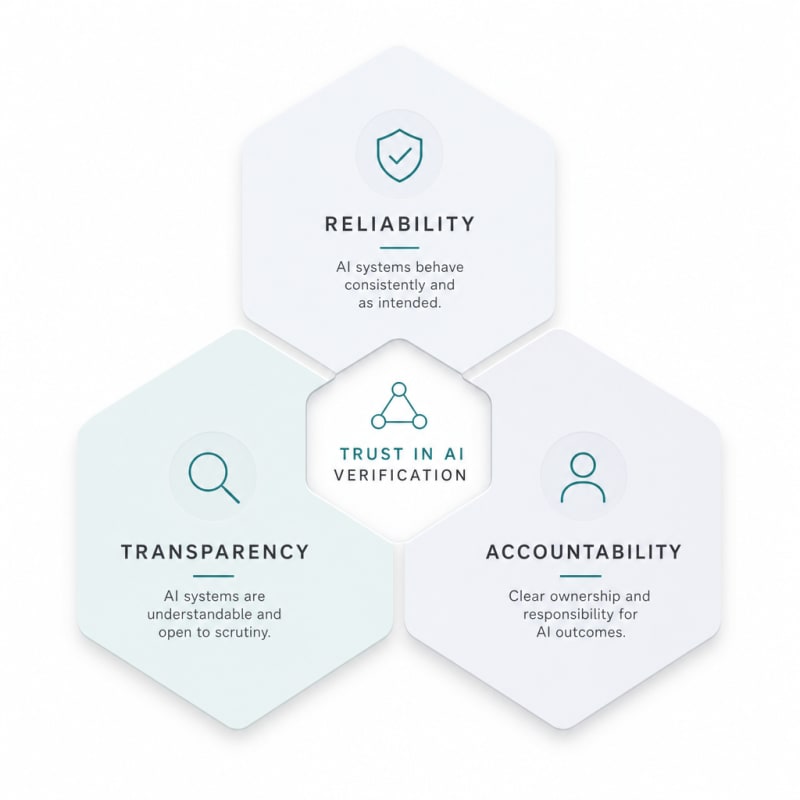
What AI Verification Actually Means
AI verification encompasses several distinct but related capabilities. It includes the ability to audit prompts before they reach models, ensuring inputs don't contain injection attacks or policy violations. It involves logging AI interactions in ways that preserve context, making it possible to reconstruct decisions after the fact. It requires monitoring model outputs for quality drift, compliance violations, or unexpected behavior patterns.
Beyond technical monitoring, verification also addresses organizational accountability. When AI generates content, who approved it? When a model's behavior changes, what triggered that change? When an output causes downstream problems, what evidence exists to support or defend the organization's decisions?
These questions matter most in regulated industries, but they're becoming relevant across sectors. Financial services firms need to verify that AI-generated investment advice meets fiduciary standards. Healthcare organizations must demonstrate that AI diagnostic tools operate within approved parameters. Legal departments require proof that contract summaries accurately reflect source documents. Marketing teams need assurance that AI-generated campaigns don't violate brand guidelines or regulatory restrictions.
Verification infrastructure provides the instrumentation, logging, and policy enforcement that makes these assurances possible. It transforms AI from an opaque decision-making system into an auditable operational process.
Why Verification Can't Be an Afterthought
Many organizations initially approach AI verification as a feature request for existing platforms. They assume model providers or enterprise software vendors will add sufficient logging, auditing, and compliance controls to their products. This assumption is proving insufficient for several reasons.
First, verification requirements vary significantly across industries, use cases, and organizational policies. A capability that satisfies regulatory requirements in one jurisdiction may be inadequate in another. Standards that work for customer service chatbots don't translate to AI systems handling protected health information or financial transactions.
Second, effective verification often requires independence from the systems being verified. When the same platform that generates AI outputs also judges their quality or compliance, conflicts of interest emerge. Organizations need verification infrastructure that operates as a distinct layer, providing objective assessment regardless of which models or platforms they use.
Third, verification demands persistence and forensic capability that general-purpose AI platforms aren't designed to provide. Proving compliance after an incident requires detailed logs, provenance chains, and audit trails that survive system updates, model changes, and infrastructure migrations. These capabilities represent infrastructure concerns, not application features.
The enterprise software market has seen similar patterns before. Security monitoring, identity management, and data governance all began as features within broader platforms before maturing into standalone infrastructure categories. AI verification is following the same trajectory.
Prompt Audits as Trust Infrastructure
One of the most immediate applications of verification infrastructure involves prompt auditing—the practice of examining inputs to AI systems before they reach models. Prompt audits serve multiple functions simultaneously.
From a security perspective, they detect prompt injection attacks, where malicious users craft inputs designed to manipulate model behavior or extract sensitive information. These attacks exploit the conversational nature of language models, embedding instructions within seemingly legitimate queries. Without prompt-level verification, organizations have limited visibility into whether their AI systems are being manipulated.
From a compliance perspective, prompt audits ensure that inputs meet organizational policies before processing begins. This matters in contexts where AI systems handle regulated data, customer information, or proprietary content. Verifying inputs prevents policy violations from entering workflows where they're harder to contain.
From a quality perspective, prompt audits identify problematic patterns before they generate problematic outputs. Teams can detect vague instructions, conflicting requirements, or inputs likely to produce unreliable responses. This improves output quality while reducing the resources spent reviewing and correcting AI-generated content.
Organizations implementing prompt audits report operational benefits beyond security and compliance. They gain visibility into how AI systems are being used across departments, which use cases generate the most problems, and where additional training or policy clarification is needed. Prompt-level verification becomes organizational intelligence, not just a control mechanism.
Building Trust Frameworks for AI Operations
As verification capabilities mature, forward-thinking organizations are assembling them into broader trust frameworks—operational systems that govern how AI is deployed, monitored, and improved over time. These frameworks address several organizational needs simultaneously.
They provide governance structures that define acceptable AI use, specifying which models can be used for which purposes, what content requires human review, and how exceptions are handled. They establish accountability by creating clear records of who approved what, when changes occurred, and what outcomes resulted. They enable continuous improvement by making AI behavior measurable, comparable, and refinable based on evidence rather than intuition.
Trust frameworks also address cross-functional coordination challenges. AI systems typically involve multiple stakeholders—product teams building features, security teams managing risk, legal departments ensuring compliance, and business units measuring outcomes. Without shared verification infrastructure, these groups operate from different information, making coordination difficult and conflicts inevitable.
When verification capabilities are centralized into trust frameworks, stakeholders work from a common operational picture. Everyone sees the same audit logs, compliance reports, and performance metrics. Disputes about whether AI systems are meeting requirements become discussions about evidence rather than opinions.
The most mature trust frameworks also incorporate provenance tracking, creating chains of evidence that connect AI outputs back to their origins. This matters when content moves through complex workflows—AI drafts that humans edit, model outputs that feed into other systems, or decisions that depend on multiple AI-generated inputs. Provenance tracking makes these workflows auditable even when they span platforms, departments, and time periods.
The Emerging TrustOps Discipline
The operational practices surrounding AI verification are coalescing into what some organizations are calling TrustOps—a discipline focused on making AI systems trustworthy, accountable, and measurably reliable in production environments.
TrustOps draws conceptual parallels with DevOps, which transformed software development by integrating development and operations into continuous workflows. Where DevOps focused on deployment velocity and system reliability, TrustOps focuses on AI accountability and behavioral integrity. It's the operational discipline of ensuring AI systems do what organizations intend, comply with relevant requirements, and provide evidence of their behavior when needed.
This discipline is still forming. Standards remain informal, practices vary widely across organizations, and many of the necessary tools are just emerging. But the operational need is clear and growing. As AI systems handle increasingly consequential decisions, the gap between deployment capability and verification capability becomes a business liability.
Organizations implementing TrustOps practices report several common benefits. They experience fewer AI-related incidents because verification catches problems before they reach production. They resolve issues faster because audit trails make root cause analysis possible. They face lower compliance risk because evidence of proper AI governance exists when auditors or regulators request it. They build AI capabilities more confidently because verification infrastructure provides organizational assurance that risks are managed.
TrustOps also changes how organizations think about AI adoption. Rather than viewing trust and verification as obstacles to deployment, mature organizations treat them as enabling capabilities. Verification infrastructure doesn't slow AI adoption—it makes faster, broader adoption possible by managing the risks that would otherwise limit deployment.
Market Evolution and Strategic Implications
The market for AI verification infrastructure is developing rapidly but unevenly. Large enterprises are building internal verification capabilities, often through combinations of custom development and point solutions. Technology vendors are adding verification features to existing platforms, though these typically address narrow use cases rather than comprehensive trust requirements. Specialized providers are emerging with products focused specifically on AI verification, governance, and trust infrastructure.
This market structure reflects an immature category. Organizations know they need verification capabilities but haven't standardized on what those capabilities should include or how they should be delivered. As the category matures, several trends are likely to shape its evolution.
First, verification infrastructure will increasingly need to operate across multiple AI platforms rather than within single ecosystems. Organizations use different models for different purposes—specialized models for domain-specific tasks, general-purpose models for broad applications, and internally developed models for proprietary use cases. Trust frameworks that only work with specific platforms create fragmentation rather than accountability.
Second, verification standards will evolve from technical specifications to operational requirements. Early verification efforts focus on what can be logged and measured. Mature verification addresses what should be logged, how long evidence must be retained, and what assurance levels different use cases require. This evolution transforms verification from an engineering problem into a governance discipline.
Third, AI verification will increasingly intersect with broader digital trust concerns. As synthetic media becomes more common, organizations need to verify not just that AI systems behave properly but also that content can be authenticated, that provenance is maintained, and that manipulated or generated media is clearly identified. Verification infrastructure that addresses AI behavior in isolation will miss these broader trust requirements.
Organizations making strategic decisions about AI verification should consider several factors. How thoroughly can they instrument AI workflows with existing tools? Do their current logging and monitoring capabilities provide sufficient evidence for compliance or incident investigation? Can they demonstrate to regulators, customers, or stakeholders that their AI systems operate within intended parameters? Are their verification approaches sustainable as AI adoption scales across the organization?
These questions increasingly determine whether AI deployments succeed or stall. Organizations with strong verification infrastructure can move faster because they've addressed the trust concerns that otherwise create deployment friction. Organizations without it face growing operational risk as AI systems proliferate beyond the oversight capacity of manual review.
Final Thoughts
AI verification is transitioning from a specialized technical capability to a fundamental requirement for enterprise AI operations. As AI systems move from experimental projects to production infrastructure, the ability to verify behavior, demonstrate compliance, and maintain accountability becomes operationally essential rather than technically optional.
This shift reflects a broader maturation in how organizations approach AI adoption. Early enthusiasm focused on capability—what AI could do. Current focus increasingly centers on accountability—how organizations ensure AI does what they intend, within acceptable boundaries, with evidence that survives scrutiny.
Independent trust infrastructure is emerging as the architectural layer that makes this accountability possible. It provides the verification, auditing, governance, and provenance capabilities that turn AI systems from unpredictable tools into manageable operational assets. Organizations that treat verification as infrastructure rather than afterthought are building AI operations that scale with confidence rather than risk.
The question facing enterprises isn't whether AI verification matters—production realities are answering that question daily. The question is how quickly organizations recognize verification as infrastructure and invest accordingly. The gap between AI capability and AI accountability is widening. Verification infrastructure is how that gap gets closed.
The Practical Position
The distinction between deploying AI and governing it reliably is where most enterprise strategies currently falter. Verification isn't emerging because organizations suddenly care more about compliance—it's surfacing because AI's probabilistic nature makes traditional quality controls obsolete. The organizations building verification capabilities now aren't reacting to regulation; they're recognizing that operational trust determines whether AI systems scale or stall. This shift separates enterprises that treat AI as experimental from those engineering...
— Kevin Marsh, Editor-in-Chief
SYNTHETIC PROOF
Independent AI Trust Infrastructure
Close Your AI Trust Gap
Independent Prompt Audits and Verification Audits with detailed findings, risk analysis, and a trust score delivered within 72 hours.
View Audit OptionsSynthetic Proof
Verified — Editorial Layer
This content has passed editorial verification for clarity, accuracy, and trust alignment.
Editor-in-Chief: Kevin Marsh
Verification Status: PASSED
Verification Status: PASSED
Comments
Post a Comment