Learn why organizations are investing in verification instead of detection alone. For years, the fight against synthetic media manipulation followed a familiar pattern: researchers identified deepfake artifacts, built detection models around those signatures, and deployed them across platforms. Detection accuracy improved. Conferences celebrated breakthroughs. The industry felt like it was winning. Then generative AI became exponentially better at eliminating the very artifacts those systems were trained to find. As synthetic media improves, confidence increasingly comes from layered evidence rather than a binary label. Synthetic Proof helps organizations evaluate that evidence in context. What's emerging isn't simply a technical gap that better detection can close. It's a fundamental shift in how organizations must approach digital trust. The old model—detect manipulated content after it's created—assumes defenders can keep pace with attackers....
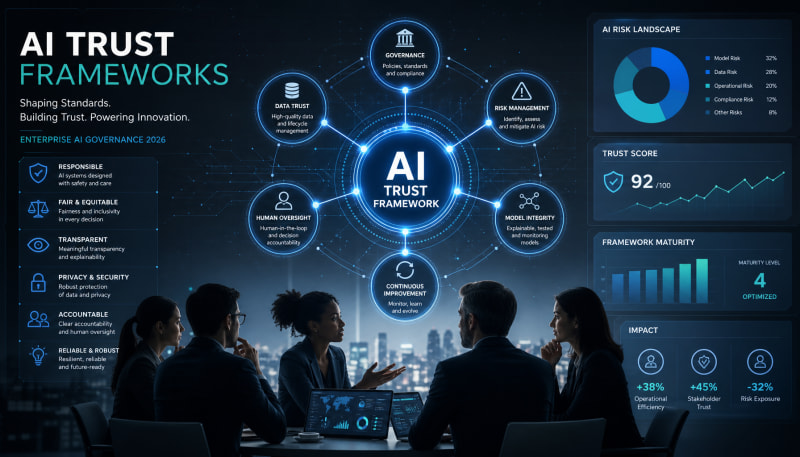
Explore the governance frameworks organizations are adopting to build confidence in AI systems.
Enterprise AI procurement conversations have changed. Three years ago, discussions centered on capabilities—what models could do, how fast they could process information, which tasks they could automate. Today, the first questions are increasingly about trust: How do we verify model behavior? How do we demonstrate compliance? How do we maintain audit trails when AI systems make consequential decisions?
This shift isn't philosophical. It reflects a practical reality: organizations deploying AI at scale need structured approaches to trust that work across vendors, jurisdictions, and use cases. They need frameworks that translate abstract principles like "fairness" and "transparency" into operational practices their teams can actually implement.
The move from AI policy to operational trust requires independent evidence. Synthetic Proof helps organizations understand where their current trust posture stands.
The industry's response has been a proliferation of AI trust frameworks—structured approaches that define what responsible AI means and how organizations should achieve it. But 2026 marks an inflection point. Early frameworks are maturing into industry standards, regulatory requirements are forcing harmonization, and enterprises are discovering which approaches actually work under operational pressure.
Frameworks Are Converging on Core Trust Dimensions
The first generation of AI trust frameworks often felt like competing philosophies. Some emphasized algorithmic fairness. Others focused on explainability or safety. Organizations faced a bewildering array of approaches, each with its own terminology and priorities.
What's emerging now is practical convergence. Despite different origins and emphases, most enterprise-ready frameworks now organize around similar trust dimensions: robustness, fairness, transparency, accountability, and safety. The terminology varies, but the underlying structure is stabilizing.
This convergence isn't accidental. It reflects hard lessons from organizations that tried to operationalize trust at scale. Abstract principles need concrete measures. Compliance requirements need documentation trails. Audit processes need standardized evidence. Frameworks that couldn't translate into repeatable operational practices simply didn't survive contact with enterprise reality.
The NIST AI Risk Management Framework exemplifies this practical orientation. Rather than prescribing specific technical controls, it provides a flexible structure for identifying, assessing, and managing AI risks throughout the system lifecycle. Organizations can map their existing practices to the framework while gradually maturing their capabilities.
ISO/IEC 42001, published in late 2023 and gaining significant traction through 2025, takes a different but complementary approach. As a management system standard, it focuses on organizational governance—defining how enterprises should establish, implement, maintain, and continuously improve AI management systems. Where NIST emphasizes risk management methodology, ISO 42001 emphasizes organizational accountability and continuous improvement.
Regulatory Requirements Are Accelerating Framework Adoption
For years, AI trust frameworks existed primarily as voluntary guidance—aspirational documents that organizations could adopt if motivated by ethics, brand protection, or customer demands. That era is ending.
The EU AI Act, now fully in force with enforcement mechanisms active, requires organizations deploying high-risk AI systems to demonstrate compliance with specific requirements. These aren't suggestions. They're legal obligations backed by substantial penalties. Organizations need documented risk management systems, technical documentation, human oversight procedures, and audit trails proving continuous compliance.
Similar regulatory dynamics are unfolding globally, though with different timelines and emphases. What matters isn't any single regulation but the cumulative effect: frameworks are moving from optional best practices to competitive necessities. Organizations that treated trust frameworks as corporate social responsibility exercises are discovering they're actually operational infrastructure.
This regulatory pressure is also forcing framework harmonization. Multinational enterprises can't maintain completely separate compliance regimes for every jurisdiction. They need frameworks flexible enough to accommodate regional variations while maintaining core consistency. The organizations building these frameworks are increasingly collaborating rather than competing, recognizing that interoperability serves everyone's interests.
Verification Is Becoming the Operational Layer
Here's where theory meets operational reality: frameworks define what trust means, but organizations need ways to prove they're actually achieving it.
A framework might require "continuous monitoring of model performance" or "documentation of training data provenance." But how do you demonstrate that monitoring actually happened? How do you prove documentation is accurate and hasn't been altered? How do you provide auditors with verifiable evidence rather than self-reported attestations?
This verification gap is driving significant infrastructure investment. Organizations are discovering that implementing framework requirements isn't just about policies and procedures—it requires technical capabilities for capturing, securing, and presenting evidence of AI system behavior.
The concept of TrustOps is emerging specifically to address this operational challenge. While still maturing as a discipline, TrustOps focuses on making trust frameworks actionable through repeatable processes, automated evidence collection, and verifiable documentation. It's where governance requirements meet operational implementation.
Some organizations are building internal verification capabilities. Others are recognizing that trust infrastructure—like security infrastructure before it—may need to be independent from the systems it verifies. The same arguments that drove third-party security audits are increasingly applied to AI trust: can an organization credibly verify its own systems, or does meaningful trust require external validation?
Industry-Specific Frameworks Are Adding Practical Context
While horizontal frameworks like NIST and ISO 42001 provide valuable structure, industries are discovering they need sector-specific guidance that accounts for their unique risk profiles and regulatory environments.
Healthcare AI faces fundamentally different trust challenges than financial services AI or autonomous vehicle systems. A framework designed for one context often creates gaps or irrelevant requirements when applied to another. The result has been a second layer of frameworks—industry-specific guides that translate general principles into sector-appropriate practices.
Financial services organizations, for example, are developing AI trust approaches that integrate with existing model risk management frameworks. They're not starting from scratch; they're extending established practices to accommodate AI-specific challenges like training data bias and behavioral drift.
Healthcare organizations are building trust frameworks around patient safety and clinical validity requirements. Their frameworks emphasize different evidence standards, different approval processes, and different accountability structures than frameworks designed for advertising optimization or supply chain automation.
This specialization is healthy. It reflects growing maturity—recognition that "AI trust" isn't a single uniform challenge but a set of related problems that manifest differently across contexts. The risk is fragmentation. If every industry develops completely incompatible approaches, the interoperability benefits of standardization disappear. The frameworks gaining traction are those that specialize without diverging entirely from common foundations.
Implementation Maturity Varies Dramatically
Framework adoption and framework implementation are very different things.
Many organizations have formally adopted AI trust frameworks—board-approved policies, published commitments, framework mapping documents. Far fewer have actually operationalized these frameworks into repeatable, verifiable practices that function under production conditions.
The gap between adoption and implementation is where most organizations currently struggle. Frameworks describe what should happen. Implementation requires determining how it actually happens: which teams are responsible, what tools they need, how evidence is collected and preserved, how compliance is demonstrated to auditors who won't accept PowerPoint presentations as proof.
Early implementers are learning that trust frameworks create substantial operational overhead if implemented naively. Manual documentation processes don't scale. Disconnected tools create compliance gaps. Evidence scattered across systems is effectively useless during audits. Organizations serious about implementation are increasingly treating trust infrastructure as a first-class engineering concern, not an administrative task.
This implementation challenge is creating market opportunities. Technology vendors are building platforms specifically designed to operationalize framework requirements. Service providers are offering trust implementation consulting. Industry groups are developing shared tooling and reference architectures. The ecosystem around frameworks is maturing alongside the frameworks themselves.
The Next Evolution Is Already Visible
Frameworks aren't static. They're evolving in response to technological change, regulatory developments, and implementation experience. Several shifts are already becoming apparent.
First, frameworks are becoming more specific about evidence requirements. Early versions often described desired outcomes—"systems should be fair"—without defining what evidence would demonstrate fairness. Newer versions increasingly specify what documentation, testing, and monitoring are actually required. This specificity makes implementation clearer but also more demanding.
Second, frameworks are increasingly addressing AI system interactions rather than treating each system in isolation. Real-world AI deployments rarely involve single models. They involve chains of models, human-AI collaborations, and complex workflows where trust properties can degrade at integration points. Frameworks are beginning to account for this systemic complexity.
Third, continuous compliance is replacing point-in-time assessments. Traditional compliance operated on audit cycles—organizations demonstrated compliance periodically, then went back to normal operations. AI systems that learn, drift, and change continuously can't be verified once and forgotten. Frameworks are incorporating expectations for ongoing monitoring and real-time trust signals.
Finally, frameworks are beginning to address AI-generated content provenance and authenticity. As AI systems produce more of the content flowing through enterprise systems, organizations need ways to track what was AI-generated, verify it hasn't been manipulated, and maintain chain of custody. This represents an expansion of traditional trust frameworks into content verification territory.
Final Thoughts
Together, these frameworks illustrate an important shift. Organizations are moving away from principles-first governance toward operational governance that can survive audits, procurement reviews, and regulatory scrutiny. Alot of early AI adopters that viewed them as distant concerns are discovering they're immediate competitive factors—determining which deals they can close, which markets they can enter, and which regulatory requirements they can meet.
The frameworks themselves are maturing. The excessive proliferation of incompatible approaches is giving way to practical convergence around core dimensions and common terminology. Industry-specific variations are adding necessary context without completely fragmenting the landscape.
The question for enterprise leaders isn't whether to adopt trust frameworks. That decision is increasingly being made by regulators, customers, and market dynamics. The question is how deeply to invest in the verification infrastructure that makes frameworks operationally meaningful.
The Practical Position
Trust frameworks succeed when they reduce the operational friction of demonstrating AI accountability, not when they add another certification layer. The enterprises gaining advantage aren't chasing framework compliance—they're embedding verification, documentation, and governance into how AI systems are built and deployed. In markets where trust is regulated, it becomes infrastructure, not aspiration.
— Kevin Marsh, Editor-in-Chief
SYNTHETIC PROOF
TURN TRUST INTO AN OPERATIONAL CAPABILITY
Evaluate Where Trust Breaks Down
Synthetic Proof helps teams identify trust gaps across prompts, digital media, verification practices, and emerging AI workflows.
Assess Your Trust ReadinessSynthetic Proof
Verified — Editorial Layer
This content has passed editorial verification for clarity, accuracy, and trust alignment.
Editor-in-Chief: Kevin Marsh
Verification Status: PASSED
Verification Status: PASSED
Comments
Post a Comment