Workflow optimization piece for digital asset management (DAM) administrators and media archivists. Digital assets rarely stay still. They're edited, reformatted, republished, reassembled into new compositions, distributed across platforms, and eventually archived. At each stage, something changes—sometimes intentionally, sometimes not. The question isn't whether assets evolve. It's whether organizations can prove how they evolved. Most digital asset management systems track where files live and who touched them last. Far fewer can demonstrate an unbroken chain of custody from creation through archive. That gap is becoming a problem—not just for media companies worried about authenticity, but for regulated industries, enterprises managing AI training data, and anyone who might need to defend the integrity of their digital records in court or audit. Provenance is becoming one part of a larger operational trust question: can an organization verify its...
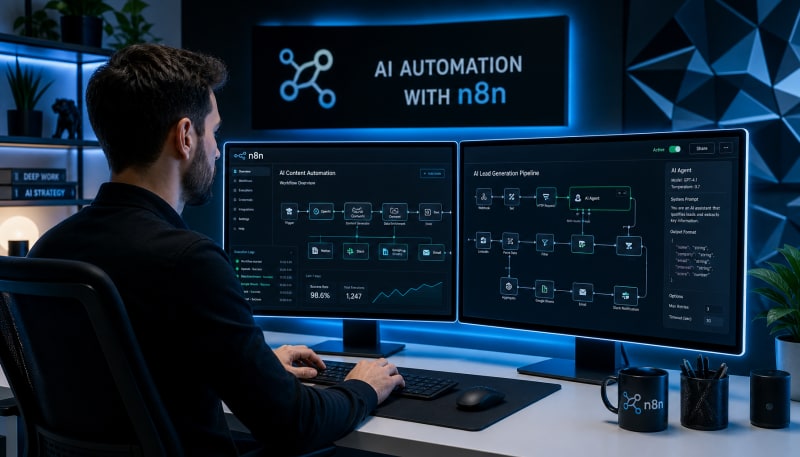
Beyond Zapier: How node-based orchestration blends the speed of no-code with full-code control over LLMs, data, and APIs.
AI automation has moved from experimental to essential, but the tools to implement it haven't kept pace with demand. Most platforms lock teams into proprietary systems, charge per operation, or require specialized development resources. N8n is shifting this landscape by offering an open-source workflow automation platform that treats AI integration as a first-class feature rather than an afterthought.
The platform's approach to AI automation differs fundamentally from traditional integration tools. Instead of forcing teams to choose between flexibility and ease of use, n8n provides a visual workflow builder that connects directly to AI models, APIs, and data sources without requiring extensive custom code. This architecture is reshaping how organizations design, deploy, and scale their AI-powered systems.
Related: If you want the full operating system for AI workflows, prompts, ideation, and execution, Snapse OS brings the pieces together.
The Architecture That Enables AI-First Workflows
N8n's node-based system treats each component of a workflow as a discrete, reusable unit. AI models from OpenAI, Anthropic, Hugging Face, and custom endpoints integrate as native nodes alongside traditional business tools. This structure allows teams to build complex decision trees where AI processing happens alongside data transformation, routing logic, and external API calls.
The platform runs on your infrastructure, whether that's a local server, private cloud, or container orchestration system. This self-hosted model addresses a critical gap in AI automation: data sovereignty. Sensitive information never leaves your environment, making n8n viable for regulated industries and privacy-conscious organizations that can't route proprietary data through third-party services.
Real-Time Execution Control
Unlike batch-processing systems, n8n executes workflows in real time with full visibility into each step. When an AI model produces an unexpected output or a workflow fails, teams can inspect the exact data that passed through each node. This transparency is essential for AI workflows where debugging often requires understanding not just what failed, but what inputs triggered the failure.
Integration Density Changes System Design
N8n ships with over 400 pre-built integrations covering databases, cloud services, communication platforms, and AI providers. This density fundamentally changes how teams approach system architecture. Instead of building custom middleware to connect disparate tools, organizations can route data between systems using visual workflows.
Consider a common AI workflow: customer support ticket classification. Traditional implementations require custom code to pull tickets from a support system, format them for an AI model, process the classification response, update the ticketing system, and notify relevant teams. In n8n, this becomes a sequence of connected nodes with conditional logic built visually. Teams can test, modify, and deploy changes without touching application code.
API-First Flexibility
When pre-built nodes don't cover a specific integration, n8n's HTTP request node and custom code capabilities fill the gap. Teams can call any REST API, process responses with JavaScript or Python, and pass results to subsequent nodes. This hybrid approach balances visual development with the flexibility to handle edge cases that every production system eventually encounters.
Cost Structure That Scales Differently
Most automation platforms charge per workflow execution, per active workflow, or per user. These pricing models become prohibitive when running AI workflows that might execute thousands of times daily. N8n's self-hosted nature eliminates per-execution fees, shifting costs to infrastructure you control.
This economic model favors AI-heavy workloads. A document processing pipeline that analyzes hundreds of files daily costs the same whether it processes 100 documents or 10,000—you pay only for the compute resources and AI API calls. Teams can experiment with AI automation without worrying that successful adoption will trigger exponential platform fees.
Version Control and Deployment Practices
N8n stores workflows as JSON, making them compatible with standard version control systems. Teams can commit workflow changes to Git, review modifications through pull requests, and deploy to production using CI/CD pipelines. This integration with existing development practices is rare in low-code platforms but critical for organizations running AI automation at scale.
The ability to version workflows also enables proper testing environments. Teams can maintain development, staging, and production instances of their AI automation infrastructure, deploying and validating changes before they affect live systems. This separation is essential when workflows handle critical business processes or customer-facing interactions.
Community-Driven Extension Model
As an open-source platform, n8n benefits from community contributions that extend its capabilities beyond what any single vendor could provide. Custom nodes for specialized AI models, industry-specific integrations, and workflow templates circulate through the community, reducing the time required to implement common patterns.
This ecosystem effect accelerates AI adoption. When a team needs to integrate a new AI service, there's a reasonable chance someone has already built and shared the connector. Organizations can contribute their own nodes back to the community or keep them private, depending on competitive considerations.
Where N8n Fits in the AI Stack
N8n operates as orchestration middleware, sitting between data sources, AI models, and business applications. It doesn't replace dedicated AI platforms, vector databases, or MLOps tools. Instead, it coordinates how these components interact, handling the routing, transformation, and business logic that connects raw AI capabilities to actual business value.
This positioning makes n8n complementary to existing AI investments. Teams already using managed AI services can add n8n as the integration layer without rearchitecting their AI infrastructure. The platform excels at solving the "last mile" problem in AI automation—getting model outputs into the right systems with appropriate context and formatting.
Conclusion
N8n is changing AI automation workflows by removing the forced choice between control and convenience. Its open-source architecture, self-hosted deployment model, and visual workflow builder address the practical challenges teams face when implementing AI at scale. The platform makes it possible to build sophisticated AI automation without custom application development while maintaining the flexibility to handle complex edge cases.
The shift toward AI-first automation isn't about replacing human decision-making—it's about eliminating repetitive cognitive work that doesn't require human judgment. N8n provides the infrastructure to implement this vision without vendor lock-in, usage-based pricing that penalizes success, or compromising on data privacy. For organizations serious about scaling AI automation, understanding how n8n fits into a broader systems strategy is becoming increasingly relevant.
The Practical Solution
Start by mapping one repetitive process where AI could make decisions—customer routing, document classification, or data enrichment. Install n8n on your own infrastructure, connect it to your existing AI provider, and build the workflow visually instead of writing custom integration code. The goal isn't replacing your entire stack; it's proving you can automate AI-dependent tasks without vendor lock-in or per-execution fees eating your budget as you scale.
— Kevin Marsh, Editor-in-Chief
SNAPSE OS
Build Your Full AI Workflow System
Get the full Snapse OS bundle with Prompt OS, ideation systems, and freelancer workflow tools in one operating system.
Explore Snapse OSSynthetic Proof
Verified — Editorial Layer
This content has passed editorial verification for clarity, accuracy, and trust alignment.
Editor-in-Chief: Kevin Marsh
Verification Status: PASSED
Verification Status: PASSED
Comments
Post a Comment