Learn why organizations are investing in verification instead of detection alone. For years, the fight against synthetic media manipulation followed a familiar pattern: researchers identified deepfake artifacts, built detection models around those signatures, and deployed them across platforms. Detection accuracy improved. Conferences celebrated breakthroughs. The industry felt like it was winning. Then generative AI became exponentially better at eliminating the very artifacts those systems were trained to find. As synthetic media improves, confidence increasingly comes from layered evidence rather than a binary label. Synthetic Proof helps organizations evaluate that evidence in context. What's emerging isn't simply a technical gap that better detection can close. It's a fundamental shift in how organizations must approach digital trust. The old model—detect manipulated content after it's created—assumes defenders can keep pace with attackers....
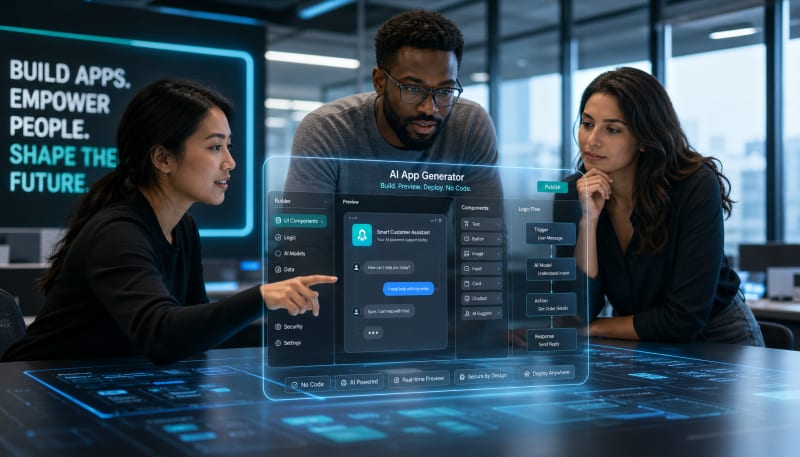
Discover why AI-powered no-code platforms are reshaping software development and startup execution.
The software development space is experiencing a fundamental shift. What once required years of programming expertise and significant capital investment can now be accomplished in hours by people with no technical background. No code ai app generators are at the forefront of this revolution, enabling anyone with an idea to build functional AI-powered applications without writing a single line of code.
This isn't just a minor convenience for hobbyists. The rise of ai no code tools represents a complete reimagining of who gets to participate in the technology economy and how quickly innovations can move from concept to market.
Related: For more practical AI workflows, tools, and systems, join the NextLayer newsletter.
Breaking Down the Barriers to Entry
Traditional software development has always been gatekept by technical complexity. Learning to code takes months or years, and building AI applications requires additional specialized knowledge in machine learning, data science, and complex frameworks. This created a significant barrier that kept countless entrepreneurs and innovators on the sidelines.
No code ai app generators eliminate these obstacles entirely. Visual interfaces replace syntax. Drag-and-drop functionality replaces architectural decisions. Pre-built AI models replace the need for data science expertise. The result is that a marketing professional, small business owner, or domain expert can now build sophisticated applications that leverage cutting-edge AI capabilities.
This accessibility extends beyond individual skill sets. The financial barrier has also dropped dramatically. Hiring a development team to build a custom AI application can cost tens or hundreds of thousands of dollars. No-code platforms operate on subscription models that cost a fraction of that amount, making AI development feasible for bootstrapped startups and individual entrepreneurs.
Speed as a Competitive Advantage
In today's market, speed to deployment can make or break a business. Traditional development cycles measure timelines in months or quarters. No code ai app generators compress this timeline to days or even hours.
This acceleration isn't just about building faster. It fundamentally changes how businesses can experiment and iterate. Instead of committing significant resources to a single vision, companies can rapidly prototype multiple versions, test them with real users, and pivot based on actual market feedback.
Rapid Prototyping and Validation
The ability to quickly validate ideas before investing heavily has become crucial for startups. With ai no code tools, founders can build a functional prototype in a weekend, show it to potential customers, and gather feedback that would have previously required months of development work and significant capital burn.
This speed advantage also applies to established companies looking to innovate. Internal teams can experiment with AI-powered solutions to business problems without going through lengthy approval processes or competing for limited developer resources.
Leveling the Playing Field for Startups
Startups have always faced an uphill battle against established companies with deeper pockets and larger teams. No code ai app generators have shifted this dynamic in meaningful ways.
A solo founder or small team can now build and launch AI-powered products that would have required a full engineering team just a few years ago. This means startups can compete on the quality of their ideas and their understanding of customer needs rather than their ability to raise venture capital for development costs.
The impact extends to geographic and demographic diversity in entrepreneurship. Talented individuals in regions without strong technical talent pools or access to venture capital can now build and launch AI applications from anywhere. This democratization is creating a more diverse and competitive startup ecosystem.
The Democratization of Software Development
The broader trend here is the democratization of software creation itself. Just as website builders democratized web presence and social media platforms democratized content creation, no code ai app generators are democratizing application development.
This shift empowers domain experts to solve problems in their own fields without waiting for technical teams to understand the nuances of their industry. A healthcare professional can build AI tools for patient management. An educator can create personalized learning applications. A logistics manager can develop optimization tools specific to their operations.
From Consumers to Creators
This transformation turns passive technology consumers into active creators. People who previously could only use existing software can now build custom solutions tailored to their specific needs. This unleashes innovation from unexpected places and surfaces solutions that traditional tech companies might never have considered.
The knowledge gap is also narrowing. As more people interact with ai no code tools, they develop a better understanding of what AI can and cannot do, leading to more realistic expectations and more creative applications of the technology.
The Technical Reality Behind the Simplicity
While these platforms abstract away complexity, they're built on sophisticated technical foundations. Modern no code ai app generators integrate with powerful AI models, handle complex data processing, and manage scalability challenges behind user-friendly interfaces.
The platforms typically offer pre-trained models for common use cases like natural language processing, image recognition, and predictive analytics. They handle the infrastructure concerns of deployment, scaling, and maintenance automatically. Users simply configure these capabilities through visual interfaces and logic builders.
This doesn't mean the tools are limitless. Complex, highly specialized applications may still require custom development. But the range of what's possible without code continues to expand as these platforms become more sophisticated.
Market Forces Driving Adoption
Several market dynamics are accelerating the adoption of no code ai app generators. The global shortage of technical talent makes traditional development increasingly expensive and slow. Companies are looking for ways to accomplish more with existing teams.
The explosion of AI capabilities has created demand for AI integration across every industry. Organizations want to leverage AI but don't have the expertise in-house. No-code solutions provide a bridge.
Investor interest has also grown significantly. Funding for no-code platforms has increased dramatically as investors recognize the massive market opportunity in democratizing software development. This capital influx accelerates platform development and creates a positive feedback loop of improvement and adoption.
Conclusion
No code ai app generators represent more than just a convenient tool. They're reshaping who can build technology, how quickly innovation can happen, and what kinds of solutions get created. By removing technical barriers, compressing development timelines, and democratizing access to AI capabilities, these platforms are fundamentally changing the software landscape.
For startups, this means the ability to compete without massive technical teams. For established companies, it means faster experimentation and innovation. For individuals, it means the power to bring ideas to life without learning to code. The trend isn't just about making things easier—it's about expanding what's possible and who gets to participate in building the future of technology. As these platforms continue to evolve and become more powerful, their impact on innovation and entrepreneurship will only grow.
The Practical Solution
Start by identifying one repetitive task in your business that could benefit from automation or AI assistance. Use a no-code platform to build a simple prototype yourself rather than spec'ing it out for developers. The goal isn't perfection—it's learning whether the idea has legs before you invest real money. Treat it as a validation tool, not a replacement for engineering when you need to scale.
— Kevin Marsh, Editor-in-Chief
NEXTLAYER AI
Stay Ahead of AI
Get weekly breakdowns of workflows, tools, and systems for creators & founders.
Subscribe to NextLayer AISynthetic Proof
Verified — Editorial Layer
This content has passed editorial verification for clarity, accuracy, and trust alignment.
Editor-in-Chief: Kevin Marsh
Verification Status: PASSED
Verification Status: PASSED
Comments
Post a Comment