Learn why organizations are investing in verification instead of detection alone. For years, the fight against synthetic media manipulation followed a familiar pattern: researchers identified deepfake artifacts, built detection models around those signatures, and deployed them across platforms. Detection accuracy improved. Conferences celebrated breakthroughs. The industry felt like it was winning. Then generative AI became exponentially better at eliminating the very artifacts those systems were trained to find. As synthetic media improves, confidence increasingly comes from layered evidence rather than a binary label. Synthetic Proof helps organizations evaluate that evidence in context. What's emerging isn't simply a technical gap that better detection can close. It's a fundamental shift in how organizations must approach digital trust. The old model—detect manipulated content after it's created—assumes defenders can keep pace with attackers....
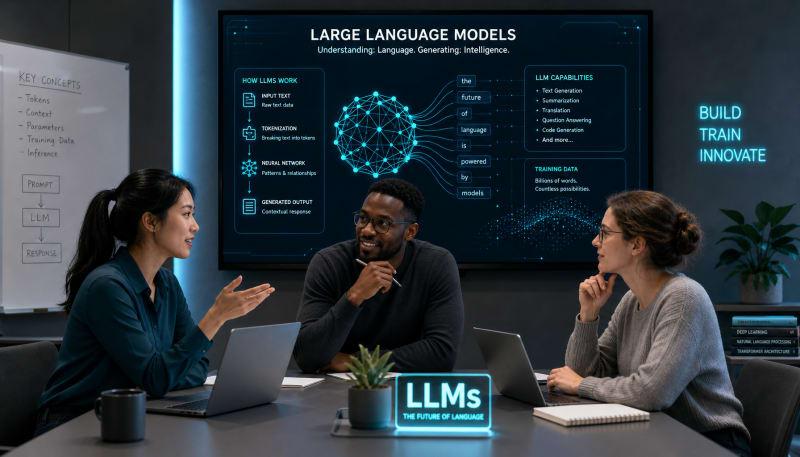
A simple guide to understanding the AI systems powering today's most popular tools.
If you've heard terms like ChatGPT, GPT-4, or Claude thrown around in tech conversations, you've encountered the work of Large Language Models, or LLMs. These AI systems have quickly become some of the most talked-about technologies in recent years, transforming how we interact with computers and process information. But what exactly is an LLM, and how does it work?
This guide breaks down everything you need to know about Large Language Models in plain language, without requiring a computer science degree to understand.
Related: If you want the full operating system for AI workflows, prompts, ideation, and execution, Snapse OS brings the pieces together.
Understanding Large Language Models: The Basics
A Large Language Model (LLM) is a type of artificial intelligence program designed to understand and generate human language. Think of it as a sophisticated pattern-recognition system that has read vast amounts of text from books, websites, articles, and other written sources, then learned to predict what words or phrases should come next in a given context.
The "large" in Large Language Model refers to two things: the enormous amount of data these models are trained on (often billions of web pages and documents), and the billions of parameters that make up the model itself. Parameters are adjustable values that help the model make decisions about language patterns.
How LLMs Learn Language
LLMs don't learn language the way humans do. Instead, they use a process called training, where they analyze massive datasets of text and learn statistical relationships between words, phrases, and concepts. During training, the model essentially plays a game of "fill in the blank," predicting missing words in sentences millions of times until it becomes remarkably good at understanding language structure, context, and even nuance.
This training process requires significant computational power and can take weeks or months, even with powerful hardware. Once trained, however, the model can generate responses, answer questions, and perform language tasks almost instantly.
What Makes LLMs Different From Traditional Software
Traditional computer programs follow explicit instructions written by programmers. If you want a calculator app to add two numbers, a developer writes specific code that says "take number A, add number B, return the result."
LLMs work differently. They're not programmed with explicit rules for every possible sentence or question. Instead, they use neural networks—computing systems loosely inspired by the human brain—to recognize patterns and make probabilistic predictions about language. This allows them to handle situations they weren't explicitly programmed for, making them far more flexible than traditional software.
Top Large Language Models You Should Know
The LLM landscape has evolved rapidly, with several major models dominating the field. Here are the most significant ones:
GPT Series (OpenAI)
The Generative Pre-trained Transformer series, including GPT-3.5 and GPT-4, represents some of the most capable and widely-used LLMs. GPT-4, the latest version as of this writing, powers ChatGPT Plus and demonstrates advanced reasoning abilities, creative writing skills, and the ability to process both text and images.
Claude (Anthropic)
Developed by Anthropic, Claude is designed with a focus on safety and helpful, harmless, and honest interactions. Claude 3 comes in several variants (Opus, Sonnet, and Haiku) optimized for different use cases, from complex analysis to quick responses.
Gemini (Google)
Google's Gemini family of models represents the company's latest effort in the LLM space, replacing earlier systems like Bard. Gemini is designed to be multimodal from the ground up, meaning it can natively understand and work with text, images, audio, and video.
LLaMA (Meta)
Meta's Large Language Model Meta AI (LLaMA) takes a different approach by being open-source, allowing researchers and developers to access and modify the model. This has spawned numerous derivative models and applications in the open-source community.
Mistral and Open-Source Alternatives
The open-source ecosystem has produced several competitive models like Mistral, which offer strong performance while being accessible to developers and researchers. These models are particularly important for applications requiring full control over the AI system or operation in privacy-sensitive environments.
What Can LLMs Actually Do?
Large Language Models excel at a wide range of language-based tasks:
Text Generation: LLMs can write articles, stories, emails, code, and other content based on prompts or instructions. The quality varies, but modern LLMs can produce remarkably coherent and contextually appropriate text.
Question Answering: You can ask an LLM questions about almost any topic, and it will provide answers based on the knowledge it gained during training. However, it's important to verify critical information, as LLMs can sometimes generate incorrect or outdated information.
Translation: LLMs can translate between languages, often capturing nuance and context better than earlier translation systems.
Summarization: Give an LLM a long document, and it can produce a concise summary of the key points.
Code Writing and Debugging: Modern LLMs have been trained on millions of lines of code and can help write, explain, and debug programming code in numerous languages.
Analysis and Reasoning: LLMs can analyze text, identify patterns, compare concepts, and perform logical reasoning tasks, though their capabilities have limits.
How LLMs Actually Work: A Simple Breakdown
Without getting too technical, here's what happens when you interact with an LLM:
Tokenization: Your input text is broken down into smaller pieces called tokens (roughly equivalent to words or word fragments).
Encoding: These tokens are converted into numerical representations that the model can process.
Processing: The model runs these numbers through its neural network, which consists of many layers of mathematical operations. Each layer transforms the data, extracting increasingly abstract patterns and relationships.
Prediction: Based on the patterns it recognizes, the model predicts what tokens should come next in the response.
Decoding: These predicted tokens are converted back into readable text, which you see as the model's response.
This entire process happens remarkably quickly, usually in just seconds, even though billions of calculations are occurring behind the scenes.
Limitations and Challenges of LLMs
Despite their impressive capabilities, LLMs have important limitations:
Knowledge Cutoffs: LLMs are trained on data up to a specific date and don't automatically know about events or information after that point unless specifically updated or given access to current information.
Hallucinations: LLMs sometimes generate false information presented with confidence. They predict plausible-sounding text based on patterns, but this doesn't guarantee factual accuracy.
Lack of True Understanding: While LLMs can process and generate language impressively, they don't "understand" in the human sense. They recognize patterns without genuine comprehension of meaning or real-world consequences.
Computational Requirements: Running large LLMs requires significant computing power, which translates to energy consumption and cost concerns, particularly for the largest models.
Bias and Fairness: Since LLMs learn from human-generated text, they can absorb and reproduce biases present in their training data, requiring ongoing work to identify and mitigate these issues.
The Technology Behind LLMs: Key Concepts
Transformers
Most modern LLMs are built on an architecture called the transformer, introduced in a 2017 research paper. Transformers use a mechanism called "attention" that allows the model to weigh the importance of different words in a sentence when processing language, enabling it to capture context and relationships more effectively than earlier approaches.
Parameters
The "size" of an LLM is often measured in parameters—the values the model adjusts during training to improve its performance. GPT-3 has 175 billion parameters, while some newer models have even more. Generally, more parameters allow for more nuanced understanding, though they also require more computational resources.
Training vs. Inference
Training is the initial, computationally intensive process of creating the model from data. Inference is when the trained model actually responds to your queries. Training happens once (or periodically for updates), while inference happens every time someone uses the model.
Practical Applications of LLMs Today
LLMs are already being integrated into numerous real-world applications:
Customer Service: Chatbots powered by LLMs can handle customer inquiries, provide product information, and resolve common issues without human intervention.
Content Creation: Writers use LLMs to brainstorm ideas, draft content, or overcome writer's block, though human editing remains essential for quality.
Education: LLMs serve as tutoring assistants, explaining concepts, answering questions, and providing personalized learning support.
Software Development: Developers use LLM-powered tools to write code faster, understand unfamiliar codebases, and debug errors.
Research and Analysis: Researchers use LLMs to summarize papers, identify patterns in large text datasets, and generate hypotheses.
Accessibility: LLMs power tools that help people with disabilities, from generating image descriptions for the visually impaired to simplifying complex text for easier comprehension.
The Future of Large Language Models
The field of LLMs continues to evolve rapidly. Several trends are shaping where this technology is headed:
Multimodal Models: Future LLMs will increasingly work with multiple types of data—text, images, audio, and video—in an integrated way, rather than focusing solely on text.
Improved Efficiency: Researchers are developing techniques to create smaller, more efficient models that deliver comparable performance with fewer resources.
Specialized Models: Rather than one-size-fits-all approaches, we're seeing more domain-specific LLMs optimized for particular fields like medicine, law, or engineering.
Better Factuality: Ongoing research aims to reduce hallucinations and improve the accuracy and reliability of LLM outputs.
Enhanced Control: New techniques are being developed to give users more precise control over LLM behavior, tone, and output characteristics.
Conclusion
Large Language Models represent a significant leap forward in how computers process and generate human language. By training on vast amounts of text data, these systems have learned to perform an impressive range of language tasks, from answering questions to writing code to analyzing complex documents.
Understanding what LLMs are and how they work helps you use them more effectively and critically evaluate their outputs. These models are powerful tools, but they're not magic—they have clear limitations and work best when users understand both their capabilities and constraints.
As LLM technology continues to advance, we'll likely see these systems become more accurate, efficient, and integrated into everyday tools and services. Whether you're a student, professional, or simply curious about AI, having a solid grasp of what LLMs are and what they can do will become increasingly valuable in our technology-driven world.
The Practical Solution
Start by picking one LLM and using it regularly for a specific task in your workflow—drafting emails, summarizing documents, or researching topics. Treat it like a capable intern: give clear context, ask follow-up questions, and verify outputs rather than accepting them blindly. The goal isn't to understand the technology perfectly but to build intuition through hands-on use, which will teach you more about capabilities and limitations than any article ever...
— Kevin Marsh, Editor-in-Chief
SNAPSE OS
Build Your Full AI Workflow System
Get the full Snapse OS bundle with Prompt OS, ideation systems, and freelancer workflow tools in one operating system.
Explore Snapse OSSynthetic Proof
Verified — Editorial Layer
This content has passed editorial verification for clarity, accuracy, and trust alignment.
Editor-in-Chief: Kevin Marsh
Verification Status: PASSED
Verification Status: PASSED
Comments
Post a Comment