Learn why organizations are investing in verification instead of detection alone. For years, the fight against synthetic media manipulation followed a familiar pattern: researchers identified deepfake artifacts, built detection models around those signatures, and deployed them across platforms. Detection accuracy improved. Conferences celebrated breakthroughs. The industry felt like it was winning. Then generative AI became exponentially better at eliminating the very artifacts those systems were trained to find. As synthetic media improves, confidence increasingly comes from layered evidence rather than a binary label. Synthetic Proof helps organizations evaluate that evidence in context. What's emerging isn't simply a technical gap that better detection can close. It's a fundamental shift in how organizations must approach digital trust. The old model—detect manipulated content after it's created—assumes defenders can keep pace with attackers....
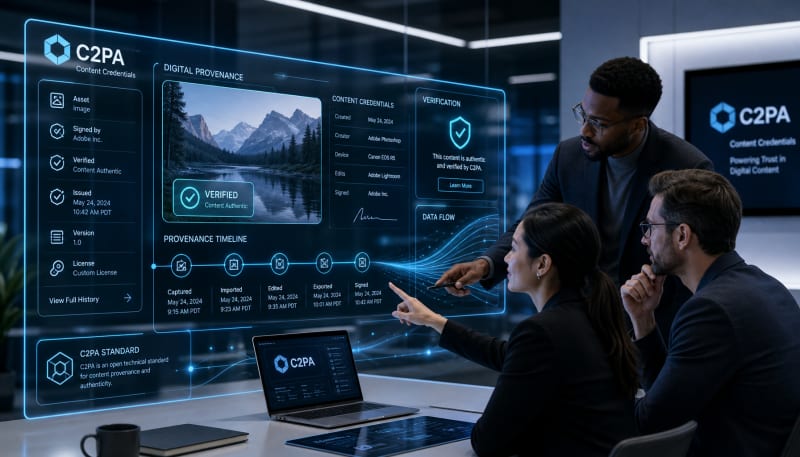
A beginner-friendly guide to the open standard helping verify digital media authenticity.
In an era where AI-generated images, deepfakes, and manipulated media proliferate across the internet, distinguishing authentic content from fabricated material has become nearly impossible. The Coalition for Content Provenance and Authenticity (C2PA) represents a critical industry response to this challenge, establishing a technical standard for tracking the origin and modification history of digital content.
C2PA isn't just another verification protocol—it's a comprehensive framework that major technology companies, media organizations, and camera manufacturers are actively implementing. Understanding how this system works and why it matters has become essential for anyone concerned with content authenticity in the digital age.
Related: If your workflow touches verification, provenance, or suspicious media, Synthetic Proof can help audit content and reduce trust risk.
What Is C2PA?
The Coalition for Content Provenance and Authenticity is an open technical standard that embeds verifiable metadata directly into digital content. Founded by Adobe, Microsoft, and other industry leaders, C2PA creates a secure record of a file's origin and any modifications made throughout its lifecycle.
Unlike watermarks or simple metadata that can be easily stripped or altered, C2PA uses cryptographic binding to attach content credentials to images, videos, and audio files. These credentials function like a tamper-evident seal, revealing if someone has modified the content after its creation.
How Content Credentials Work
When a piece of content is created with C2PA-enabled software or hardware, the system generates a manifest containing information about the content's origin. This manifest can include the creator's identity, the device or software used, the date and time of creation, and whether AI tools were involved in the generation or editing process.
Each subsequent edit creates a new manifest entry, establishing a transparent chain of custody. The cryptographic signatures ensure that tampering with these records becomes immediately detectable, providing a reliable audit trail for digital provenance.
The Technology Behind Digital Provenance
C2PA builds on existing standards like the Content Authenticity Initiative (CAI) and addresses the limitations of previous verification attempts. The technical architecture relies on several key components working together to ensure content authenticity.

Cryptographic Signing and Validation
At the core of C2PA lies public key cryptography. When content is created or modified, the software signs the manifest with a private key. Anyone can then verify this signature using the corresponding public key, confirming both the identity of the signer and the integrity of the content.
This approach prevents unauthorized parties from creating false credentials while allowing transparent verification by anyone with access to the content. The system supports both hard assertions (cryptographically guaranteed facts) and soft assertions (claims that provide context but aren't cryptographically bound).
The Manifest Structure
C2PA manifests contain three primary elements: assertions about the content, the digital signature binding these assertions to the asset, and ingredients representing previous versions or source materials used in creating the final output. This structure enables complex editing histories to be preserved and verified.
For example, if a photographer captures an image with a C2PA-enabled camera, then edits it in compatible software, and finally publishes it online, each step adds to the manifest. Viewers can see the entire chain: camera capture, software edits, and any AI enhancements applied along the way.
C2PA in Practice: Current Implementations
Major platforms and tool providers have begun integrating C2PA support into their products. Adobe has implemented content credentials across Creative Cloud applications. Microsoft has added support to Edge browser and other products. Camera manufacturers including Leica, Nikon, and Sony have announced C2PA-compatible hardware.
Social media platforms face particular pressure to adopt content authenticity standards. While implementation varies, several major networks have begun testing C2PA display features that show users when content includes verifiable credentials and what those credentials reveal about the content's origin.
AI Verification and Synthetic Media Labeling
One of C2PA's most critical applications involves identifying AI-generated or AI-modified content. As generative AI tools become more sophisticated, distinguishing synthetic media from captured reality grows increasingly difficult without technical assistance.
C2PA addresses this by requiring AI generation tools to declare their involvement in the creation process. When an AI system generates an image, the resulting file includes credentials indicating synthetic origin. This transparency allows platforms and users to make informed decisions about content authenticity without banning AI-generated material outright.
Limitations and Challenges
Despite its robust design, C2PA faces several practical challenges. The standard only works when implemented—content created without C2PA-enabled tools contains no credentials. This creates a transition period where absence of credentials doesn't necessarily indicate manipulation, just that the creator didn't use compatible tools.
Screenshots and re-encoding strip credentials from content, making it easy for bad actors to remove provenance information. While this removal itself can serve as a red flag, it means C2PA functions best as a positive indicator of authenticity rather than a definitive detector of manipulation.
Adoption and Ecosystem Development
Widespread adoption requires coordination across the entire content creation and distribution ecosystem. Cameras must support C2PA, editing software must preserve and extend credentials properly, and platforms must display credential information in ways users understand and find valuable.
The technical infrastructure for managing signing certificates and validating credentials also needs maturation. Questions about who gets to sign content, how certificate authorities operate, and what happens when credentials conflict all require ongoing governance and standardization work.
The Role of Digital Provenance in Building Trust
Content authenticity represents more than a technical problem—it's fundamental to maintaining informed public discourse. When audiences can't distinguish real documentation from fabricated propaganda, the shared reality necessary for democratic society erodes.
C2PA provides infrastructure for rebuilding digital trust, but the standard alone isn't sufficient. Media literacy, platform policies, and user interface design all play critical roles in translating technical credentials into meaningful information that helps people make better decisions about content credibility.
Beyond Misinformation: Creative Rights and Attribution
Digital provenance also supports creator rights and proper attribution. Content credentials can help photographers prove ownership of their work, enable proper licensing verification, and establish clear records for copyright purposes. These applications may drive adoption even in contexts where misinformation concerns are less acute.
Conclusion
C2PA represents the most comprehensive industry effort yet to establish content authenticity standards for the digital age. By creating technical infrastructure for tracking digital provenance and verifying content credentials, the coalition addresses urgent challenges posed by AI-generated media and sophisticated manipulation tools.
The standard's success depends on widespread adoption across hardware manufacturers, software developers, and distribution platforms. While technical limitations and implementation challenges remain, C2PA provides a foundation for content authenticity that can evolve alongside emerging technologies and threats.
For individuals and organizations concerned about content verification, understanding C2PA clarifies how authenticity infrastructure works and what it can realistically achieve. As more tools and platforms implement the standard, content credentials will become increasingly important signals in evaluating media credibility and provenance.
The Practical Solution
Start by checking if your current tools support C2PA standards; several modern camera models and editing suites already have this built in. If you are creating content professionally, enable Content Credentials in your workflow today—don’t wait for mainstream adoption. For everyone else, learn to inspect digital assets for C2PA verification badges whenever authenticity matters, particularly on news or contested media.
If you need to instantly audit incoming assets, trace media origin, or flag synthetic manipulation within your existing pipelines, Synthetic Proof streamlines the entire process, reducing trust risk before you publish.
— Kevin Marsh, Editor-in-Chief
SNAPSE
Run Client Work More Smoothly
Use structured systems for delivery, handoff, and repeatable execution.
Explore Freelancer & Contractor HubSynthetic Proof
Verified — Editorial Layer
This content has passed editorial verification for clarity, accuracy, and trust alignment.
Editor-in-Chief: Kevin Marsh
Verification Status: PASSED
Verification Status: PASSED
Comments
Post a Comment