Learn why organizations are investing in verification instead of detection alone. For years, the fight against synthetic media manipulation followed a familiar pattern: researchers identified deepfake artifacts, built detection models around those signatures, and deployed them across platforms. Detection accuracy improved. Conferences celebrated breakthroughs. The industry felt like it was winning. Then generative AI became exponentially better at eliminating the very artifacts those systems were trained to find. As synthetic media improves, confidence increasingly comes from layered evidence rather than a binary label. Synthetic Proof helps organizations evaluate that evidence in context. What's emerging isn't simply a technical gap that better detection can close. It's a fundamental shift in how organizations must approach digital trust. The old model—detect manipulated content after it's created—assumes defenders can keep pace with attackers....
Exploring Future Trends For Tools & Systems
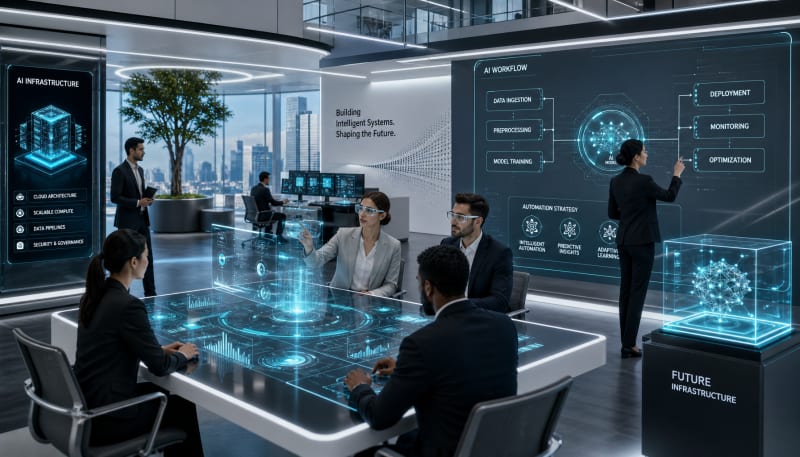
Automation has evolved from simple if-then statements into sophisticated systems that reshape how businesses operate. The infrastructure powering today's automated workflows combines artificial intelligence, cloud computing, and interconnected platforms into a cohesive architecture that would have seemed impossible a decade ago.
Understanding the technical foundation of modern automation isn't just for engineers anymore. As AI infrastructure becomes central to competitive advantage, leaders across industries need to grasp what separates effective automation strategy from superficial tool adoption.
Related: If you want the full operating system for AI workflows, prompts, ideation, and execution, Snapse OS brings the pieces together.
The Infrastructure Layer: Where Automation Lives
Modern automation runs on a stack of technologies that work in concert. At the base level, cloud infrastructure provides the computational power and storage needed to process data at scale. Services like AWS Lambda, Google Cloud Functions, and Azure Functions enable serverless architectures where automation triggers execute without dedicated servers waiting idle.
API layers connect these services, allowing data to flow between platforms. RESTful APIs and GraphQL endpoints create the connective tissue that turns isolated software into an integrated ecosystem. When you trigger an automation that pulls data from a CRM, processes it through an AI model, and outputs results to a spreadsheet, you're watching this infrastructure in action.
Message queues and event-driven architectures handle the timing and sequencing. Technologies like Apache Kafka, RabbitMQ, and cloud-native event buses ensure that automated workflows execute in the right order, even when dealing with millions of events per second.
AI Systems vs Tools: A Critical Distinction
The difference between ai systems vs tools defines the boundary between shallow and deep automation. Tools are point solutions—a chatbot here, an image classifier there. Systems are architectural approaches that embed intelligence throughout your operations.
An AI tool might analyze customer sentiment in support tickets. An AI system monitors sentiment across all customer touchpoints, routes conversations based on urgency and complexity, learns from resolution patterns, and feeds insights back into product development. The tool executes a function. The system orchestrates outcomes.

System-Level Thinking
Building ai workflows future requires thinking in systems. This means designing for data flow, feedback loops, and continuous learning. A properly architected AI system includes:
- Data pipelines that clean, transform, and route information to where it's needed
- Model management infrastructure for versioning, testing, and deploying AI models
- Monitoring systems that track performance and detect drift
- Feedback mechanisms that improve accuracy over time
These components work together to create automation that adapts rather than just executes.
Orchestration: The Brain of Automation Strategy
Orchestration platforms manage the complexity of modern automation strategy. Tools like Apache Airflow, Prefect, and Temporal define workflows as code, handling dependencies, retries, and error handling automatically.
Unlike simple automation tools that follow linear paths, orchestration systems handle branching logic, parallel processing, and conditional execution. They can pause workflows to wait for human approval, resume after delays, and adapt to changing conditions.
The real power emerges when orchestration layers incorporate AI decision-making. Rather than following predetermined paths, workflows can analyze context and choose optimal routes in real-time. This is where automation transitions from mechanical to intelligent.
AI Future Trends Shaping Automation
Several ai future trends are pushing automation capabilities into new territory:
Multi-Modal AI Integration
Automation systems increasingly process text, images, audio, and video within the same workflow. A customer service automation might analyze a support ticket's text, review attached screenshots, and transcribe voice messages—all while understanding context across modalities.
Edge Computing and Distributed Intelligence
Rather than routing everything through centralized cloud servers, edge computing pushes AI processing to where data originates. This reduces latency and enables real-time automation in manufacturing, logistics, and IoT applications.
Agentic AI Workflows
The next generation of ai workflows future involves autonomous agents that pursue goals rather than execute scripts. These agents break down complex objectives, determine necessary steps, and adapt their approach based on results. Early implementations are already handling research tasks, code generation, and strategic planning with minimal human guidance.
Neural Architecture Search
AI systems are beginning to design their own architectures, optimizing neural networks for specific automation tasks. This meta-level intelligence promises automation systems that continuously improve their own efficiency.
Building Resilient Automation Infrastructure
Production-grade automation requires more than functional code. Resilient ai infrastructure incorporates redundancy, graceful degradation, and comprehensive monitoring.
Circuit breakers prevent cascading failures when external services become unavailable. Rate limiting protects systems from overload. Dead letter queues capture failed events for later analysis. Health checks verify that all components are functioning correctly.
Observability tools provide visibility into what's happening inside complex automation workflows. Distributed tracing tracks requests across multiple services. Metrics dashboards reveal performance patterns. Log aggregation surfaces errors before they become critical.
The Human Element in Automated Systems
Despite the sophistication of modern automation, human judgment remains essential. The most effective automation strategy includes clear intervention points where humans review, approve, or override automated decisions.
This human-in-the-loop design serves multiple purposes: it maintains accountability, catches edge cases that automation handles poorly, and provides training data for improving AI models. The goal isn't to remove humans but to elevate their role from repetitive execution to strategic oversight.
Scaling Considerations
Automation that works for hundreds of transactions per day may collapse under millions. Scaling requires architectural choices made early:
Stateless services scale horizontally by adding more instances. Caching layers reduce database load. Asynchronous processing prevents bottlenecks. Database sharding distributes data across multiple servers.
Cost management becomes critical at scale. Cloud spending can spiral as automation volume increases. Efficient ai infrastructure uses spot instances for non-critical workloads, optimizes data transfer, and archives cold data to cheaper storage tiers.
Security in Automated Environments
Automation multiplies the impact of security vulnerabilities. A compromised automation system can execute malicious actions at machine speed across entire infrastructures.
Zero-trust architectures verify every request, even from internal systems. Secrets management keeps API keys and credentials out of code. Audit logs track every automated action. Role-based access control limits what each automation can do.
AI-specific security concerns include model poisoning, adversarial attacks, and data leakage through model outputs. Robust automation strategy addresses these risks through model validation, input sanitization, and output filtering.
The Road Ahead
The technology underpinning automation continues to evolve rapidly. Foundation models are becoming more capable and accessible. Development frameworks are abstracting away complexity. Regulatory frameworks are emerging to govern AI deployment.
Organizations building automation infrastructure today must balance current needs with future flexibility. The systems you architect now should accommodate AI models that don't yet exist and integrate with platforms not yet launched.
This requires modular design, clear interfaces, and comprehensive documentation. Technical debt accumulates faster in automation systems because they touch so many parts of an organization. Investing in clean architecture pays compounding returns.
Conclusion
The tech behind automations represents a convergence of cloud computing, artificial intelligence, and distributed systems engineering. Success requires moving beyond tool adoption to system-level thinking—designing infrastructure that learns, adapts, and scales.
As ai future trends push capabilities forward, the gap between organizations with sophisticated automation strategy and those with ad-hoc implementations will widen. The foundation you build today determines whether automation becomes a strategic advantage or a maintenance burden tomorrow.
The Practical Solution
The Reality is understanding these technical underpinnings isn't optional anymore. The future belongs to organizations that architect their automation infrastructure with the same rigor they apply to their products.
— Kevin Marsh, Editor-in-Chief
SNAPSE OS
Build Your Full AI Workflow System
Get the full Snapse OS bundle with Prompt OS, ideation systems, and freelancer workflow tools in one operating system.
Explore Snapse OSSynthetic Proof
Verified — Editorial Layer
This content has passed editorial verification for clarity, accuracy, and trust alignment.
Editor-in-Chief: Kevin Marsh
Verification Status: PASSED
Verification Status: PASSED
Comments
Post a Comment