Strategies for ensuring your asset’s chain of custody remains verifiable across any channel. A photograph appears in a news report. A legal document crosses a negotiation table. A research dataset underpins a policy decision. In each case, the same question arises: where did this content actually come from? For decades, that question was answerable through metadata, file properties, and institutional trust. But generative AI has fundamentally altered the equation. Content can now be created, modified, and redistributed at scale with minimal effort and near-perfect fidelity. The result is a provenance crisis that affects everything from newsrooms to courtrooms to corporate data operations. A credential can explain part of an asset’s history. Independent evaluation helps determine how much confidence the available evidence should support. Synthetic Proof is built for that wider trust assessment. The industry's response has largely centered on two technologies...
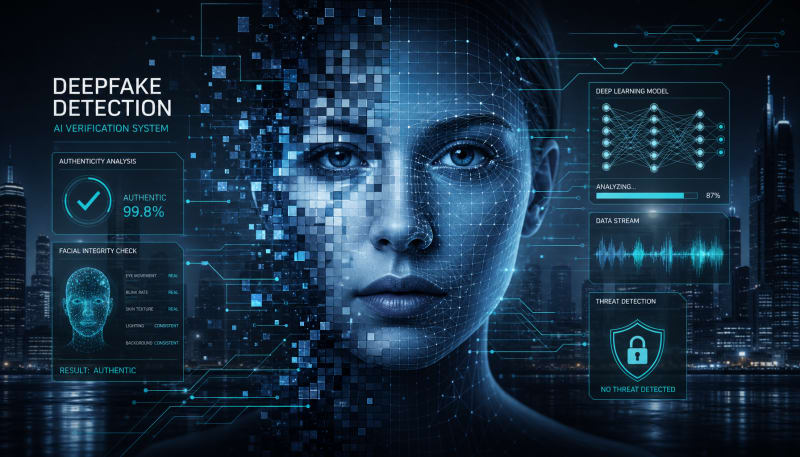
How advanced verification systems and content provenance models are rebuilding digital trust.
The digital landscape has entered an era where seeing is no longer believing. Synthetic media—particularly deepfakes—has become sophisticated enough to fool even trained observers. As artificial intelligence continues to generate increasingly convincing fake videos, images, and audio, the development of robust deepfake detection systems has become critical for maintaining trust in digital content.
Understanding how AI verification technologies work is no longer optional for organizations handling media content. From news outlets to social media platforms, from corporate communications to legal proceedings, the ability to distinguish authentic content from synthetic forgeries has become a fundamental requirement.
Related: If your workflow touches verification, provenance, or suspicious media, Synthetic Proof can help audit content and reduce trust risk.
The Evolution of Synthetic Media
Deepfakes leverage deep learning algorithms, particularly generative adversarial networks (GANs), to create or manipulate video and audio content with remarkable precision. These systems train on vast datasets of real media, learning to replicate facial movements, voice patterns, and even behavioral quirks with uncanny accuracy.
The technology has progressed from obvious manipulations to productions that can deceive both human observers and early detection systems. Modern deepfakes can maintain consistent lighting across frames, preserve natural eye movements, and replicate micro-expressions that once served as telltale signs of manipulation.
How Deepfake Detection Systems Operate
AI verification systems employ multiple detection approaches, often working in concert to identify synthetic media. These technologies analyze content at various levels, from pixel-level inconsistencies to behavioral patterns that human creators might miss.
Biological Signal Analysis
Advanced deepfake detection examines physiological markers that AI-generated content struggles to replicate accurately. These systems analyze subtle indicators like pulse detection through facial color changes, natural breathing patterns, and the physics of how light interacts with human skin. Synthetic media often fails to reproduce these biological signatures with complete accuracy, creating detectable anomalies.
Temporal Consistency Checking
Detection algorithms examine how content changes across frames, looking for inconsistencies that suggest manipulation. Authentic video maintains certain continuity in lighting, shadows, and object relationships. Deepfakes often introduce subtle discontinuities—a shadow that moves incorrectly, lighting that shifts unnaturally, or facial features that don't maintain proper spatial relationships across sequential frames.

Neural Network Fingerprinting
Each AI generation model leaves distinctive artifacts in the content it produces. Detection systems can identify these "fingerprints" by analyzing the statistical properties of media files. Different GAN architectures produce characteristic patterns in how they generate pixels, compress information, or handle edges and textures. By cataloging these signatures, verification systems can identify not just whether content is synthetic, but which tools likely created it.
Multi-Modal Verification Approaches
Modern AI verification doesn't rely on a single detection method. Instead, sophisticated systems combine multiple analytical approaches to build confidence in their assessments.
Audio-Visual Synchronization
Detection systems analyze whether lip movements accurately match spoken words, whether facial muscle movements align with speech patterns, and whether audio quality remains consistent with the visual environment. Deepfakes often excel at either video or audio manipulation but struggle to maintain perfect synchronization between both modalities.
Metadata and Provenance Analysis
Beyond analyzing the content itself, verification systems examine file metadata, compression artifacts, and digital provenance chains. Authentic media captured by cameras or recording devices carries specific metadata signatures and compression patterns. Synthetic media or heavily edited content often lacks these markers or contains inconsistencies that reveal manipulation.
The Arms Race Between Creation and Detection
Deepfake detection exists in a state of continuous evolution. As detection methods improve, creation techniques adapt to evade them. This adversarial dynamic drives innovation on both sides, with detection systems constantly updating their models to recognize new generation techniques.
Machine learning models trained on current deepfakes may struggle with next-generation synthetic media. This reality requires detection systems to employ adaptive learning, continuously training on new examples and updating their detection criteria. The most effective verification platforms maintain databases of known manipulation techniques and regularly test against emerging methods.
Limitations and Challenges in AI Verification
Despite significant advances, deepfake detection technology faces inherent limitations. High-quality deepfakes created with state-of-the-art tools and sufficient computational resources can bypass many detection systems. Compressed or low-resolution media makes detection more difficult, as manipulation artifacts become harder to distinguish from compression artifacts.
False positives present another challenge. Overly aggressive detection systems may flag authentic content as synthetic, particularly when that content has been heavily edited or compressed. Balancing sensitivity with specificity remains an ongoing challenge for developers of verification technology.
The Context Problem
Technical detection alone cannot solve the deepfake problem. Context matters enormously in assessing whether media has been manipulated and whether that manipulation is deceptive. Legitimate editing, special effects, and artistic modifications all involve "synthetic" elements without intent to deceive. Effective verification systems must distinguish between benign manipulation and malicious forgery.
Implementation Strategies for Organizations
Organizations implementing deepfake detection should adopt layered approaches that combine automated analysis with human oversight. Automated systems provide scalable initial screening, flagging potentially synthetic content for closer examination. Human reviewers then apply contextual judgment and expertise to make final determinations.
Integration points matter significantly. Verification can occur at upload, during content moderation, before publication, or in response to user reports. The optimal approach depends on the organization's specific use case, risk tolerance, and operational constraints.
Training staff to understand both the capabilities and limitations of detection systems prevents overreliance on automated tools. Human judgment remains essential, particularly when dealing with edge cases or when the stakes of misidentification are high.
The Future of Media Verification
Emerging approaches to synthetic media detection focus on proactive authentication rather than reactive detection. Cryptographic signing of authentic media at capture time, blockchain-based provenance tracking, and hardware-level authentication built into cameras and recording devices represent the next frontier in establishing media trustworthiness.
These approaches flip the verification model: rather than trying to detect fakes, they establish positive proof of authenticity. Content that lacks proper authentication credentials becomes suspect by default, regardless of how convincing it appears.
Conclusion
Deepfake detection technology represents a critical defense against synthetic media manipulation, but it functions best as part of a comprehensive trust and verification strategy. No single technical solution can completely solve the challenge of distinguishing authentic from synthetic content in every context.
The most effective approach combines multiple detection methodologies, maintains continuous adaptation to new manipulation techniques, and integrates automated analysis with human expertise. Organizations must understand both the capabilities and limitations of current verification technology while preparing for the next generation of both synthetic media creation and detection tools.
As synthetic media becomes increasingly sophisticated, the emphasis will likely shift from detection alone to comprehensive authentication ecosystems that establish positive proof of content authenticity. Until those systems mature, current AI verification technologies provide essential but imperfect tools for maintaining trust in digital media.
SYNTHETIC PROOF
Verify What You See
Synthetic media is getting harder to identify. Get verification-focused analysis for suspicious content.
Run a Synthetic Proof AuditSynthetic Proof
Verified — Editorial Layer
This content has passed editorial verification for clarity, accuracy, and trust alignment.
Editor-in-Chief: Kevin Marsh
Verification Status: PASSED
Verification Status: PASSED
Comments
Post a Comment