Learn why organizations are investing in verification instead of detection alone. For years, the fight against synthetic media manipulation followed a familiar pattern: researchers identified deepfake artifacts, built detection models around those signatures, and deployed them across platforms. Detection accuracy improved. Conferences celebrated breakthroughs. The industry felt like it was winning. Then generative AI became exponentially better at eliminating the very artifacts those systems were trained to find. As synthetic media improves, confidence increasingly comes from layered evidence rather than a binary label. Synthetic Proof helps organizations evaluate that evidence in context. What's emerging isn't simply a technical gap that better detection can close. It's a fundamental shift in how organizations must approach digital trust. The old model—detect manipulated content after it's created—assumes defenders can keep pace with attackers....
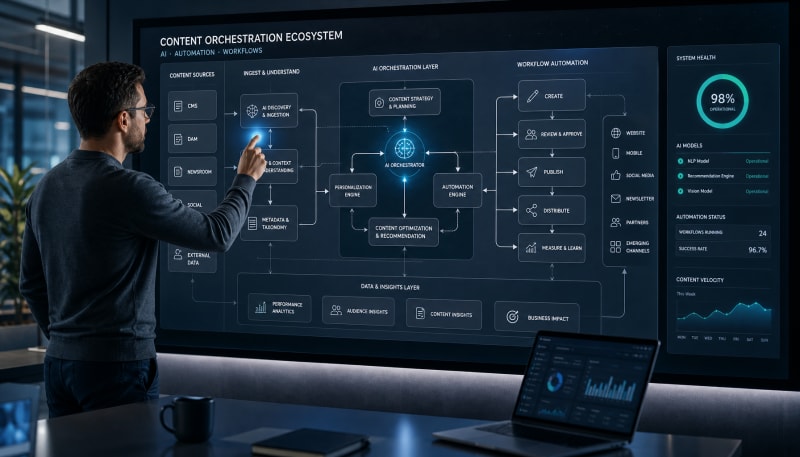
Learn how orchestration platforms connect tools, data, and AI workflows into a single operational system.
Modern content operations are drowning in disconnected tools. Marketing teams juggle AI writing assistants, automation platforms, content management systems, and analytics dashboards—each operating in its own silo. The result is inefficiency, duplicated effort, and content that fails to reach its full potential.
This is where content orchestration changes everything. Unlike simple automation or standalone AI tools, orchestration creates an intelligent layer that connects your AI systems, business platforms, and human workflows into a unified operation. It's the difference between having smart tools and having a smart system.
Related: If you want the full operating system for AI workflows, prompts, ideation, and execution, Snapse OS brings the pieces together.
The right orchestration platform doesn't just automate tasks—it coordinates entire content lifecycles, ensures consistency across channels, and adapts workflows based on real-time data. Here are the five essential tools that make modern workflow orchestration possible.
1. Workflow Orchestration Platforms
At the foundation of any orchestrated content operation sits a dedicated workflow orchestration platform. These systems serve as the central nervous system, managing task dependencies, routing approvals, and triggering actions across your entire tech stack.
Tools like Workato, Zapier, and n8n excel at connecting disparate systems without requiring extensive development resources. They allow you to build sophisticated workflows that respond to triggers—when a content brief is approved, the system automatically generates assignments, creates project folders, and notifies relevant team members.
What separates true orchestration from simple automation is conditional logic and intelligent routing. Modern platforms can evaluate content performance data and automatically adjust distribution strategies, or route content through different approval chains based on topic sensitivity or compliance requirements.
Key Capabilities to Look For
- Native integrations with major content platforms and AI systems
- Visual workflow builders that don't require coding expertise
- Conditional logic and branching workflows
- Error handling and workflow monitoring
- API connectivity for custom integrations
2. AI Content Intelligence Hubs
AI systems have become indispensable for content creation, but managing multiple AI tools creates its own complexity. An AI content intelligence hub acts as the orchestration layer specifically for your artificial intelligence capabilities.
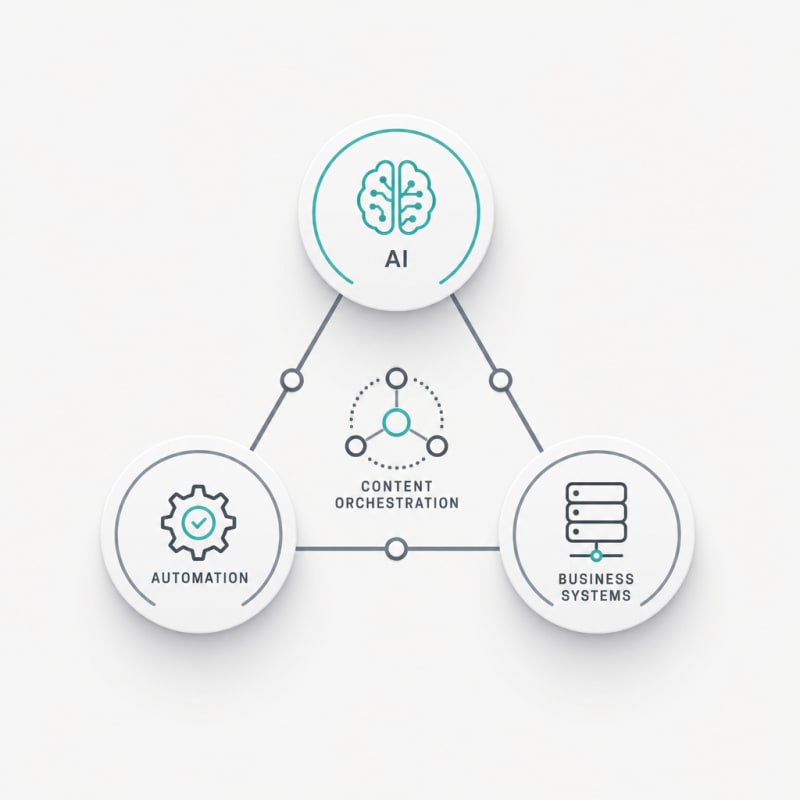
These platforms aggregate multiple AI models—from generative text to image creation to content analysis—into a single interface. More importantly, they add governance, consistency, and workflow integration that standalone AI tools lack.
Instead of team members using different AI assistants with different prompts producing inconsistent results, an intelligence hub standardizes how your organization leverages AI. It maintains brand voice guidelines, enforces content standards, and ensures that AI-generated content flows seamlessly into your review and publishing workflows.
The orchestration advantage becomes clear when you consider multi-step content operations. Your hub can automatically generate first drafts, run them through brand compliance checks, highlight sections requiring human review, and route approved sections directly to your CMS—all without manual handoffs.
3. Digital Asset Management (DAM) Systems
Content orchestration breaks down when teams can't find or access the assets they need. A robust DAM system serves as the central repository and distribution engine for all content assets, from images and videos to documents and templates.
Modern DAM platforms like Bynder, Cloudinary, and Brandfolder don't just store files—they actively participate in workflow orchestration. They provide APIs that let other systems automatically retrieve approved assets, enforce usage rights, and maintain version control across channels.
The orchestration power comes from intelligent tagging and metadata. When your DAM integrates with your AI systems and workflow platforms, assets can be automatically tagged, categorized, and made available to the right teams at the right time. Your content creators never waste time searching or accidentally use outdated materials.
Orchestration Integration Points
- Automated asset delivery to publishing platforms based on workflow triggers
- AI-powered tagging and categorization as assets are uploaded
- Rights management enforcement across distribution channels
- Dynamic asset optimization based on delivery channel requirements
4. Content Management and Publishing Hubs
Your content management system is where planning meets execution, making it a critical orchestration point. Modern headless CMS platforms and content hubs like Contentful, Sanity, and Contentstack are built specifically for orchestrated workflows.
These systems separate content from presentation, allowing you to create once and publish everywhere. But their real orchestration value lies in how they integrate with your broader tech stack. Through APIs and webhooks, they can receive content from AI systems, trigger review workflows, and automatically distribute approved content across channels.
Content orchestration means your CMS isn't just a publishing tool—it's a coordination hub. When a piece of content is published, it can automatically trigger social media posts, update email campaigns, notify sales teams, and refresh related content across your digital properties.
Look for platforms that support structured content models, maintain comprehensive version histories, and provide robust API access. The more programmable your CMS, the more effectively it can participate in orchestrated workflows.
5. Analytics and Performance Intelligence Platforms
Orchestration isn't complete without the feedback loop that analytics provides. Performance intelligence platforms close the loop by feeding data back into your workflows, enabling continuous optimization.
Tools like Google Analytics, Mixpanel, and specialized content analytics platforms track how your content performs across channels. But in an orchestrated environment, this data doesn't just sit in dashboards—it actively informs future content decisions and workflow adjustments.
Advanced orchestration connects your analytics directly to content planning and production systems. If certain content types consistently outperform others, your workflow orchestration can automatically prioritize similar content in production queues. If engagement drops on specific channels, distribution workflows adapt accordingly.
The most sophisticated setups use AI systems to analyze performance patterns and recommend workflow adjustments. This creates a truly intelligent orchestration layer that learns and improves over time, rather than simply executing predetermined rules.
Orchestration Through Data
- Automated reporting that feeds into content planning workflows
- Performance triggers that adjust distribution strategies
- Predictive analytics that inform content production priorities
- A/B testing integrated directly into publishing workflows
Building Your Orchestration Layer
The power of content orchestration comes not from any single tool, but from how these systems work together. Each platform serves as a node in your orchestration network, with workflow automation providing the connective tissue.
Start by mapping your current content workflows and identifying the gaps between systems. Where do manual handoffs slow things down? Where does information get lost in translation? Where are teams duplicating effort because systems don't communicate?
These friction points are your orchestration opportunities. Begin with high-impact, high-frequency workflows—perhaps the path from content brief to published article, or the process of updating content across multiple channels. Build your orchestration layer incrementally, proving value with each integration before expanding scope.
Remember that effective workflow orchestration requires both technology and process discipline. The best tools can't overcome poorly defined workflows or unclear responsibilities. Document your processes, establish clear ownership, and ensure your team understands not just how to use individual tools but how they fit into the larger orchestrated system.
Conclusion
Content orchestration represents a fundamental shift from managing individual tools to conducting an integrated system. The five tool categories outlined here—workflow platforms, AI intelligence hubs, digital asset management, content management systems, and analytics platforms—form the essential infrastructure for modern content operations.
These systems transform disconnected activities into coordinated workflows where AI systems generate initial drafts, automation routes them through review processes, assets are automatically retrieved and optimized, content publishes across channels simultaneously, and performance data feeds back into planning. The result is faster production, better consistency, and content that actually achieves business objectives.
The organizations winning with content aren't necessarily those with the most advanced AI or the biggest budgets. They're the ones who have built effective orchestration layers that amplify their existing capabilities and ensure every tool, system, and team member works in concert toward shared goals.
SNAPSE OS
Build Your Full AI Workflow System
Get the full Snapse OS bundle with Prompt OS, ideation systems, and freelancer workflow tools in one operating system.
Explore Snapse OSSynthetic Proof
Verified — Editorial Layer
This content has passed editorial verification for clarity, accuracy, and trust alignment.
Editor-in-Chief: Kevin Marsh
Verification Status: PASSED
Verification Status: PASSED
Comments
Post a Comment