Learn why organizations are investing in verification instead of detection alone. For years, the fight against synthetic media manipulation followed a familiar pattern: researchers identified deepfake artifacts, built detection models around those signatures, and deployed them across platforms. Detection accuracy improved. Conferences celebrated breakthroughs. The industry felt like it was winning. Then generative AI became exponentially better at eliminating the very artifacts those systems were trained to find. As synthetic media improves, confidence increasingly comes from layered evidence rather than a binary label. Synthetic Proof helps organizations evaluate that evidence in context. What's emerging isn't simply a technical gap that better detection can close. It's a fundamental shift in how organizations must approach digital trust. The old model—detect manipulated content after it's created—assumes defenders can keep pace with attackers....
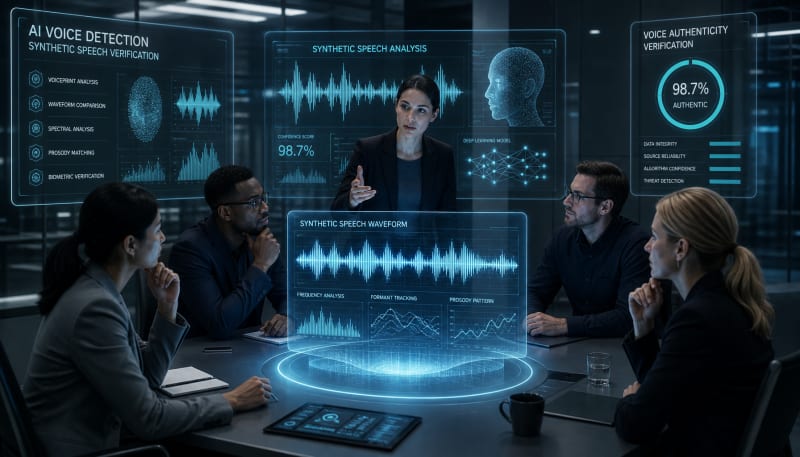
Explore the technologies and methods used to identify AI-generated audio.
Synthetic voices have become remarkably sophisticated. What once sounded robotic and artificial now mimics human speech with startling accuracy. This technological leap brings significant benefits, from accessibility tools to content creation. But it also introduces serious risks: deepfake scams, impersonation fraud, and misinformation campaigns that exploit our trust in what we hear.
Understanding how to detect AI-generated voices isn't just a technical skill anymore—it's a critical component of digital literacy. Whether you're a content creator verifying authenticity, a business protecting against fraud, or simply someone who wants to navigate media more critically, knowing the signs of synthetic speech matters.
Related: If your workflow touches verification, provenance, or suspicious media, Synthetic Proof can help audit content and reduce trust risk.
What Makes Modern AI Voices So Convincing
Today's text-to-speech systems use deep learning models trained on thousands of hours of human speech. These neural networks don't just string together pre-recorded sounds. They learn the complex patterns of human vocalization: pitch variations, breathing patterns, emotional inflections, and even regional accents.
Technologies like WaveNet, Tacotron, and more recent transformer-based models can generate speech that captures subtle nuances. They replicate the micro-pauses when someone thinks, the slight changes in tone that convey emotion, and the natural rhythm of conversational speech. Some systems can clone a specific person's voice from just a few seconds of audio sample.
This realism explains why synthetic voices are increasingly difficult to identify by ear alone. The quality gap between human and artificial speech has narrowed considerably, making detection techniques essential.
Auditory Clues That Reveal Synthetic Speech
Unnatural Breathing Patterns
Human speech includes natural breathing sounds and pauses. We breathe between sentences, take deeper breaths before long phrases, and sometimes have slight catches in our breath when emotional. AI-generated voices often lack these biological necessities or place them incorrectly. Listen for speech that continues without natural breath breaks or breathing sounds that seem inserted rather than organic.
Consistent Pitch and Tone
Real human voices fluctuate constantly. Even when reading scripted content, people vary their pitch, pace, and energy naturally. Synthetic voices sometimes maintain too consistent a tone across long passages. While modern systems have improved here, extended listening often reveals a mechanical uniformity that human voices rarely maintain.

Odd Pronunciation and Stress Patterns
AI models can struggle with uncommon words, proper nouns, or context-dependent pronunciation. They might place emphasis on the wrong syllable or pronounce homophones incorrectly based on context. Listen carefully to how technical terms, foreign words, or names are handled—these often expose synthetic speech.
Unnatural Emotional Expression
Expressing genuine emotion through voice involves complex coordination between tone, pace, volume, and subtle vocal qualities. Synthetic voices often apply emotional markers inconsistently or inappropriately. The emotion might sound "painted on" rather than integrated naturally into the speech.
Technical Methods For Detection
Spectral Analysis
Audio spectrograms visualize the frequency content of speech over time. Human voices produce characteristic patterns in these visualizations, including natural variations and harmonics that reflect our physical vocal apparatus. Synthetic speech often shows unusual regularities, missing harmonics, or artifacts in the frequency spectrum that trained analysts can identify.
Neural Network Detectors
Just as AI can generate synthetic speech, AI can also detect it. Machine learning models trained on both real and synthetic voice samples can identify subtle patterns imperceptible to human ears. These detectors analyze features like phase relationships, temporal patterns, and statistical properties that distinguish generated audio from recordings of actual speech.
Artifact Detection
The speech synthesis process can leave digital fingerprints. These might include repetitive patterns in background noise, unusual frequency spikes, or compression artifacts specific to certain generation models. Specialized audio analysis software can reveal these technical markers even in high-quality synthetic speech.
Context and Metadata Verification
Detection shouldn't rely solely on audio analysis. Context provides crucial verification signals. Consider the source of the audio. Is it from a verified channel? Does the content align with what you'd expect from that person? Are there corroborating video or text sources?
Metadata examination can also help. Audio files contain information about how they were created and edited. While this data can be manipulated, inconsistencies or suspicious patterns in file properties might indicate synthetic generation or heavy editing.
Cross-reference claims made in audio with other reliable sources. If someone allegedly said something controversial, check their official channels, recent interviews, or statements. Deepfakes often contain claims or statements that don't align with a person's documented positions or recent communications.
Common Scenarios Where Voice Detection Matters
Fraud and Impersonation Schemes
Criminals use voice cloning to impersonate executives, family members, or officials in sophisticated scams. A call that sounds like your CEO requesting an urgent wire transfer might be synthetic. Organizations need verification protocols that don't rely on voice recognition alone—multi-factor authentication and callback procedures to verified numbers provide essential safeguards.
Misinformation and Fake Media
Synthetic voices enable the creation of fake audio clips attributed to public figures, potentially spreading false statements or damaging reputations. Media literacy now includes questioning audio authenticity, especially for sensational or out-of-character statements circulating on social media.
Content Verification for Media
Journalists and fact-checkers increasingly need to verify audio authenticity before publication. Established verification workflows should include both technical analysis and contextual checking before treating audio as reliable evidence.
Limitations of Current Detection Methods
Detection technology faces ongoing challenges. As generation models improve, they produce fewer detectable artifacts. It's an arms race: detection methods advance, then generation methods evolve to evade them. What works today might fail against tomorrow's models.
Detection also isn't foolproof. False positives can flag genuine speech as synthetic, while sophisticated forgeries might pass undetected. Environmental factors like background noise, recording quality, or audio compression can complicate analysis and affect accuracy.
Human perception has limits too. Most people can't reliably distinguish high-quality synthetic speech from real voices without training or tools. This perceptual vulnerability means we can't depend on intuition alone for verification.
Best Practices for Protection
Implement verification protocols that don't rely solely on voice. For sensitive requests—financial transfers, confidential information, access credentials—require multiple confirmation methods. Establish code words with family members for emergency situations. Organizations should train employees to recognize voice fraud risks and follow verification procedures.
Use available detection tools when authenticity matters. Several services and software applications offer voice verification analysis. While not perfect, they add a valuable verification layer, especially for important decisions based on audio content.
Stay informed about synthetic voice capabilities and limitations. Understanding current technology helps you assess risk appropriately and recognize situations where extra scrutiny makes sense. Follow security updates from trusted sources about emerging fraud techniques.
Maintain healthy skepticism about unexpected audio content, especially sensational claims or unusual requests. If something sounds off or feels wrong, investigate further before acting. Trust your instincts, then verify through independent channels.
Conclusion
AI voice synthesis represents remarkable technological progress with legitimate applications across accessibility, entertainment, and communication. But this same technology enables deception at unprecedented scale and sophistication. The ability to spot synthetic speech isn't about paranoia—it's about informed caution in an environment where audio can no longer serve as inherent proof of authenticity.
Detection requires combining multiple approaches: listening for auditory anomalies, using technical analysis tools, verifying context and sources, and implementing robust authentication protocols. No single method offers complete certainty, but layered verification significantly reduces risk.
As synthetic voices continue improving, detection will become more challenging. The solution isn't perfect identification of every fake, but rather building systems and habits that reduce vulnerability. By understanding how synthetic speech works and where it falls short, you can make more informed judgments about audio authenticity and protect yourself from voice-based deception.
SYNTHETIC PROOF
Verify What You See
Synthetic media is getting harder to identify. Get verification-focused analysis for suspicious content.
Run a Synthetic Proof AuditSynthetic Proof
Verified — Editorial Layer
This content has passed editorial verification for clarity, accuracy, and trust alignment.
Editor-in-Chief: Kevin Marsh
Verification Status: PASSED
Verification Status: PASSED
Comments
Post a Comment