Learn why organizations are investing in verification instead of detection alone. For years, the fight against synthetic media manipulation followed a familiar pattern: researchers identified deepfake artifacts, built detection models around those signatures, and deployed them across platforms. Detection accuracy improved. Conferences celebrated breakthroughs. The industry felt like it was winning. Then generative AI became exponentially better at eliminating the very artifacts those systems were trained to find. As synthetic media improves, confidence increasingly comes from layered evidence rather than a binary label. Synthetic Proof helps organizations evaluate that evidence in context. What's emerging isn't simply a technical gap that better detection can close. It's a fundamental shift in how organizations must approach digital trust. The old model—detect manipulated content after it's created—assumes defenders can keep pace with attackers....
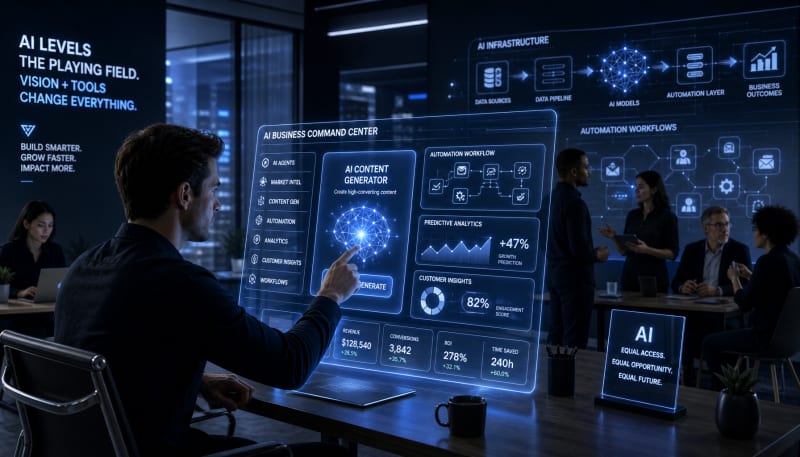
Using natural language to create a new world.
Something fundamental is shifting in how software gets built. Entrepreneurs who once needed to raise millions just to hire a technical team are now shipping products with a laptop and the right set of tools. This isn't about no-code widgets or superficial automation. It's about a new layer of capability that sits between traditional coding and clicking through templates—what some are calling "vibe coding."
The term sounds dismissive, but it captures something real. Entrepreneurs are describing their vision, their vibe, and watching AI systems translate that into functional code. The playing field between funded startups and solo founders is compressing faster than most people realize. The tools enabling this shift aren't just getting better—they're fundamentally changing what it means to build technology.
Related: If you want the full operating system for AI workflows, prompts, ideation, and execution, Snapse OS brings the pieces together.
The Infrastructure Underneath the Shift
Understanding where we are requires looking at the ai infrastructure that makes vibe coding possible. Large language models trained on billions of lines of code can now understand context, anticipate patterns, and generate working solutions across multiple programming languages. But the real breakthrough isn't the models themselves—it's how they've been packaged into tools that understand software architecture, not just syntax.
Modern AI coding assistants can reason about entire codebases. They understand dependencies, recognize architectural patterns, and suggest changes that maintain consistency across thousands of files. This is a different category from autocomplete. The infrastructure supporting these tools includes vector databases that map semantic relationships, continuous learning systems that adapt to your specific codebase, and orchestration layers that coordinate multiple AI models working in concert.
This creates a new dynamic in automation strategy. Instead of automating individual tasks, entrepreneurs can now automate entire technical workflows. The infrastructure handles the complexity while the human provides direction and judgment.
Systems Versus Tools: A Critical Distinction
The conversation about ai systems vs tools matters more than it seems. A tool does one thing well. A system orchestrates multiple capabilities to solve complex problems. Most entrepreneurs get trapped using AI as a collection of disconnected tools—one for code generation, another for debugging, a third for documentation.
The winners are building systems. They're connecting AI coding assistants with automated testing frameworks, linking those to deployment pipelines, and wrapping everything in monitoring that feeds back into the development loop. This systems thinking separates entrepreneurs who ship products from those who just experiment with interesting technology.
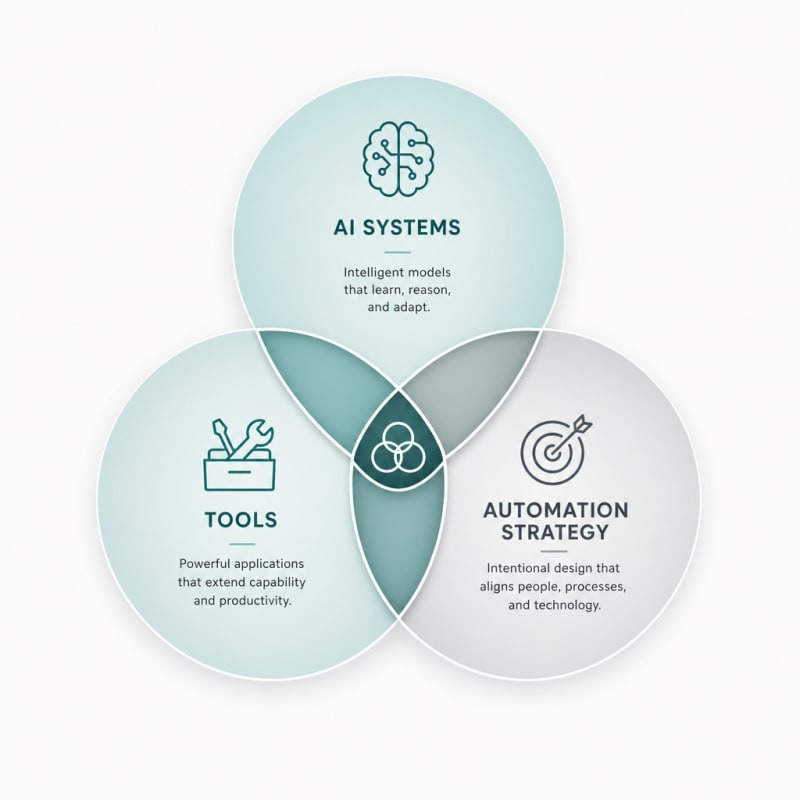
The distinction shows up in results. An entrepreneur using ChatGPT to generate code snippets they paste into their editor is using a tool. An entrepreneur who has AI agents that can read error logs, propose fixes, test them, and open pull requests is using a system. The gulf in productivity between these approaches is enormous.
What Actual Entrepreneurs Are Using
The specific tools in play tell us about ai future trends. GitHub Copilot remains the baseline—most technical founders consider it essential infrastructure now. But Cursor and Windsurf are gaining ground with entrepreneurs who need more contextual awareness. These editors understand project structure and can refactor across files while maintaining architectural consistency.
For backend work, Replit's AI features let non-technical founders spin up APIs and databases with natural language. V0 from Vercel translates design visions into React components that actually follow best practices. Claude and GPT-4 serve as architectural consultants, helping entrepreneurs make technical decisions they would have needed a CTO for previously.
The pattern across all these tools is the same: they're getting better at understanding intent rather than just executing instructions. An entrepreneur can describe a feature from a user perspective, and the AI translates that into technical requirements, suggests an implementation approach, and generates the initial code structure.
Workflows Are Evolving, Not Disappearing
One misconception needs clearing up: this isn't about replacing developers or eliminating technical work. The ai workflows future looks more like augmentation than replacement. Technical founders are building faster. Non-technical founders are becoming capable of building things they couldn't before. The overall volume of software being created is expanding dramatically.
The new workflows involve different skills. Instead of writing every function from scratch, entrepreneurs are orchestrating AI systems, reviewing generated code for quality and security, and focusing on product decisions rather than implementation details. Code review becomes more important, not less. Understanding architecture matters more than memorizing syntax.
Smart entrepreneurs are developing a hybrid skillset. They understand enough about databases to know when the AI is proposing something inefficient. They recognize security vulnerabilities even if they couldn't write the exploit themselves. They can evaluate whether generated code is maintainable or a future nightmare. This shallow-but-broad technical literacy combined with AI systems creates remarkable leverage.
Where This Goes Next
Projecting forward, the ai future trends point toward even more compression. AI systems are getting better at handling ambiguity, which means entrepreneurs can operate with less technical precision and still get working results. The tools are moving from generating code to generating and maintaining entire features, handling updates, managing technical debt, and even making architectural recommendations.
We're likely to see AI systems that can manage multiple services, coordinate between frontend and backend, handle deployment and scaling, and maintain documentation automatically. The entrepreneur's role shifts toward product vision, user research, and strategic decisions. The AI handles the expanding surface area of technical complexity that used to require teams.
This creates interesting competitive dynamics. Large companies with legacy codebases struggle to integrate these new workflows. Small teams and solo founders move faster because they can build from scratch with AI-native approaches. The traditional advantages of scale—big engineering teams, established infrastructure, extensive resources—matter less when a founder with the right tools can ship comparable products in weeks instead of years.
The Real Competitive Edge
Having the tools isn't enough. The entrepreneurs actually leveling the field share several characteristics. They're treating AI as a capability to build systems around, not a magic solution. They're investing in understanding their domain deeply, because AI amplifies judgment—good and bad. They're focusing on shipping and learning from users rather than perfecting technology.
They're also comfortable with a different kind of technical debt. Code generated by AI often works but isn't elegant. It solves the immediate problem without the architectural purity a senior engineer might insist on. Successful entrepreneurs are making pragmatic decisions about when that matters and when shipping fast matters more.
The automation strategy that works involves continuous iteration. Deploy the AI-generated solution, see how it performs with real users, then refine. The cycle time from idea to deployed feature has compressed so dramatically that entrepreneurs can test dozens of approaches in the time it used to take to build one.
Conclusion
Vibe coding represents a genuine shift in who can build technology products. The tools entrepreneurs are using now—AI coding assistants, intelligent editors, natural language interfaces to technical infrastructure—compress the gap between vision and execution. This isn't hype about the future. It's happening in thousands of startups right now.
The playing field isn't perfectly level. Technical expertise still provides advantages. Resources still matter. But the barriers have dropped dramatically. An entrepreneur with domain expertise, user insight, and the right AI tools can compete with funded teams. The infrastructure exists. The systems are maturing. The workflows are proven. What separates winners from observers is willingness to adopt these new approaches while everyone else debates whether they're real.
SNAPSE OS
Build Your Full AI Workflow System
Get the full Snapse OS bundle with Prompt OS, ideation systems, and freelancer workflow tools in one operating system.
Explore Snapse OSSynthetic Proof
Verified — Editorial Layer
This content has passed editorial verification for clarity, accuracy, and trust alignment.
Editor-in-Chief: Kevin Marsh
Verification Status: PASSED
Verification Status: PASSED
Comments
Post a Comment