Learn why organizations are investing in verification instead of detection alone. For years, the fight against synthetic media manipulation followed a familiar pattern: researchers identified deepfake artifacts, built detection models around those signatures, and deployed them across platforms. Detection accuracy improved. Conferences celebrated breakthroughs. The industry felt like it was winning. Then generative AI became exponentially better at eliminating the very artifacts those systems were trained to find. As synthetic media improves, confidence increasingly comes from layered evidence rather than a binary label. Synthetic Proof helps organizations evaluate that evidence in context. What's emerging isn't simply a technical gap that better detection can close. It's a fundamental shift in how organizations must approach digital trust. The old model—detect manipulated content after it's created—assumes defenders can keep pace with attackers....

Use AI to brainstorm ideas, structure projects, generate concepts, and improve creative output.
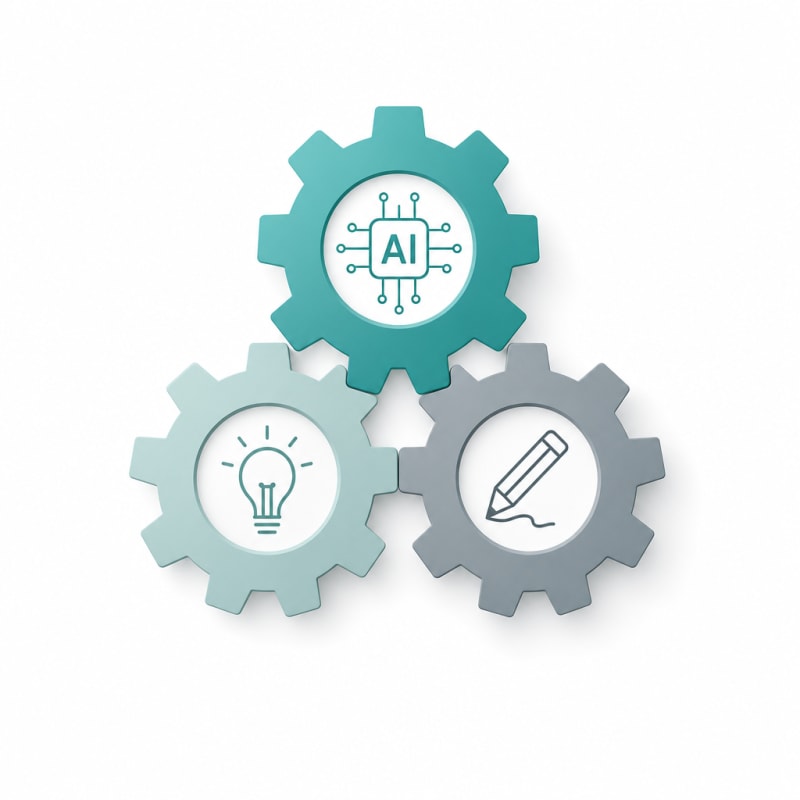
The creative process has always been messy. Ideas come at odd times, brainstorming sessions hit walls, and getting from concept to execution often feels like navigating a maze blindfolded. Artificial intelligence is changing that dynamic by offering tools that complement human creativity rather than replace it. When integrated properly into your workflow, AI can help generate ideas faster, explore creative territories you might have overlooked, and streamline the path from initial concept to finished work.
This isn't about letting machines do the thinking. It's about building a creative ai workflows system that amplifies your natural creative abilities while handling the cognitive heavy lifting that often bogs down the ideation process.
Related: If you need a better system for planning, organizing, and developing content ideas, Content Ideation Hub gives you a repeatable structure.
Why AI Works for Ideation
Human creativity thrives on making unexpected connections between disparate concepts. The problem is that our brains have limits—we draw from our existing knowledge, experiences, and the mental frameworks we've built over time. AI tools don't have the same constraints. They can process vast amounts of information and identify patterns or combinations that wouldn't naturally occur to us.
When you use AI for brainstorming, you're essentially adding a collaborator with different strengths. You bring context, judgment, taste, and strategic thinking. The AI brings speed, breadth, and the ability to generate variations without fatigue. This combination creates a more robust ideation process than either could achieve alone.
Building Your AI Productivity Stack
The term "ai productivity stack" refers to the collection of AI tools you use together to enhance your workflow. The key is selecting tools that address specific friction points in your creative process rather than adopting technology for its own sake.
Start With Conceptual Generation
Large language models excel at generating initial concepts when given proper direction. The trick is learning how to prompt effectively. Instead of asking for "marketing ideas," try: "Generate ten unexpected angles for promoting a productivity app to freelance designers who are skeptical of technology." The more specific your input, the more useful the output.
Use AI to create idea clusters around a central theme. Ask it to explore different perspectives, target audiences, or use cases. The goal isn't to find the perfect idea in the first output but to populate your mental landscape with possibilities you can then refine.
Enhance Research and Discovery
AI tools can quickly surface relevant information, trends, and examples that inform your creative direction. Rather than spending hours researching, you can use AI to compile competitive analyses, identify emerging patterns in your industry, or summarize complex topics that might inspire new approaches.
This acceleration of the research phase means you spend less time gathering information and more time synthesizing it into creative solutions.
Iterate and Refine Faster
One of the biggest bottlenecks in creative work is iteration. Creating variations, testing different approaches, and refining concepts traditionally requires significant time investment. AI dramatically reduces this friction.
Need five different headlines for the same concept? Ten variations of a visual direction? Multiple approaches to solving a design problem? AI can generate these variations in seconds, giving you a broader palette to choose from and combine in unexpected ways.
Practical Applications for Artificial Intelligence Brainstorming
Content and Copywriting
Use AI to generate article outlines, headline variations, or opening paragraphs. The initial output rarely needs to be perfect—it just needs to break through the blank page problem. You can then apply your editorial judgment to reshape, combine, or use the AI output as a springboard for your own thinking.
For longer content projects, AI can help structure complex topics, suggest transitions between sections, or identify gaps in your argument that need addressing.
Visual Concept Development
AI image generators have become surprisingly sophisticated tools for visual ideation. Rather than using them to create final assets, treat them as rapid prototyping tools. Generate mood boards, explore color palettes, test compositional ideas, or visualize concepts that would be time-prohibitive to mock up traditionally.
This approach lets you visualize ideas quickly enough to test them before investing significant time in execution.
Problem-Solving and Strategy
Present AI with complex problems and ask it to generate potential solutions from different frameworks—business strategy, design thinking, systems analysis, or psychological perspectives. The varied approaches can reveal solutions you might not have considered.
Use AI to play devil's advocate with your ideas, identifying potential weaknesses or overlooked considerations before you commit to a direction.
Cross-Pollination of Ideas
Ask AI to apply concepts from unrelated fields to your current challenge. How would a jazz musician approach this product design problem? What could ecosystem biology teach us about community building? These metaphorical leaps often generate genuinely novel perspectives.
Avoiding Common Pitfalls
The most common mistake in using AI for creative work is treating it as an oracle that produces finished work. AI output is raw material, not a final product. You need to bring critical thinking, taste, and strategic judgment to evaluate and refine what it generates.
Another pitfall is over-reliance. If every idea comes from AI prompts, your creative instincts atrophy. Use AI to augment your natural ideation process, not replace it. Start with your own thinking, use AI to expand and explore, then return to human judgment for selection and refinement.
Privacy and data considerations matter too. Don't feed proprietary information, client data, or sensitive content into public AI systems. Build your creative ai workflows with security and confidentiality in mind.
Integrating AI Into Team Workflows
AI ideation tools become even more powerful when used collaboratively. Teams can use AI to generate a broad field of possibilities that become the starting point for group discussion rather than having meetings where people stare at whiteboards waiting for inspiration.
Before a brainstorming session, have team members independently generate AI-assisted ideas around the challenge. Bring these collections together as conversation starters. This approach ensures meetings focus on evaluation and synthesis rather than just generation.
Establish shared standards for how your team uses AI. Which tools are approved? How do you attribute AI-assisted work? What level of human refinement is expected before sharing AI-generated content? These guidelines prevent confusion and maintain quality standards.
Measuring Impact on Your Creative Process
Track how AI integration affects your workflow. Are you generating more ideas per session? Moving from concept to execution faster? Exploring more creative directions before committing to one? Finding more innovative solutions?
The goal isn't just speed—it's improving the quality and range of your creative output. If AI helps you explore ten directions instead of three, you're more likely to find exceptional solutions. If it handles routine variations, you can focus cognitive energy on the truly novel aspects of a project.
Conclusion
Artificial intelligence has matured into a genuinely useful tool for creative professionals who understand how to leverage it effectively. The key is viewing AI as a collaborative partner in your creative process rather than a replacement for human creativity. When you build a thoughtful ai productivity stack that addresses real friction points in your workflow, you create conditions for better ideation, faster iteration, and more thorough exploration of creative possibilities.
The most successful creative professionals using AI today aren't the ones who've outsourced their thinking to algorithms. They're the ones who've learned to dance with these tools—using AI to expand their capabilities while maintaining the human judgment, taste, and strategic thinking that make creative work valuable. Start small, experiment with different applications, and gradually build AI into your creative ai workflows where it genuinely adds value. The technology will continue evolving, but the fundamental principle remains constant: use these tools to become a better creative thinker, not to avoid creative thinking altogether.
The Practical Solution
Treat AI as a thinking partner. Use it to generate concept clusters around specific problems, then apply your judgment to what actually works. Build prompts that are specific enough to get unusual outputs, then combine AI speed and your real world skillset.
— Kevin Marsh, Editor-in-Chief
SNAPSE
Build Better Content Systems
Structure ideation, content planning, and execution into a repeatable system.
Explore Content Ideation HubSynthetic Proof
Verified — Editorial Layer
This content has passed editorial verification for clarity, accuracy, and trust alignment.
Editor-in-Chief: Kevin Marsh
Verification Status: PASSED
Verification Status: PASSED
Comments
Post a Comment