Learn how digital provenance evolved from research into a cornerstone of AI governance and enterprise trust. A decade ago, provenance was mostly a concern for art collectors and archivists. Today, it's becoming foundational infrastructure for organizations deploying AI at scale. The shift happened quietly, then suddenly—driven not by technology alone, but by a collision of regulatory pressure, reputational risk, and the uncomfortable realization that most organizations cannot answer basic questions about their AI systems. Digital provenance—the verifiable record of an asset's origin, transformations, and custody—has evolved from a niche technical capability into a governance requirement. The reasons are straightforward: AI systems are being deployed in consequential settings, regulators are demanding accountability, and the penalties for getting it wrong are no longer theoretical. Provenance is becoming one part of a larger operational trust question: ca...
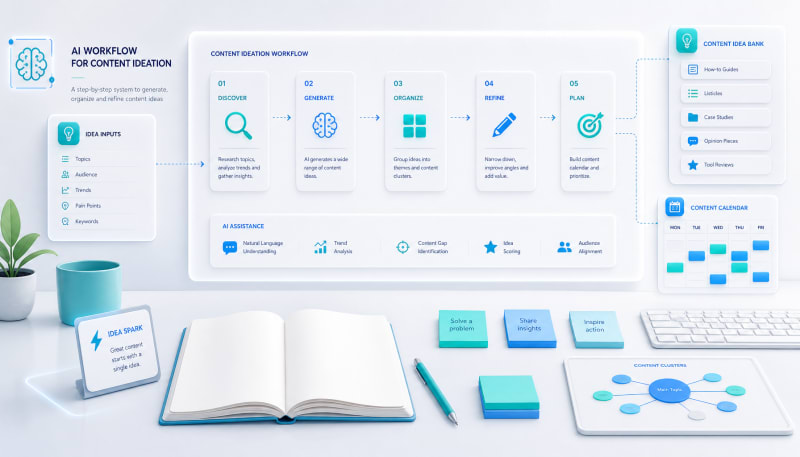
Creating practical AI workflows that help small teams automate repetitive work, improve collaboration, and scale output without increasing operational overhead.
Small teams don't have the luxury of throwing bodies at content problems. You need systems that multiply your output without multiplying your headcount. AI can help, but only if you build a workflow that actually works instead of adding another layer of chaos to your process.
This guide walks through a step-by-step system for using AI to generate and organize content ideas, then turn those ideas into a publishing system that keeps your team moving forward.
Related: If you need a better system for planning, organizing, and developing content ideas, Content Ideation Hub gives you a repeatable structure.
Why Small Teams Need AI-Powered Content Workflows
The gap between what small teams want to publish and what they actually can publish usually comes down to three bottlenecks: generating enough quality content ideas, organizing those ideas into a coherent plan, and maintaining consistency without burning out your team.
An AI workflow doesn't replace human creativity or judgment. It removes the friction from ideation and planning so your team can focus on execution and quality control. When you're working with limited resources, that shift matters.
Step 1: Set Up Your Ideation Workflow
Start by building a repeatable process for generating content ideas. The goal isn't to let AI write your content strategy. It's to use AI as a brainstorming partner that never runs out of angles.

Create Your Prompt Library
Build a collection of prompts that consistently generate useful content ideas for your specific audience and niche. Your prompts should include context about your audience, your brand voice, and the types of content that perform well for you.
A basic prompt template might look like: "Generate 10 content ideas for [your audience] who struggle with [specific problem]. Focus on [content type] that can be created in [timeframe]. Each idea should address a specific pain point and suggest a clear outcome."
Store these prompts in a shared document where your team can access and refine them over time. What works evolves as you learn more about your audience.
Schedule Regular Ideation Sessions
Run AI-powered ideation sessions weekly or biweekly. Don't wait until you're desperate for ideas. Set aside 30 minutes to generate a batch of content ideas, then spend another 30 minutes as a team reviewing and selecting the best ones.
This rhythm prevents the feast-or-famine cycle that kills consistency in small teams.
Step 2: Build Your Content Planning System
Raw ideas aren't enough. You need a system that turns those ideas into an organized content plan your team can actually execute against.
Create an Idea Scoring Framework
Not all content ideas deserve equal priority. Build a simple scoring system based on factors like audience relevance, search potential, production effort, and strategic alignment.
You can use AI to help evaluate ideas against these criteria, but the final scoring should involve human judgment. AI can suggest that an idea has high search volume, but only your team knows if you have the expertise and resources to execute it well.
Map Ideas to Your Publishing Calendar
Once you've scored and selected ideas, slot them into your publishing calendar based on your team's capacity. Be realistic about what you can produce. A consistent schedule of quality content beats sporadic bursts of mediocre posts.
Use AI to help identify content clusters and themes. If you're planning content around a specific topic, AI can suggest related angles that turn one-off posts into a series that builds authority and keeps readers engaged.
Step 3: Organize Your Content Database
A workflow only works if everyone on your team knows where to find things. Build a centralized system for storing and tracking content ideas from inception to publication.
Choose Your Tools
You don't need expensive software. A well-organized spreadsheet or a simple project management tool like Notion, Airtable, or Trello works fine. The key is having one source of truth where every content idea has a clear status.
Your database should track: the original idea, who's responsible for it, current status, target publish date, relevant keywords, and any AI-generated research or outlines associated with it.
The Practical Solution
Start by building three shared documents: a prompt library for consistent ideation, a scoring rubric that weighs effort against impact, and a single content database that shows who owns what. Run weekly 30-minute AI brainstorming sessions, but ensure you make the final call on what gets published not the AI. Human in the loop every time.
— Kevin Marsh, Editor-in-Chief
Synthetic Proof
Verified — Editorial Layer
This content has passed editorial verification for clarity, accuracy, and trust alignment.
Editor-in-Chief: Kevin Marsh
Verification Status: PASSED
Verification Status: PASSED
Comments
Post a Comment