Strategies for ensuring your asset’s chain of custody remains verifiable across any channel. A photograph appears in a news report. A legal document crosses a negotiation table. A research dataset underpins a policy decision. In each case, the same question arises: where did this content actually come from? For decades, that question was answerable through metadata, file properties, and institutional trust. But generative AI has fundamentally altered the equation. Content can now be created, modified, and redistributed at scale with minimal effort and near-perfect fidelity. The result is a provenance crisis that affects everything from newsrooms to courtrooms to corporate data operations. A credential can explain part of an asset’s history. Independent evaluation helps determine how much confidence the available evidence should support. Synthetic Proof is built for that wider trust assessment. The industry's response has largely centered on two technologies...

Work smarter, not harder: Building a modern engine for effortless asset generation.
Content creation has become a high-stakes game. Whether you're running a solo blog or managing a team of writers, the pressure to publish consistently while maintaining quality can feel overwhelming. The good news? AI tools have evolved beyond simple writing assistants into complete content pipeline systems that handle everything from ideation to publication.
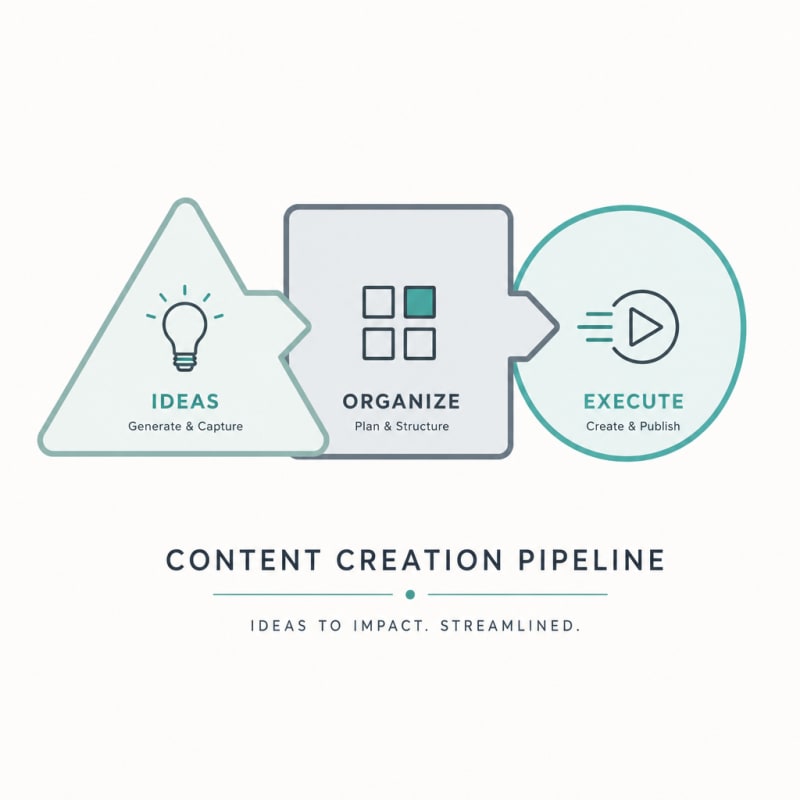
This guide walks you through a step-by-step system for using ai tools content creation to generate, organize, and execute your content strategy. You'll learn which best ai tools 2026 actually deliver results and how to build a workflow that keeps your content calendar full without burning out.
Related: If you need a better system for planning, organizing, and developing content ideas, Content Ideation Hub gives you a repeatable structure.
Why Your Content Pipeline Needs Automation Now
The traditional content creation process is broken. Most teams waste hours in brainstorming sessions that produce mediocre ideas, then scramble to fill their publishing calendar at the last minute. AI automation solves this by creating a systematic approach to content generation.
When you automate your content pipeline, you gain three critical advantages: consistent output without the creative burnout, data-driven topic selection instead of guesswork, and the ability to scale your content production without hiring additional writers.
Step 1: Automate Content Ideation and Topic Research
The foundation of any content pipeline starts with ideas. Instead of staring at a blank page, use AI tools to generate dozens of relevant topics in minutes.
Jasper AI for Topic Generation
Jasper has refined its content brief workflow to analyze your competitors, identify content gaps, and suggest topics that actually rank. Input your target keywords, and the platform generates content ideas complete with suggested headlines, key points to cover, and SEO recommendations.
The real power comes from Jasper's integration with search data. It doesn't just suggest random topics—it shows you what your audience is actively searching for and where you have the best chance to rank.
MarketMuse for Strategic Content Planning
MarketMuse takes a different approach by analyzing your entire content library and comparing it against top-performing competitors. It identifies which topics you should prioritize based on your domain authority and competitive landscape.
Use MarketMuse to build topic clusters rather than isolated articles. The platform maps out how different pieces of content should link together, creating a strategic content architecture instead of random blog posts.
Step 2: Organize Ideas with AI-Powered Content Calendars
Having ideas means nothing if they sit in a disorganized spreadsheet. This is where AI-enhanced project management tools transform your workflow.
Notion AI for Content Planning
Notion AI has become the go-to workspace for content teams. Create a content database that automatically categorizes ideas by topic cluster, keyword difficulty, and estimated traffic potential. The AI assistant can generate content briefs, suggest publication dates based on your capacity, and even draft outline structures.
Set up views that show your pipeline at different stages: ideas in research, outlines ready for writing, drafts in review, and content scheduled for publication. Notion's AI can fill in missing details and keep your database organized without manual updates.
ClickUp AI for Workflow Automation
ClickUp takes organization further by automating task assignments and deadline management. When you add a new content idea, the AI can automatically create subtasks for research, writing, editing, and promotion. It assigns team members based on their workload and expertise, then adjusts timelines as priorities shift.
The standout feature is ClickUp's ability to learn from your team's patterns. It recognizes how long different content types take to produce and adjusts future scheduling accordingly.
Step 3: Accelerate Content Production with AI Writing Tools
Once your ideas are organized, it's time to actually create content. The best ai tools 2026 don't write for you—they write with you, handling the heavy lifting while you focus on strategy and refinement.
Claude for Long-Form Content
Claude excels at maintaining context over long documents. Feed it your content brief and research materials, and it produces comprehensive first drafts that stay on topic. The key is using Claude for structure and depth, then editing for your unique voice.
Create custom prompts that include your brand guidelines, target audience details, and content goals. Claude will adapt its output to match your requirements, producing drafts that need refinement rather than complete rewrites.
Writesonic for Multiple Content Formats
Your pipeline isn't just blog posts. You need social media updates, email newsletters, video scripts, and landing pages. Writesonic specializes in repurposing core content into multiple formats quickly.
Start with a pillar article, then use Writesonic to extract key points for LinkedIn posts, create email sequences, and generate video script outlines. This multiplication effect means one research session feeds your entire content ecosystem.
Step 4: Optimize and Refine with AI Editing Tools
Raw AI output needs human polish. These tools catch errors and improve readability without manual line-by-line editing.
Grammarly Business for Team Consistency
Grammarly has evolved into a content quality platform. Set up a style guide that automatically flags inconsistencies in tone, terminology, and brand voice across your entire team's output. The business version learns your preferences and provides increasingly relevant suggestions.
The plagiarism checker integration is essential when using AI writing tools. It ensures your content is unique enough to avoid penalties while maintaining your editorial standards.
Hemingway Editor Plus for Readability
AI-generated content often sounds robotic because it uses complex sentence structures. Hemingway Editor Plus now includes AI-powered rewriting suggestions that simplify without dumbing down your content.
Run every draft through Hemingway before publication. Target a reading level appropriate for your audience, and let the tool suggest concrete improvements rather than vague feedback.
Step 5: Schedule and Distribute Content Automatically
The final pipeline stage is getting your content in front of readers. Automation here ensures nothing sits unpublished due to manual bottlenecks.
Buffer AI for Social Media Automation
Buffer's AI assistant analyzes your past posts to determine optimal publishing times and content formats. It generates social media captions from your articles, suggests which platforms will perform best, and even recommends hashtags based on current trends.
Set up content queues for each platform, and Buffer fills them automatically from your published articles. The AI adjusts posting frequency based on engagement patterns, ensuring you're not over-saturating your audience.
Zapier for Cross-Platform Integration
Zapier connects your entire content stack. When you publish an article in WordPress, automatically create social posts in Buffer, add the link to your newsletter in Mailchimp, and notify your team in Slack. These workflows eliminate the manual busywork that eats up hours after publication.
Build Zaps that move content through your pipeline without human intervention. The AI-powered path suggestions help you discover integration opportunities you hadn't considered.
Building Your Complete Automated Content System
The power isn't in individual tools—it's in how they work together. Here's how to connect these ai tools content creation into a single system:
Start each month by using MarketMuse to identify your top content opportunities. Import these into Notion AI as project cards with target keywords and strategic goals. Use Jasper to generate detailed content briefs for each topic, then assign them to writers in ClickUp with automated deadlines based on your publishing calendar.
Writers use Claude or Writesonic to create first drafts, which move automatically to an editing queue. Editors use Grammarly and Hemingway to refine the content, then approve for publication. Once published, Zapier triggers your distribution workflow through Buffer and your email platform.
This system runs continuously. While you're publishing this week's content, AI tools are already generating next month's ideas and organizing them into your pipeline. You shift from constant firefighting to strategic oversight.
Measuring What Actually Matters
Automation only works if you're tracking the right metrics. Focus on pipeline health indicators: how many ideas move from research to publication each month, average time from ideation to publishing, and the ratio of AI-generated drafts to published pieces.
Use Google Analytics to track whether your automated content performs as well as manually created pieces. If AI-assisted articles underperform, adjust your prompts and editing process rather than abandoning automation entirely.
Common Pitfalls to Avoid
The biggest mistake is treating AI tools as a complete replacement for human judgment. These systems generate starting points, not finished products. Your expertise determines topic selection, ensures accuracy, and adds the unique perspectives that make content worth reading.
Don't automate everything at once. Start with ideation and organization, get comfortable with those workflows, then add content generation tools. Trying to implement a complete system overnight leads to confusion and abandoned tools.
Watch for homogenization. When everyone uses the same AI tools with similar prompts, content becomes generic. Use automation for structure and research, but inject your specific knowledge and viewpoint during the editing phase.
Moving Forward with Your Automated Pipeline
The top ai tools have matured into production systems rather than experimental toys. They handle the repetitive, time-consuming aspects of content creation so you can focus on strategy, quality control, and the creative elements that actually differentiate your content.
Start small. Pick one stage of your content pipeline that creates the most friction—usually ideation or organization—and implement automation there first. Once that's running smoothly, expand to the next stage. Within a few months, you'll have a system that produces more content with less stress.
Your content pipeline should work for you, not the other way around. These AI tools create the infrastructure for consistent, quality output without the burnout that comes from manual processes. Build your system, refine it based on results, and watch your content operation transform from chaotic to predictable.
Synthetic Proof
Verified — Editorial Layer
This content has passed editorial verification for clarity, accuracy, and trust alignment.
Editor-in-Chief: Kevin Marsh
Verification Status: PASSED
Verification Status: PASSED
Comments
Post a Comment