Strategies for ensuring your asset’s chain of custody remains verifiable across any channel. A photograph appears in a news report. A legal document crosses a negotiation table. A research dataset underpins a policy decision. In each case, the same question arises: where did this content actually come from? For decades, that question was answerable through metadata, file properties, and institutional trust. But generative AI has fundamentally altered the equation. Content can now be created, modified, and redistributed at scale with minimal effort and near-perfect fidelity. The result is a provenance crisis that affects everything from newsrooms to courtrooms to corporate data operations. A credential can explain part of an asset’s history. Independent evaluation helps determine how much confidence the available evidence should support. Synthetic Proof is built for that wider trust assessment. The industry's response has largely centered on two technologies...

User-focused breakdown demonstrating how creative teams can transparently show their human-plus-AI creative process.
When a photograph carries EXIF data showing camera make, lens type, ISO, and location, no one questions why that information exists. It's simply understood as part of the file—context that travels with the image because context matters. Now imagine applying that same principle to every piece of content created, edited, or touched by AI tools.
That's the promise behind content metadata standards designed to function as nutrition labels for media. Just as food packaging reveals ingredients, processing methods, and nutritional content, these emerging frameworks aim to make the provenance of digital content visible, traceable, and verifiable.
The value of provenance ultimately depends on whether organizations can turn evidence into confident decisions. Synthetic Proof helps examine that broader trust picture across AI content and workflows.
The shift isn't purely technical. It reflects a broader recognition that in an environment where generative AI can produce credible text, images, and video at scale, the question "where did this come from?" has become as important as "what does this say?"
Metadata as Provenance Infrastructure
Traditional file metadata has always existed, but it was designed for a different era. Creation dates, file sizes, and author names served organizational purposes—helping users find documents or track versions within known systems. They weren't built to answer questions about synthetic content, multi-stage editing workflows, or tool chains involving four different AI models.
Modern content provenance metadata operates differently. Rather than simply recording who saved a file last, it captures the complete lifecycle: which tools were used, what transformations occurred, whether human editing followed AI generation, and crucially, whether the content has been altered since its initial creation.
This isn't metadata as afterthought. It's metadata as trust infrastructure.
The technical mechanism typically involves embedding structured data directly into content files—similar to how EXIF works for images, but extended to video, audio, text documents, and other media types. Standards like the Coalition for Content Provenance and Authenticity's (C2PA) specification define how this information should be formatted, signed cryptographically, and preserved across platforms.
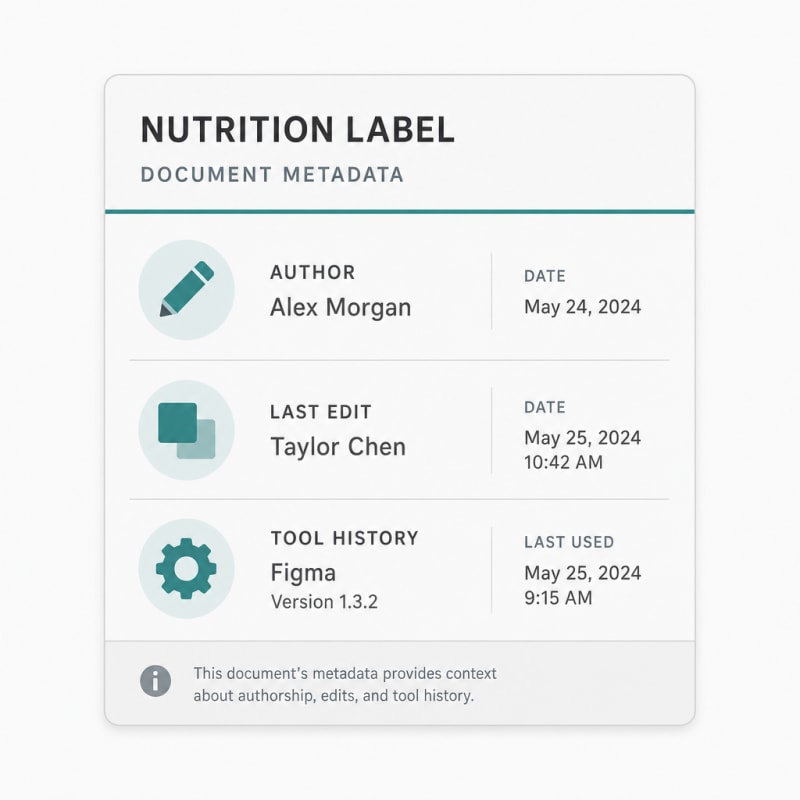
What Actually Gets Tracked
Effective provenance metadata doesn't just stamp "AI-generated" onto a file. It creates a detailed history that can answer specific operational questions.
Authorship tracking identifies not just who created something, but the nature of that creation. Was it authored by a human using a word processor? Generated entirely by a language model? Co-created through an iterative process where a designer sketched an initial concept and then refined AI-generated iterations?
Edit history captures each significant modification. If an image began as a photograph, was enhanced through generative fill, had color grading applied, and then was cropped, that sequence gets recorded. This isn't about surveillance—it's about transparency. The goal is making editorial choices visible rather than invisible.
Tool provenance logs which software and models touched the content. This matters more than it initially appears. When a particular AI model is later discovered to have been trained on contested data, or when a specific tool version introduces artifacts, organizations need to know which assets were created using those systems. Without tool history, that becomes forensic guesswork.
Crucially, many implementations also track whether metadata chains have been broken. If content passes through a system that strips or alters provenance information, that gap itself becomes part of the record when the content re-enters a provenance-aware environment.
The Nutrition Label Analogy Reveals the Purpose
Comparing content metadata to nutrition labels isn't just marketing language—it clarifies what these systems actually aim to accomplish.
Nutrition labels don't tell you whether food is "good" or "bad." They provide standardized information that lets different stakeholders make informed decisions based on their own criteria. A competitive athlete, someone managing diabetes, and a parent packing school lunches all read the same label but apply different frameworks for evaluation.
Content provenance metadata works similarly. Publishers might use it to verify that submitted articles meet editorial standards around AI disclosure. Platforms could surface provenance information to help users assess credibility. Legal teams might rely on it during discovery to establish content authenticity. Archivists use it to maintain reliable historical records.
The metadata itself remains neutral. It documents what happened without prescribing what should happen. That separation between recording and policy-making is what makes these systems viable across different organizations with different standards.
Where This Intersects TrustOps
As TrustOps emerges as an operational discipline—focused on making AI systems transparent, accountable, and verifiable in production environments—content metadata becomes critical infrastructure rather than optional enhancement.
TrustOps isn't just about preventing failures. It's about creating auditable systems where claims can be verified, where processes can be reconstructed, and where accountability exists beyond self-reporting. Content metadata provides the evidence layer that makes those capabilities possible.
Consider a financial services firm using AI to generate client communications. TrustOps practices would ensure that every generated message carries metadata showing which model version created it, whether compliance review occurred, what edits were made, and who approved final distribution. If questions arise six months later, that metadata trail allows reconstruction of exactly what happened—not approximations based on system logs and employee memory.
This is where metadata transitions from "interesting technical feature" to "operational requirement." Organizations building mature AI operations increasingly recognize that without provenance infrastructure, they're running systems they can't fully audit, deploying content they can't completely verify, and accepting risks they can't properly quantify.
Implementation Happens in Layers
Adopting content provenance doesn't require replacing entire content management stacks overnight. Practical implementation typically happens incrementally.
The first layer involves choosing tools and platforms that support provenance standards. Adobe, Microsoft, and other major software vendors have begun integrating C2PA support. When organizations select or upgrade creative tools, procurement decisions can prioritize provenance-aware options.
The second layer addresses workflows. Even with compatible tools, metadata only helps if it's actually captured and preserved. This means configuring systems to embed provenance information by default, training teams on why it matters, and establishing policies around metadata handling—particularly ensuring it isn't accidentally stripped during format conversions or platform migrations.
The third layer involves verification infrastructure. Metadata only creates trust if it can be validated. This requires systems capable of checking cryptographic signatures, verifying certificate chains, and surfacing metadata to stakeholders who need it. For many organizations, this is where independent trust infrastructure becomes relevant—specialized platforms designed specifically for provenance verification rather than trying to build that capability in-house.
Implementation doesn't need to be perfect to be valuable. Even partial provenance coverage—tracking AI-generated marketing images but not yet covering every internal document—provides more transparency than none.
What Metadata Cannot Solve
Provenance metadata is powerful infrastructure, but it's not a complete solution to content authenticity challenges.
Metadata can be stripped. A bad actor can remove provenance information before redistributing content. While tamper-evident features make alterations detectable, they don't physically prevent modification.
Metadata doesn't verify truth—only lineage. A document might carry perfect provenance metadata showing it was entirely human-authored using traditional word processing, and still contain factual errors or deliberate misinformation. Provenance tells you how content was made, not whether claims within it are accurate.
Adoption remains incomplete. Until provenance-aware tools and platforms reach critical mass, metadata coverage will have gaps. Content passing through non-compliant systems loses its provenance trail, at least temporarily.
These limitations don't invalidate the approach. They simply clarify that content metadata is one component of trust infrastructure—not a singular solution. Organizations building comprehensive TrustOps practices layer multiple verification approaches rather than depending on any single mechanism.
The Shift From Optional to Expected
Five years ago, content provenance metadata was a research topic. Today it's moving toward operational reality, driven by several converging pressures.
Regulatory frameworks increasingly expect transparency around AI-generated content. The EU AI Act, state-level legislation, and industry-specific regulations all push toward disclosure requirements that are significantly easier to implement with automated metadata than manual tracking.
Platform policies are evolving. Major social networks and content platforms have begun requiring AI disclosure for certain content types. Provenance metadata provides a technical mechanism for meeting those requirements consistently rather than relying on user compliance.
Enterprise risk management is catching up. Legal, compliance, and audit teams increasingly ask questions about content verification that communications and marketing teams can't easily answer without provenance infrastructure.
The transition mirrors earlier shifts around security practices. SSL certificates seemed like unnecessary complexity until they became expected infrastructure. Multi-factor authentication felt burdensome until it became standard practice. Content provenance is following a similar trajectory—from specialist concern to operational baseline.
Conclusion
Tracking authorship, edits, and tool history through metadata represents a fundamental shift in how digital content carries context. Rather than treating provenance as something to reconstruct forensically when questions arise, these systems embed it as native infrastructure—traveling with content as naturally as creation dates or file formats.
The nutrition label analogy captures what makes this approach viable. By providing standardized information without prescribing specific interpretations, provenance metadata becomes useful across different use cases, different industries, and different risk frameworks. Publishers, platforms, legal teams, and archivists can all leverage the same underlying infrastructure for their distinct purposes.
For organizations building TrustOps practices around AI systems, content metadata transitions from interesting option to operational necessity. The question isn't whether to track provenance, but how quickly to build that capability before its absence becomes a liability. The infrastructure is emerging. The standards are maturing. What remains is organizational commitment to implementing them before transparency becomes mandated rather than chosen.
SYNTHETIC PROOF
FROM PROVENANCE TO OPERATIONAL TRUST
Understand Your AI Trust Gap
Synthetic Proof helps teams evaluate verification, provenance, prompt risk, and digital media trust through independent audits and structured findings.
Explore Synthetic ProofSynthetic Proof
Verified — Editorial Layer
This content has passed editorial verification for clarity, accuracy, and trust alignment.
Editor-in-Chief: Kevin Marsh
Verification Status: PASSED
Verification Status: PASSED
Comments
Post a Comment