Strategies for ensuring your asset’s chain of custody remains verifiable across any channel. A photograph appears in a news report. A legal document crosses a negotiation table. A research dataset underpins a policy decision. In each case, the same question arises: where did this content actually come from? For decades, that question was answerable through metadata, file properties, and institutional trust. But generative AI has fundamentally altered the equation. Content can now be created, modified, and redistributed at scale with minimal effort and near-perfect fidelity. The result is a provenance crisis that affects everything from newsrooms to courtrooms to corporate data operations. A credential can explain part of an asset’s history. Independent evaluation helps determine how much confidence the available evidence should support. Synthetic Proof is built for that wider trust assessment. The industry's response has largely centered on two technologies...
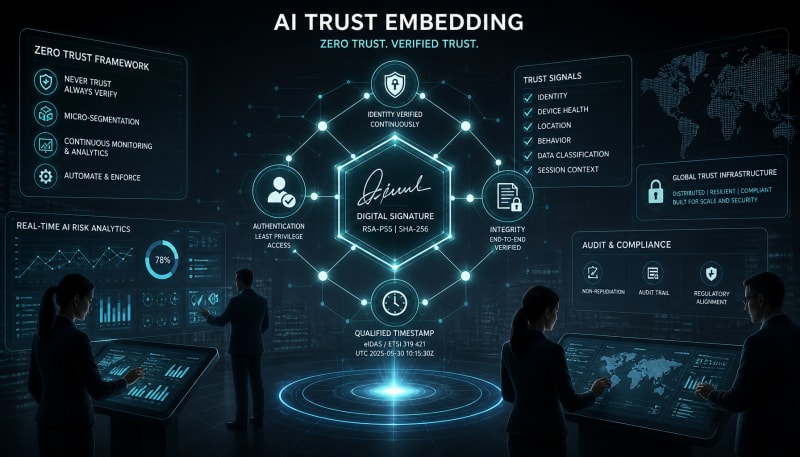
Practical deep dive into time-stamping authorities (TSA) and cryptographic signatures for legal and forensic admissibility.
The most valuable AI outputs are often the ones that matter most if they turn out to be fake. A medical diagnostic analysis. A legal contract summary. A financial compliance report. A forensic image used as evidence. These aren't casual workflows—they're decisions with consequences.
Traditional trust models assume verification happens at the perimeter. You authenticate a user, validate their credentials, then trust everything that happens inside your systems. But AI changes the equation. Models operate across distributed infrastructure. Outputs get copied, modified, and shared across organizational boundaries. By the time someone questions an AI-generated report or image, the original context may be long gone.
The next stage of AI adoption is not only about capability. It is about what organizations can confidently verify. Synthetic Proof is building the independent trust layer for that shift.
That's why a small but growing number of organizations are shifting toward what's increasingly called zero-trust capture—the practice of embedding cryptographic signatures and qualified timestamps directly into AI outputs at the moment of creation, not after the fact.
Trust Used to Be an Afterthought
For most of AI's short history, trust infrastructure wasn't part of the conversation. Teams built models, optimized performance, and shipped features. If someone later questioned an output's authenticity, you'd dig through logs, check metadata, maybe reconstruct the workflow. It was reactive, manual, and often inconclusive.
That approach worked when AI outputs stayed inside controlled environments. It breaks down when those outputs become evidence in regulatory filings, get used in courtrooms, influence financial decisions, or shape public policy. You can't retroactively prove what a model generated, when it was created, or whether it's been altered—not with any cryptographic certainty.
The industry is recognizing that trust needs to be architectural, not procedural. It can't be something you add later. It has to be embedded at creation.
Why Metadata Alone Isn't Enough
Some organizations assume that logging metadata—prompt text, model version, timestamp—provides sufficient provenance. It doesn't. Metadata can be edited. Logs can be manipulated. Files can be copied with new timestamps. Without cryptographic binding, metadata is just a claim, not proof.
Zero-trust capture treats every AI output as untrusted by default until it's cryptographically signed and timestamped at the source. The signature proves what was created. The timestamp proves when. Together, they create an immutable record that moves with the asset, independent of where it's stored or who handles it next.
How Cryptographic Signatures Bind Identity to Output
A cryptographic signature is a mathematical proof that a specific entity—whether a model, system, or operator—created a specific output. It works by using asymmetric encryption: a private key signs the data, and anyone with the corresponding public key can verify the signature without accessing the private key itself.
When applied to AI outputs, this means the moment a model generates an image, document, or dataset, that output gets hashed and signed. The signature is embedded into the file or attached as metadata that travels with it. Any modification to the content—even a single pixel or character—breaks the signature, making tampering immediately detectable.
This isn't theoretical. Organizations handling sensitive AI workflows are already embedding signatures into outputs for compliance, auditability, and legal defensibility. The shift is happening quietly, but it's accelerating.
The Role of Qualified Timestamps
Signatures prove identity and integrity, but they don't prove time. That's where qualified timestamps come in.
A qualified timestamp is a cryptographically secure record of when an output was created, issued by a trusted timestamping authority. Unlike system clocks—which can be manipulated—qualified timestamps are anchored to external, auditable sources. They provide legal-grade proof that a specific asset existed at a specific moment, which becomes critical in disputes, audits, or regulatory reviews.
The combination of cryptographic signatures and qualified timestamps creates a trust anchor that moves with the asset. It doesn't matter if the file gets copied to a different server, shared via email, or submitted as evidence months later. The embedded proof remains intact and independently verifiable.
Zero-Trust Capture Shifts Verification to the Edge
The zero-trust capture model inverts traditional verification. Instead of trusting the environment and verifying outputs later, it treats the environment as untrusted and embeds verification at the point of creation.
This matters because AI workflows increasingly span multiple systems. A model might be hosted in one cloud environment, called via API by another service, with outputs stored in a third location. By the time that output reaches a decision-maker, it may have passed through several intermediaries. Without embedded trust, proving its origin and integrity becomes nearly impossible.
Organizations implementing zero-trust capture are embedding signing and timestamping into their AI pipelines—at the model inference layer, within content generation tools, or as part of post-processing workflows. The technical implementation varies, but the principle is consistent: trust is established at creation, not retroactively.
What This Looks Like in Practice
Consider a healthcare organization using AI to analyze medical imaging. The diagnostic output includes not just the analysis, but a cryptographic signature from the model that generated it and a qualified timestamp proving when the inference occurred. If that analysis is later questioned—by a physician, insurer, or regulator—the organization can provide cryptographic proof of its origin and integrity without relying on internal logs or trust-me assurances.
Or consider a newsroom using AI to generate visual content. Embedding signatures and timestamps into those images allows downstream consumers—fact-checkers, platforms, audiences—to verify authenticity independently. The provenance travels with the asset, making verification distributed rather than centralized.
The Compliance and Legal Dimensions
Regulators are starting to ask harder questions about AI-generated content. How do you prove an output wasn't altered after creation? How do you demonstrate that a specific model version produced a specific result? How do you maintain chain of custody for AI assets used in legal proceedings?
Cryptographic signatures and qualified timestamps provide answers that hold up under scrutiny. They're not just technical safeguards—they're becoming evidentiary requirements. The EU AI Act, emerging data privacy frameworks, and sector-specific regulations increasingly expect organizations to demonstrate provenance and integrity for AI outputs, particularly in high-risk applications.
Organizations that embed trust infrastructure now are positioning themselves ahead of these requirements. Those that wait are building technical debt that will be expensive to retrofit.
Independent Trust Infrastructure Is Emerging
The demand for embedded trust is driving the emergence of independent trust infrastructure—platforms and protocols designed specifically to sign, timestamp, and verify AI outputs at scale.
These systems operate as neutral third parties, providing cryptographic services without requiring organizations to build their own certificate authorities, timestamping infrastructure, or verification endpoints. They're designed to integrate into existing AI workflows with minimal friction, embedding trust without slowing down production pipelines.
This is still an early market, but the pattern is clear: trust infrastructure is moving from ad-hoc, internal solutions toward standardized, auditable, and interoperable systems. Organizations want cryptographic certainty without becoming cryptography experts.
Final Thoughts
AI trust isn't about trusting the technology. It's about proving what happened, when it happened, and whether it's been altered—without relying on trust at all.
Cryptographic signatures and qualified timestamps make that proof possible. They turn AI outputs into verifiable artifacts, moving trust from the environment to the asset itself. This is zero-trust capture: the practice of embedding provenance at creation rather than reconstructing it after the fact.
The organizations adopting this approach aren't doing it because it's trendy. They're doing it because the alternative—hoping metadata holds up under legal scrutiny or regulatory review—isn't a defensible strategy anymore. AI outputs are becoming too consequential, too distributed, and too scrutinized to rely on anything less than cryptographic certainty.
The industry is moving from treating trust as an operational concern to treating it as infrastructure. And that shift is already underway.
The Practical Position
Organizations still treating AI provenance as a logging problem are confusing documentation with proof. The shift toward cryptographic signatures and qualified timestamps signals something deeper: trust infrastructure is becoming as fundamental to AI systems as compute or data architecture. The question isn't whether to embed verification—it's whether you're building systems that can defend their outputs when it matters most.
— Kevin Marsh, Editor-in-Chief
SYNTHETIC PROOF
INDEPENDENT AI TRUST INFRASTRUCTURE
Understand Your AI Trust Gap
Synthetic Proof helps teams evaluate prompts, digital media, verification signals, and operational trust through independent audits.
Explore Synthetic ProofSynthetic Proof
Verified — Editorial Layer
This content has passed editorial verification for clarity, accuracy, and trust alignment.
Editor-in-Chief: Kevin Marsh
Verification Status: PASSED
Verification Status: PASSED
Comments
Post a Comment