Strategies for ensuring your asset’s chain of custody remains verifiable across any channel. A photograph appears in a news report. A legal document crosses a negotiation table. A research dataset underpins a policy decision. In each case, the same question arises: where did this content actually come from? For decades, that question was answerable through metadata, file properties, and institutional trust. But generative AI has fundamentally altered the equation. Content can now be created, modified, and redistributed at scale with minimal effort and near-perfect fidelity. The result is a provenance crisis that affects everything from newsrooms to courtrooms to corporate data operations. A credential can explain part of an asset’s history. Independent evaluation helps determine how much confidence the available evidence should support. Synthetic Proof is built for that wider trust assessment. The industry's response has largely centered on two technologies...

Learn how provenance standards are transforming digital authenticity.
A photograph used to carry inherent evidence of its creation. The grain structure, the lens distortion, even the metadata embedded in the file—all of it pointed back to a camera, a moment, a physical reality. That contract is breaking. As generative AI makes synthetic content indistinguishable from captured reality, the industry is responding not with detection algorithms, but with something more fundamental: a standard for proving where digital content actually comes from.
The Coalition for Content Provenance and Authenticity—known as C2PA—represents the most significant coordinated effort to embed verifiable origin data directly into images, videos, and audio files. Backed by Adobe, Microsoft, Google, Intel, the BBC, and others, C2PA isn't a watermark or a detection tool. It's a specification for cryptographically signing content at the moment of creation and preserving that signature as the file moves through editing workflows, publishing systems, and distribution channels.
The value of provenance ultimately depends on whether organizations can turn evidence into confident decisions. Synthetic Proof helps examine that broader trust picture across AI content and workflows.
For organizations publishing content, commissioning creative work, or operating in regulated industries, this standard is quickly becoming infrastructure rather than experiment.
Provenance Works Differently Than Detection
Most discussions about synthetic content focus on detection—training classifiers to identify AI-generated images or deepfakes. C2PA takes the opposite approach. Rather than asking whether content is real, it asks: can this file prove its own history?
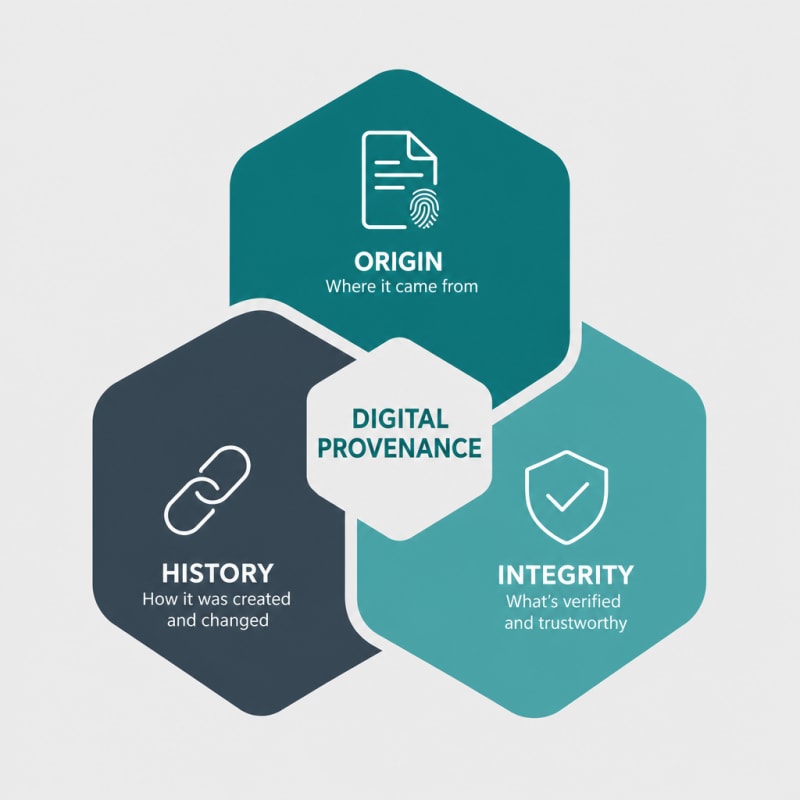
The standard works by attaching a cryptographically signed manifest to a digital file. That manifest records what created the content—whether a camera sensor, design software, or a generative AI model—and tracks every substantive edit made afterward. Each change creates a new entry in the provenance chain, signed by the tool or platform that made it.
The result is not a binary judgment of authenticity. It's a verifiable record. A newsroom can examine an image and see that it originated from a specific camera model, was edited in Photoshop to adjust exposure, and was never touched by generative AI. A brand reviewing influencer content can verify that a product photograph was captured rather than generated. A legal team can trace a contested image back to its source.
This matters because detection will always lag creation. As generative models improve, the artifacts that reveal synthetic origin disappear. C2PA sidesteps that arms race entirely by making origin a property of the file itself.
The Standard Is Already Inside Production Tools
C2PA adoption is no longer theoretical. Adobe integrated Content Credentials—its implementation of the standard—across Photoshop, Lightroom, and Premiere Pro starting in 2022. Users can attach provenance data to their work, and viewers can inspect that data through a panel built into Creative Cloud applications or through browser extensions.
Leica embedded C2PA signing into its M11-P camera, making it the first production camera to generate cryptographically signed images at capture. Nikon, Sony, and Canon have announced similar commitments. Microsoft added provenance metadata to AI-generated images in Bing and Designer. Google is integrating the standard into Android's camera framework.
OpenAI now embeds C2PA manifests in images created by DALL·E. The manifest identifies the content as AI-generated, records the creation timestamp, and signs the data with OpenAI's cryptographic key. The same pattern is emerging across Midjourney, Stability AI, and other generative platforms.
What's notable is the consistency. Rather than competing proprietary systems, the industry is converging on a shared technical specification. That convergence makes C2PA infrastructure—something platforms can assume exists rather than something each organization builds from scratch.
Provenance Doesn't Guarantee Truth
The standard proves origin, not accuracy. A photograph signed by a camera sensor still might misrepresent its subject through framing, timing, or context. An AI-generated image labeled as synthetic might illustrate a concept more clearly than a misleading photograph.
This distinction is critical. C2PA does not create a hierarchy where camera-captured content is trustworthy and AI-generated content is suspect. It creates transparency. The viewer knows what they're looking at and can make their own judgment.
For newsrooms, that transparency changes editorial workflows. A signed image from a conflict zone carries verifiable evidence of its capture. An unsigned image requires additional verification. The provenance data becomes one input among many in editorial decision-making—not a replacement for journalistic judgment, but a technical foundation that makes verification faster and more reliable.
For platforms, the standard enables nuanced content policies. Rather than banning synthetic media or trying to detect it after upload, platforms can require creators to preserve provenance data and surface that information to viewers. Instagram is already testing Content Credentials display. YouTube has announced plans to require disclosure of realistic AI-generated content, with C2PA as one mechanism for doing so.
The Limits Are Still Being Tested
Provenance data only works if it survives distribution. When an image is uploaded to a social platform, compressed, re-encoded, and downloaded by another user, the manifest must remain intact and verifiable. That requires coordination across platforms, content delivery networks, and publishing systems.
Some platforms already strip metadata as part of their compression pipelines. Others preserve EXIF data but haven't yet implemented C2PA support. The result is an ecosystem where provenance works reliably in some contexts and disappears in others.
There's also the challenge of adoption among smaller tools and open-source projects. While Adobe, Microsoft, and Google can integrate the standard across their ecosystems, the long tail of creative software, camera manufacturers, and publishing tools moves more slowly. A photograph might pass through five applications before publication. If any one of them strips the manifest or fails to sign its edits, the chain breaks.
The standard assumes honest participation. A malicious actor can choose not to sign their edits, can strip provenance data from content they redistribute, or can create fabricated but technically valid manifests. C2PA makes tampering detectable—if a signature doesn't verify, the viewer knows something changed—but it doesn't prevent bad actors from removing provenance entirely.
Regulation Is Accelerating Implementation
The European Union's AI Act includes provisions requiring transparency in AI-generated content. While the regulation doesn't mandate a specific technical standard, C2PA provides a ready-made implementation path. Organizations subject to the AI Act can point to Content Credentials as evidence of compliance.
California's AB 730 requires large online platforms to disclose digitally altered or AI-generated content depicting candidates in political advertisements. Again, the law is technology-neutral, but C2PA offers a mechanism that scales beyond manual review.
China's regulations on deepfakes and synthetically generated content similarly require disclosure. While Chinese platforms may implement their own provenance systems, the underlying technical principles—cryptographic signing, manifest preservation, transparent disclosure—align with C2PA's architecture.
This regulatory momentum creates practical pressure. Organizations operating across jurisdictions need a consistent approach to content provenance. Implementing C2PA once is more efficient than building separate systems for each market.
Provenance Is Becoming Expected, Not Optional
The shift is visible in procurement requirements, editorial policies, and platform guidelines. Stock photography agencies are beginning to require Content Credentials for AI-generated submissions. Brands commissioning creative work are asking agencies to preserve provenance data. News organizations are updating their verification protocols to check for C2PA manifests.
This isn't universal yet, but the direction is clear. As more content carries provenance data by default, the absence of that data becomes notable. An unsigned image isn't necessarily untrustworthy, but it requires more scrutiny.
For organizations creating or distributing content, this creates a strategic calculus. Early adoption builds trust and simplifies compliance. Delayed adoption risks content being deprioritized by platforms, questioned by audiences, or rejected by partners who expect verifiable provenance.
The technical implementation is straightforward for most organizations. Creative tools already support the standard. Cameras increasingly ship with signing enabled. The workflow change is minimal—provenance happens in the background, added automatically rather than requiring manual input.
The harder shift is organizational. Legal teams need to understand what provenance data reveals and what it doesn't. Editorial teams need to incorporate manifest verification into their processes. Marketing teams need to decide when AI-generated content is appropriate and ensure it's labeled accordingly.
Final Thoughts
C2PA doesn't solve content authenticity. It solves provenance—the ability to trace digital content back to its origin and track its transformation over time. That's a narrower problem, but also a more solvable one.
The standard is already deployed across major creative platforms, camera systems, and generative AI tools. It's being referenced in regulations and incorporated into editorial workflows. The infrastructure is taking shape faster than most organizations realize.
For decision-makers, the question isn't whether to adopt provenance standards. It's whether to adopt them intentionally now or reactively later when partners, platforms, or regulators require it. The organizations building fluency with Content Credentials today are the ones who'll operate with fewer disruptions as expectations shift.
Provenance won't eliminate misinformation or make synthetic content go away. But it will make digital content legible again—verifiable, traceable, and honest about what it is. In an environment where creation is increasingly automated, that legibility might be the most important infrastructure we build.
The Practical Position
The erosion of the camera's testimonial authority marks a deeper shift than most organizations recognize. Provenance infrastructure doesn't restore the old contract between image and reality—it replaces certainty with accountability. In markets where content moves faster than context, verifiable origin becomes the foundation for everything built on top of it: editorial judgment, legal defensibility, platform moderation, and consumer trust.
— Kevin Marsh, Editor-in-Chief
SYNTHETIC PROOF
FROM PROVENANCE TO OPERATIONAL TRUST
Understand Your AI Trust Gap
Synthetic Proof helps teams evaluate verification, provenance, prompt risk, and digital media trust through independent audits and structured findings.
Explore Synthetic ProofSynthetic Proof
Verified — Editorial Layer
This content has passed editorial verification for clarity, accuracy, and trust alignment.
Editor-in-Chief: Kevin Marsh
Verification Status: PASSED
Verification Status: PASSED
Comments
Post a Comment