Strategies for ensuring your asset’s chain of custody remains verifiable across any channel. A photograph appears in a news report. A legal document crosses a negotiation table. A research dataset underpins a policy decision. In each case, the same question arises: where did this content actually come from? For decades, that question was answerable through metadata, file properties, and institutional trust. But generative AI has fundamentally altered the equation. Content can now be created, modified, and redistributed at scale with minimal effort and near-perfect fidelity. The result is a provenance crisis that affects everything from newsrooms to courtrooms to corporate data operations. A credential can explain part of an asset’s history. Independent evaluation helps determine how much confidence the available evidence should support. Synthetic Proof is built for that wider trust assessment. The industry's response has largely centered on two technologies...
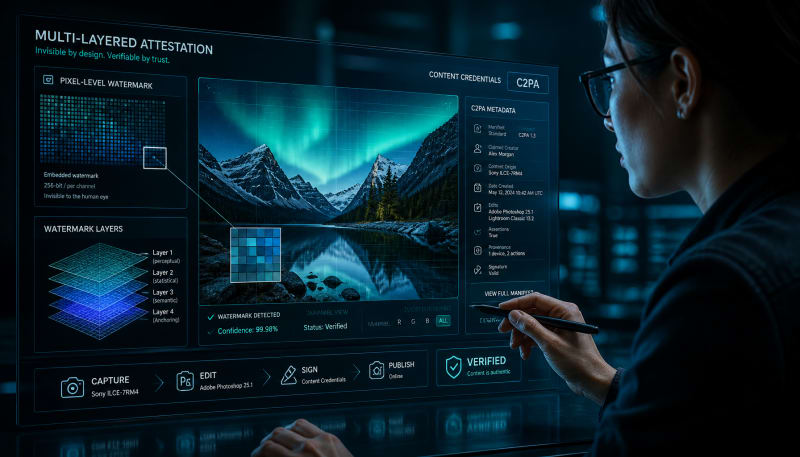
Why bulletproof digital authenticity requires both open provenance standards and persistent pixel signals.
A single truth is becoming painfully clear across newsrooms, platforms, and courtrooms: metadata alone cannot survive the internet. C2PA standards have given us a powerful framework for attaching provenance information to digital content. But metadata can be stripped in seconds—intentionally or accidentally—through screenshots, format conversions, social media compression, or simple file manipulation.
The industry's answer isn't to abandon metadata standards. It's to add a second layer that survives when the first one fails.
A credential can explain part of an asset’s history. Independent evaluation helps determine how much confidence the available evidence should support. Synthetic Proof is built for that wider trust assessment.
Multi-layered attestation combines C2PA's structured metadata with invisible watermarking embedded directly into image pixels. The result is content that carries provenance information through two independent channels—one that machines read easily, and one that persists even when the content is cropped, compressed, or stripped of its original file wrapper.
It's not redundancy. It's resilience by design.
Why Metadata Travels Poorly Across Digital Ecosystems
C2PA metadata lives in the file container—the technical envelope surrounding the actual image data. That envelope includes standardized fields describing content origin, authorship, edit history, and whether AI was involved in creation. The format is elegant, extensible, and increasingly supported by Adobe, Microsoft, camera manufacturers, and major platforms.
The problem is that most digital workflows weren't designed to preserve file containers.
When someone takes a screenshot of an image, the new file inherits none of the original metadata. When a journalist downloads an image from email and uploads it to a CMS, metadata may or may not survive depending on platform configuration. When social networks transcode media for performance optimization, provenance information often disappears entirely—not through malicious intent, but through architectural choices made long before content authenticity became a priority.

Even well-intentioned organizations struggle with metadata persistence. A newsroom might adopt C2PA-compliant tools internally, only to discover that their publishing pipeline strips provenance data at three different handoff points before content reaches readers.
This fragility creates a dangerous gap. The organizations most committed to transparency can implement perfect metadata standards and still deliver content to audiences with no verifiable provenance.
Watermarking Operates From Inside the Content Itself
Invisible watermarking takes a fundamentally different approach. Instead of attaching information to a file, it encodes that information into the visual data itself—modifying pixel values in ways imperceptible to human eyes but detectable through specialized algorithms.
The modifications are subtle. A watermarking system might shift specific color channel values by amounts too small to affect visual quality, or embed patterns across frequency domains that survive compression. The encoded information might include a content identifier, timestamp, creator signature, or pointer to external verification records.
Because the watermark exists within the pixels rather than the file wrapper, it persists through many transformations that destroy metadata. Screenshots capture the watermark. Format conversions carry it forward. Social media compression may degrade it, but sophisticated watermarking techniques can survive significant quality reduction while remaining readable.
Watermarks aren't invincible. Aggressive cropping, extreme compression, or intentional adversarial attacks can damage or remove them. But they represent a second line of defense—one that operates independently of file formats, upload workflows, and platform architecture.
The Technical Tradeoff Between Robustness and Invisibility
Watermark design involves constant tension between competing goals. Stronger watermarks—those more likely to survive compression and manipulation—generally require larger pixel modifications that increase the risk of visible artifacts. More subtle watermarks preserve perfect visual fidelity but may fail to survive even moderate quality reduction.
The balance depends on use case. A photojournalism organization might prioritize absolute visual integrity, accepting that watermarks may not survive aggressive social media compression. A stock photography platform might embed more robust watermarks, tolerating minimal perceptual impact in exchange for stronger persistence across customer workflows.
Modern watermarking systems increasingly use adaptive techniques—analyzing image content to determine where modifications will be least perceptible, and adjusting encoding strength based on the specific visual characteristics of each image. Dark, textured regions can hide stronger watermarks than smooth gradients or bright skies.
Why Combining Both Methods Creates Operational Flexibility
Multi-layered attestation recognizes that different verification scenarios have different requirements. Sometimes you need rich, detailed provenance with full edit history and cryptographic signatures. Sometimes you just need to know whether content is authentic after it's been copied, compressed, and reposted six times.
C2PA metadata excels at the first scenario. When the file container survives intact, verification systems can access comprehensive provenance information—who created the content, what tools were used, whether AI was involved, what edits occurred, and how to verify the entire chain of custody cryptographically.
Watermarks excel at the second scenario. When only the pixels remain—after screenshots, social shares, or format conversions—watermark detection can still answer basic but critical questions: Is this content authentic? What's its origin? Where can I find authoritative provenance records?
By deploying both methods simultaneously, organizations create resilience across the full lifecycle of digital content. The metadata provides rich verification when possible. The watermark provides baseline verification when the metadata is gone.
Watermarks Can Point Back to Rich Metadata
An increasingly common architecture uses watermarks as lightweight identifiers rather than complete provenance records. The watermark itself might contain only a content ID or cryptographic hash. When detected, that identifier points verification systems to external databases where full C2PA metadata, edit history, and chain-of-custody records are stored.
This approach combines the persistence of watermarking with the expressiveness of structured metadata. Even when the original C2PA container is lost, the surviving watermark provides a path back to comprehensive provenance information.
For newsrooms and platforms, this creates verification workflows that gracefully degrade. Pristine content gets full cryptographic verification through C2PA standards. Content that's been copied and compressed still gets meaningful verification through watermark detection and database lookup. Content with neither gets flagged for additional scrutiny.
Where Detection Capabilities Still Lag Behind Creation
The biggest operational gap in multi-layered attestation isn't creation—it's detection at scale. Adding both C2PA metadata and invisible watermarks to content is increasingly straightforward. Major creative tools are building these capabilities directly into export workflows. Platform APIs are beginning to preserve provenance information through upload and distribution.
But detection remains fragmented. Most social platforms don't yet surface C2PA verification to users. Watermark detection requires specialized software that most readers, editors, and content moderators don't have. Even organizations committed to verification often lack the infrastructure to check incoming content against both metadata standards and watermark registries.
This creates an awkward transition period. Content creators can attest to authenticity through multiple technical layers, but the verification infrastructure to check those attestations isn't yet ubiquitous. It's like putting detailed nutritional labels on food before stores have trained anyone to read them.
The gap is closing. Browser extensions, platform partnerships, and specialized verification services are beginning to automate multi-layered checks. But widespread detection still lags behind widespread creation, limiting the immediate impact of multi-layered attestation.
Governance Requires Coordinated Standards, Not Competing Ones
As both metadata and watermarking mature, the risk isn't technical failure—it's fragmentation. If different organizations deploy incompatible watermarking schemes, competing metadata standards, and siloed verification databases, multi-layered attestation becomes multi-layered confusion.
The industry is moving toward convergence rather than fragmentation, but coordination remains imperfect. C2PA provides a unifying metadata standard that's gaining broad adoption. Watermarking is less standardized—different vendors use different algorithms, encoding schemes, and detection methods. Some watermarks are proprietary; others are moving toward open standards.
For multi-layered attestation to function as infrastructure rather than vendor-specific implementation, watermarking needs similar standardization momentum. That means agreement on encoding methods that different systems can detect, registry protocols that different platforms can query, and governance frameworks that prevent watermark collision or spoofing.
The alternative is a future where content carries three different watermarks from three different vendors, none of which the receiving platform can detect or verify.
Final Thoughts
Multi-layered attestation acknowledges a fundamental reality about digital content: it will be copied, compressed, cropped, and stripped of metadata as it moves through the internet. Fighting that reality is futile. Building verification systems that survive it is essential.
C2PA metadata and invisible watermarking aren't competing approaches. They're complementary layers addressing different failure modes. Metadata provides rich provenance when technical infrastructure preserves it. Watermarks provide baseline verification when that infrastructure fails.
The organizations building trust infrastructure today are moving beyond single-method attestation. They're recognizing that content authenticity isn't a single technical problem with a single technical solution—it's a set of related challenges requiring coordinated defenses.
The Practical Position
The shift from single-point attestation to layered verification systems signals that digital provenance is maturing from a technical standard into an operational discipline. Organizations building content authenticity strategies around metadata alone are architecting for ideal conditions that rarely exist at scale. Durable trust requires systems designed to survive the friction, compression, and chaos of real distribution networks—not just the controlled...
— Kevin Marsh, Editor-in-Chief
SYNTHETIC PROOF
BEYOND A SINGLE TRUST SIGNAL
See the Wider Trust Picture
Synthetic Proof helps organizations assess trust signals across AI content, prompts, media, and operational workflows.
View Trust and Audit OptionsSynthetic Proof
Verified — Editorial Layer
This content has passed editorial verification for clarity, accuracy, and trust alignment.
Editor-in-Chief: Kevin Marsh
Verification Status: PASSED
Verification Status: PASSED
Comments
Post a Comment