Strategies for ensuring your asset’s chain of custody remains verifiable across any channel. A photograph appears in a news report. A legal document crosses a negotiation table. A research dataset underpins a policy decision. In each case, the same question arises: where did this content actually come from? For decades, that question was answerable through metadata, file properties, and institutional trust. But generative AI has fundamentally altered the equation. Content can now be created, modified, and redistributed at scale with minimal effort and near-perfect fidelity. The result is a provenance crisis that affects everything from newsrooms to courtrooms to corporate data operations. A credential can explain part of an asset’s history. Independent evaluation helps determine how much confidence the available evidence should support. Synthetic Proof is built for that wider trust assessment. The industry's response has largely centered on two technologies...
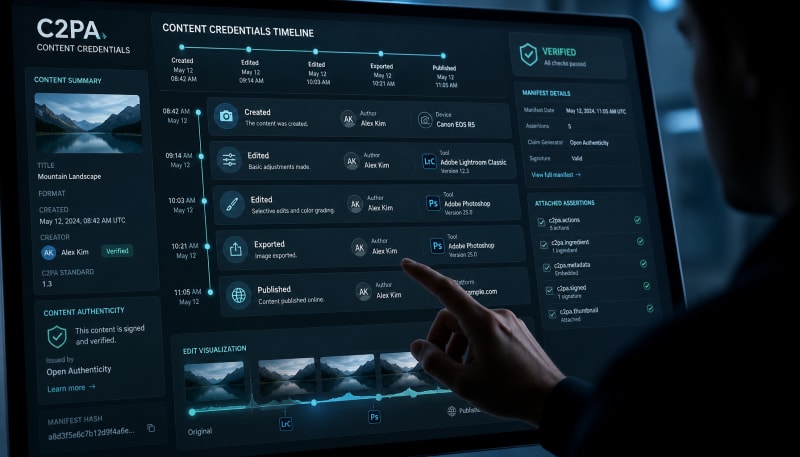
How "nutrition labels for media" record every crop, generative edit, and software iteration.
The same tools that made synthetic media creation effortless are now forcing organizations to answer a harder question: how do you prove where content actually came from? As generative AI moves from novelty to infrastructure, the ability to verify authorship, trace editing history, and identify which tools touched a file is transitioning from technical curiosity to operational necessity.
The Coalition for Content Provenance and Authenticity (C2PA) addresses this challenge through a technical standard that embeds tamper-evident metadata directly into digital files. Rather than relying on external databases or third-party registries, C2PA Content Credentials travel with the content itself—creating a portable, verifiable record of origin, modification, and tooling.
Standards can make content more transparent without eliminating every operational risk. Synthetic Proof helps teams examine trust across the full workflow rather than relying on one signal alone.
Understanding how this works matters because provenance is no longer optional architecture. It's becoming the foundation for trust in an environment where authenticity can no longer be assumed.
What C2PA Content Credentials Actually Record
C2PA Content Credentials function as embedded manifest files that document the lifecycle of a digital asset. When a camera, editing application, or AI generation tool supports C2PA, it can attach signed metadata describing what happened to the content and when.
The standard tracks three categories of information: authorship data, edit history, and tool provenance.
Authorship data captures who created the content and under what circumstances. This can include the creator's identity, the organization publishing the work, and the device or application used for initial capture. For a photograph, this might include camera make, model, and sensor information. For AI-generated content, it documents which model produced the output and what prompt or input initiated generation.
Edit history creates a chronological record of modifications. Each time content passes through a compatible tool, a new assertion can be added to the manifest. If an image is cropped, color-corrected, or composited with other elements, those actions are documented. If text is rewritten by an AI model, that transformation is recorded. The result is a chain of custody showing how the content evolved from origin to final form.
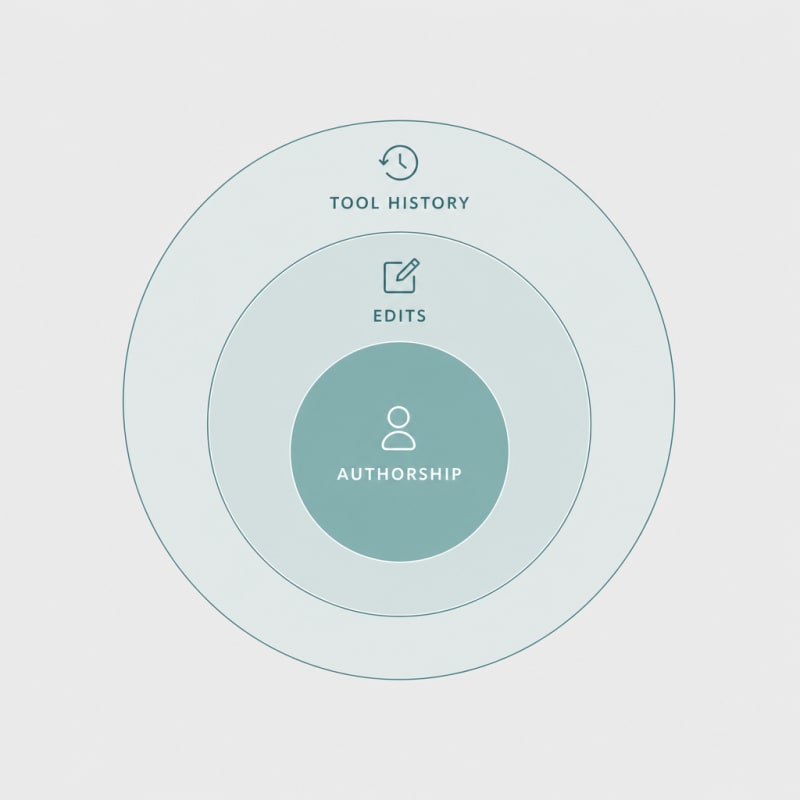
Tool provenance identifies the specific software, models, or hardware involved in creation and modification. This matters because different tools introduce different risks. Knowing whether content passed through a consumer app, enterprise platform, or specialized AI model changes how organizations evaluate authenticity and compliance.
How the Manifest Structure Creates Verifiable Chains
C2PA manifests use cryptographic signatures to ensure that recorded information cannot be altered without detection. Each assertion in the manifest is signed by the entity making the claim—whether that's a camera manufacturer, software vendor, or individual creator. These signatures are bound to the content itself, so tampering with either the file or the manifest breaks the cryptographic seal.
When new edits occur, compatible tools add a new manifest entry rather than overwriting previous data. This creates a linked chain where each step references the prior state. The structure resembles a append-only ledger: you can add new information, but you cannot retroactively change what was already recorded.
This architecture enables verification without requiring a centralized authority. Anyone inspecting a file can validate the signatures, check the chain of custody, and determine whether the metadata has been tampered with—all without querying an external database or trusting a third-party registry.
The technical elegance matters because it solves a fundamental challenge: how do you create portable trust in an environment where content moves across platforms, jurisdictions, and organizational boundaries?
What Gets Captured During AI Generation
When AI models generate content, C2PA-compatible systems can document the generation event with specificity that wasn't previously possible. This includes the model name and version, the organization operating the service, and the timestamp of generation.
Some implementations also record whether the output was fully synthetic or whether it incorporated existing content. For example, an AI image generator might note that it produced a new image from a text prompt, while an AI photo editor might document that it modified an existing photograph.
The level of detail varies by implementation. Some systems record the full prompt used to generate content. Others record only that generation occurred, without capturing input specifics. This flexibility exists because different use cases demand different privacy and security considerations. A newsroom might want detailed provenance for accountability. A creative professional might want proof of AI involvement without exposing proprietary prompts.
What matters is that AI generation stops being invisible. Instead of leaving no trace, AI tools that support C2PA create a verifiable record that the content passed through a generative process.
The Difference Between Disclosure and Deception
C2PA doesn't prevent AI-generated content from circulating. It creates the infrastructure to identify it when authenticity matters. This distinction is critical. The goal isn't to restrict synthetic media—it's to prevent synthetic media from being misrepresented as something it's not.
A marketing team using AI to generate product imagery can label it clearly. A newsroom can verify that submitted footage came from a camera rather than a generator. A legal team can audit whether content used in litigation contains undisclosed AI modifications. The same content can flow through different contexts with different authenticity requirements—and provenance data enables appropriate handling in each.
Where Content Credentials Break Down
C2PA Content Credentials are only as reliable as the entities signing them. If a software vendor falsely claims their tool didn't modify content, or if a creator manipulates metadata before signing, the technical standard cannot detect the deception. Cryptography ensures that signed data hasn't been altered—it doesn't guarantee the data was truthful in the first place.
This is sometimes called the "garbage in, garbage out" problem. C2PA creates verifiable chains of custody, but it cannot verify the honesty of the initial claim. A camera manufacturer might certify that a file came from their device, but they cannot prevent someone from photographing a high-quality fake and claiming it as authentic reality.
The standard also faces adoption challenges. For Content Credentials to function, tools across the content lifecycle must support the specification. A photograph captured with C2PA metadata loses its provenance record if it's edited in a tool that strips metadata or fails to append new assertions. The chain breaks, and downstream consumers have no way to recover the missing history.
Even when tools support C2PA, content often moves through environments that aren't designed to preserve it. Social media platforms, messaging apps, and content management systems routinely strip metadata during upload or transcoding. This isn't malicious—it's a legacy of architectures built before provenance was considered essential infrastructure.
Provenance Is Becoming Infrastructure, Not Feature
What's changing is that organizations are no longer treating provenance as a nice-to-have capability. Regulatory pressure, brand safety concerns, and litigation risk are pushing content authenticity from experimental feature to operational requirement.
Publishers are integrating C2PA verification into editorial workflows. Platforms are beginning to display Content Credentials alongside posts. Enterprise content management systems are preserving provenance metadata rather than discarding it. Camera manufacturers are embedding C2PA support at the hardware level.
This shift from optional to expected is accelerating because the cost of unverified content is increasing. Misinformation campaigns, deepfake fraud, and AI-generated disinformation create reputational, financial, and legal exposure. Organizations that can demonstrate content authenticity gain competitive advantage in environments where trust is scarce.
The broader pattern resembles how encryption moved from niche security feature to baseline expectation. A decade ago, HTTPS was considered unnecessary for most websites. Today, browsers flag non-encrypted sites as unsafe. Provenance appears to be following a similar trajectory—from experimental to expected, driven by rising threats and falling implementation costs.
What This Means for Organizations Handling Content
For organizations publishing, moderating, or making decisions based on digital content, C2PA Content Credentials create both opportunity and obligation. The opportunity is differentiation: demonstrating content authenticity becomes a trust signal in markets where verification is rare. The obligation is consistency: once you claim to track provenance, gaps in that tracking become liabilities.
Newsrooms adopting C2PA verification can distinguish authenticated reporting from synthetic content, but they must also establish policies for handling content that lacks provenance data. Does absence of credentials indicate manipulation, or simply that the content predates widespread adoption? These are editorial decisions, not technical ones—but the technical infrastructure makes those decisions possible.
Legal teams increasingly encounter Content Credentials in evidence chains. A video with intact provenance metadata carries different weight than one with stripped or missing credentials. Understanding what C2PA can and cannot prove becomes essential for evaluating evidentiary value.
Marketing and creative teams face different considerations. C2PA enables transparent use of AI tools without sacrificing authenticity claims. A brand can generate synthetic product imagery while maintaining a verifiable record of how it was created—preventing confusion without restricting creative flexibility.
Final Thoughts
C2PA Content Credentials solve a specific problem: creating tamper-evident records of content origin, modification, and tooling without requiring centralized infrastructure. The standard makes it technically possible to verify authorship, trace editing history, and identify AI involvement—capabilities that were previously either impossible or prohibitively expensive.
But technology standards don't create trust on their own. They create the conditions under which trust can be verified. What matters now is whether organizations treat provenance as infrastructure worth maintaining, whether platforms preserve metadata rather than discarding it, and whether the entities signing Content Credentials prove trustworthy over time.
The shift is already underway. Provenance is moving from experimental feature to expected capability, driven by organizations that recognize verification as a competitive advantage rather than a compliance burden. Understanding how C2PA works—and where it doesn't—becomes essential for anyone building, publishing, or making decisions based on digital content in an environment where authenticity can no longer be assumed.
SYNTHETIC PROOF
BEYOND A SINGLE TRUST SIGNAL
See the Wider Trust Picture
Synthetic Proof helps organizations assess trust signals across AI content, prompts, media, and operational workflows.
View Trust and Audit OptionsSynthetic Proof
Verified — Editorial Layer
This content has passed editorial verification for clarity, accuracy, and trust alignment.
Editor-in-Chief: Kevin Marsh
Verification Status: PASSED
Verification Status: PASSED
Comments
Post a Comment