Strategies for ensuring your asset’s chain of custody remains verifiable across any channel. A photograph appears in a news report. A legal document crosses a negotiation table. A research dataset underpins a policy decision. In each case, the same question arises: where did this content actually come from? For decades, that question was answerable through metadata, file properties, and institutional trust. But generative AI has fundamentally altered the equation. Content can now be created, modified, and redistributed at scale with minimal effort and near-perfect fidelity. The result is a provenance crisis that affects everything from newsrooms to courtrooms to corporate data operations. A credential can explain part of an asset’s history. Independent evaluation helps determine how much confidence the available evidence should support. Synthetic Proof is built for that wider trust assessment. The industry's response has largely centered on two technologies...
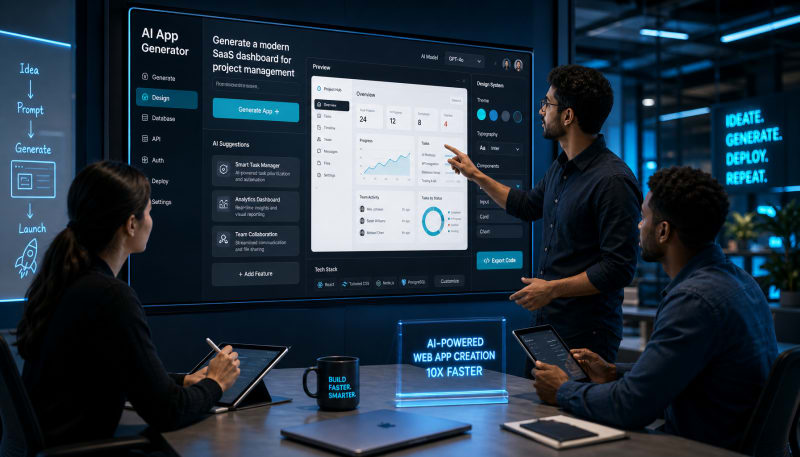
Explore how AI-powered builders are accelerating app development, design, and software creation.
Web development has always been a field defined by innovation, but the recent surge in AI-powered tools is reshaping how developers approach building applications. AI app generators and frontend tools are no longer experimental novelties—they're becoming practical solutions that accelerate design, prototyping, and even production-ready code generation. For developers, designers, and product teams, this shift represents both an opportunity and a fundamental change in workflow.
The promise is compelling: describe what you want in plain language, and watch as AI generates functional interfaces, responsive layouts, and even complex application logic. But how well do these tools actually perform, and what does their rise mean for the future of web development?
Related: For more practical AI workflows, tools, and systems, join the NextLayer newsletter.
How AI Frontend Tools Are Changing Development Workflows
Traditional web development follows a familiar pattern: designers create mockups, developers translate those designs into code, and iterations happen through manual adjustments. AI frontend tools compress this timeline dramatically. By interpreting design intentions—whether from sketches, descriptions, or reference images—these systems can produce working code in minutes rather than hours or days.
Tools leveraging AI coding capabilities can now generate React components, Vue templates, or vanilla HTML/CSS from simple prompts. Some platforms go further, analyzing existing design systems to ensure generated code matches established patterns and conventions. This isn't just about speed—it's about reducing the friction between concept and implementation.
The practical impact shows up in several areas. Rapid prototyping becomes genuinely rapid, allowing teams to test multiple interface approaches without significant developer time investment. Small businesses and startups can move from idea to functional prototype without building entire development teams. Even experienced developers find value in using AI to handle boilerplate code and routine interface patterns.
The Technology Behind AI App Generators
Understanding what makes these tools work helps clarify both their capabilities and limitations. Most modern AI app generators rely on large language models trained on massive datasets of code, design patterns, and web development documentation. These models learn the relationships between design concepts and their code implementations.
Core Capabilities
Current AI frontend tools typically excel at several specific tasks. Component generation is perhaps the most developed capability—creating buttons, forms, navigation bars, and other UI elements based on descriptions or examples. Layout construction has also advanced significantly, with AI systems capable of producing responsive grid systems and flexbox arrangements that adapt to different screen sizes.
Style generation represents another strength. AI tools can apply color schemes, typography choices, and spacing rules to create visually coherent interfaces. Some systems even maintain design system consistency, ensuring that generated components align with existing brand guidelines.
More advanced platforms venture into logic implementation, generating state management code, API integration patterns, and basic business logic. While this capability remains less mature than pure UI generation, the progress has been notable.
Current Limitations
Despite rapid advancement, AI coding tools face real constraints. Complex application architecture remains challenging—these systems work best for discrete components and page layouts rather than intricate multi-layer applications. Performance optimization often requires human review, as AI-generated code may include redundancies or inefficient patterns.
Accessibility compliance is another area where human oversight remains essential. While AI can include semantic HTML and ARIA attributes, ensuring truly accessible interfaces requires understanding context and user needs in ways current systems struggle with.
Popular Use Cases and Applications
The versatility of AI app generators means they're finding applications across different development scenarios. Each use case highlights different strengths of the technology.
Rapid Prototyping and MVPs
Product teams use AI frontend tools to quickly validate ideas before committing significant resources. A product manager can describe a dashboard concept and receive a working prototype within hours, complete with sample data visualization and interactive elements. This speed enables more experimentation and faster learning cycles.
Design-to-Code Translation
The traditional handoff between design and development is being reimagined. Some AI tools can analyze Figma designs or even screenshots and generate corresponding code. While the output typically requires refinement, it provides a solid starting point that preserves the designer's intent while establishing the technical foundation.
Landing Pages and Marketing Sites
For content-focused websites with relatively standard patterns, AI generators perform particularly well. Marketing teams can create landing pages for campaigns without waiting for developer availability, adjusting layouts and content as needed based on performance data.
Internal Tools and Admin Interfaces
Many businesses need custom internal applications—dashboards, data entry forms, reporting tools. These interfaces prioritize functionality over cutting-edge design, making them ideal candidates for AI generation. The time savings here can be substantial, allowing development teams to focus on customer-facing products.
Impact on Developers and the Development Profession
The rise of AI frontend tools naturally raises questions about the future role of human developers. The reality appears more nuanced than simple replacement scenarios suggest.
Junior developers might find the landscape more challenging as routine coding tasks become automated. The traditional path of starting with simple UI implementation and gradually tackling more complex problems may need rethinking. However, the same tools also provide learning opportunities, showing working code examples and helping newcomers understand patterns and best practices.
For experienced developers, AI coding assistants function more as productivity multipliers than threats. They handle tedious, repetitive work while humans focus on architecture decisions, complex problem-solving, and ensuring code quality. The skill emphasis shifts toward understanding systems holistically, reviewing AI-generated code critically, and integrating components into larger applications effectively.
Design skills are becoming more valuable for developers. Understanding visual principles, user experience, and interface patterns helps developers work more effectively with AI tools, providing better prompts and evaluating outputs more critically.
Choosing and Evaluating AI Frontend Tools
The marketplace for AI app generators has become crowded quickly. Evaluating options requires looking beyond marketing claims to understand practical capabilities.
Code quality and maintainability should be primary considerations. Generated code needs to be readable, follow standard conventions, and be something your team can actually maintain. Tools that produce incomprehensible or overly complex output create technical debt regardless of how quickly they work.
Integration with existing workflows matters significantly. The best tools fit naturally into current development processes rather than requiring wholesale changes. Consider how AI frontend tools connect with your version control, CI/CD pipelines, and testing frameworks.
Customization and control determine how well a tool adapts to specific needs. Can you guide the AI toward your preferred frameworks and patterns? Does it respect your existing component libraries and design systems?
The learning curve varies considerably between platforms. Some AI coding tools require extensive prompt engineering to achieve good results, while others work more intuitively. Consider your team's available time for learning new tools.
The Future Trajectory of AI-Powered Development
Current AI app generators represent early iterations of what's possible. Several trends suggest where the technology is heading.
Contextual awareness is improving. Future systems will better understand entire codebases, maintaining consistency across large projects and making architectural decisions that align with existing patterns. Rather than generating isolated components, they'll understand how pieces fit together within complex applications.
Multimodal capabilities are expanding beyond text prompts. Voice descriptions, hand-drawn sketches, and even gestural interfaces may become input methods, making the tools accessible to more people and fitting different creative workflows.
Collaborative AI represents another frontier—systems that work alongside humans in real-time, suggesting improvements, catching errors, and explaining decisions. This moves beyond simple generation toward genuine partnership in the development process.
Specialized domain tools will likely emerge, trained specifically for particular industries or application types. An AI frontend tool optimized for e-commerce might deeply understand cart interfaces and checkout flows, while one focused on data visualization would excel at dashboard creation.
Conclusion
AI frontend tools and app generators have moved from experimental curiosities to practical development aids remarkably quickly. They're genuinely accelerating web development workflows, particularly for prototyping, standard interfaces, and routine implementation tasks. The technology isn't replacing developers—it's changing what development work looks like and where human expertise adds the most value.
The most successful teams will likely be those that integrate AI coding capabilities thoughtfully, using automation for appropriate tasks while maintaining human oversight for architecture, quality, and user experience decisions. As these tools continue improving, the distinction between AI-generated and human-written code may become less relevant than whether the resulting application serves its users effectively.
For developers and organizations, now is the time to experiment with these tools, understand their capabilities and limitations, and develop workflows that leverage their strengths. The rise of AI in frontend development isn't a distant future scenario—it's happening now, and the competitive advantages will accrue to those who adapt effectively.
The Practical Solution
Beign using AI generators for prototypes and throwaway explorations, not production code you'll maintain for years. Treat the output as a first draft that needs your review—check for accessibility gaps, performance issues, and whether it actually fits your architecture. The real win is collapsing the gap between idea and testable interface so you can learn faster and spend your skilled time on problems AI can't solve.
— Kevin Marsh, Editor-in-Chief
NEXTLAYER AI
Stay Ahead of AI
Get weekly breakdowns of workflows, tools, and systems for creators & founders.
Subscribe to NextLayer AISynthetic Proof
Verified — Editorial Layer
This content has passed editorial verification for clarity, accuracy, and trust alignment.
Editor-in-Chief: Kevin Marsh
Verification Status: PASSED
Verification Status: PASSED
Comments
Post a Comment