Learn why organizations are investing in verification instead of detection alone. For years, the fight against synthetic media manipulation followed a familiar pattern: researchers identified deepfake artifacts, built detection models around those signatures, and deployed them across platforms. Detection accuracy improved. Conferences celebrated breakthroughs. The industry felt like it was winning. Then generative AI became exponentially better at eliminating the very artifacts those systems were trained to find. As synthetic media improves, confidence increasingly comes from layered evidence rather than a binary label. Synthetic Proof helps organizations evaluate that evidence in context. What's emerging isn't simply a technical gap that better detection can close. It's a fundamental shift in how organizations must approach digital trust. The old model—detect manipulated content after it's created—assumes defenders can keep pace with attackers....
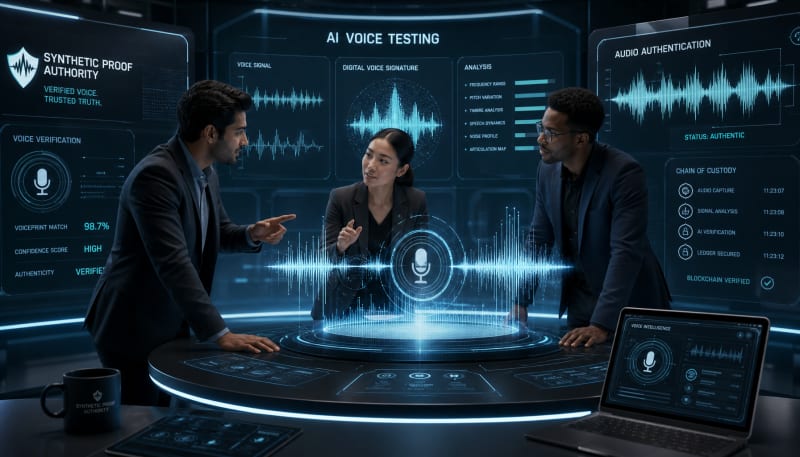
Understand how emerging voice verification technologies are addressing synthetic audio risks.
Voice technology has become embedded in our daily lives, from virtual assistants to customer service automation. But as synthetic voice generation becomes increasingly sophisticated, the ability to verify authentic human speech has emerged as a critical challenge. AI voice testing technology represents the cutting edge of this verification arms race, offering solutions that can distinguish between genuine and artificially generated audio with unprecedented accuracy.
The stakes are high. Deepfake audio has already been used in fraud schemes, misinformation campaigns, and identity theft. As these threats multiply, organizations across industries need reliable methods to authenticate voice recordings and real-time speech. This is where advanced AI voice testing systems prove their worth.
Related: If your workflow touches verification, provenance, or suspicious media, Synthetic Proof can help audit content and reduce trust risk.
How AI Voice Testing Technology Works
Modern voice verification systems leverage machine learning algorithms trained on millions of voice samples, both authentic and synthetic. These systems analyze dozens of acoustic features that human ears cannot detect, from micro-variations in pitch to subtle artifacts in frequency patterns that synthetic voices inadvertently produce.
The technology operates on multiple analytical layers. At the acoustic level, algorithms examine waveform characteristics, spectral properties, and temporal patterns. At the linguistic level, systems evaluate speech naturalness, prosody, and contextual coherence. Advanced implementations also incorporate neural network architectures specifically designed to identify manipulation artifacts.
Detection Methods and Techniques
Voice testing platforms employ several complementary approaches. Spectrogram analysis reveals visual patterns in audio that expose synthetic generation. Phase analysis identifies discontinuities that occur during voice splicing or manipulation. Behavioral biometrics examine speaking patterns unique to individuals, while neural voiceprint technology creates detailed acoustic fingerprints.
What sets current-generation systems apart is their ability to detect zero-day synthetic voices—newly developed generation methods they have never encountered before. This generalization capability stems from understanding the fundamental physics of human speech production rather than simply memorizing known fake voice signatures.
Applications Across Industries
Financial institutions are implementing voice testing technology to combat voice phishing and fraudulent transaction authorization. Authentication systems now require not just voice matching but verification that the speaker is a living human, not a playback or synthesized voice.

Legal and forensic contexts demand the highest standards of audio authenticity. Courts increasingly require expert verification that evidence recordings have not been manipulated. AI testing systems provide forensic-grade analysis with detailed reports on any detected anomalies or signs of tampering.
Media organizations use verification technology to combat misinformation spread through deepfake audio clips. Before publishing sensitive audio content, newsrooms can now verify authenticity through automated analysis that would have required extensive expert review in the past.
Enterprise Security Integration
Corporate security teams are embedding voice testing into access control systems and sensitive communication channels. This adds a critical verification layer to voice-based authentication, preventing attackers from using recorded or synthetic voices to bypass security measures.
Call centers and customer service operations deploy real-time voice analysis to flag potentially fraudulent interactions. When combined with other behavioral signals, this creates robust fraud detection systems that protect both organizations and customers.
The Evolving Threat Landscape
Voice synthesis technology continues to advance rapidly. Modern text-to-speech systems produce audio that most humans cannot distinguish from authentic speech. Voice cloning tools can replicate a person's voice from just minutes of sample audio. This ongoing evolution demands equally sophisticated detection capabilities.
The challenge is not static. As detection systems improve, synthesis technologies adapt. This creates an adversarial dynamic where both offensive and defensive capabilities continuously advance. The most effective verification systems incorporate adaptive learning that updates detection models as new synthesis methods emerge.
Synthetic Voice Quality Improvements
Today's neural voice generators capture nuances like breathing patterns, emotional inflection, and natural speech disfluencies. They reproduce acoustic environments and replicate individual vocal characteristics with disturbing accuracy. This quality leap means detection systems must operate at similarly granular levels to maintain effectiveness.
The proliferation of accessible voice cloning tools has democratized synthetic voice creation. What once required specialized expertise now happens with consumer-grade applications. This accessibility magnifies the verification challenge across all sectors.
Implementation Considerations
Organizations evaluating voice testing solutions should prioritize systems with proven accuracy across diverse audio conditions. Performance metrics matter—both the false positive rate (flagging authentic voices as fake) and false negative rate (missing synthetic voices) impact practical utility.
Processing speed is another critical factor. Real-time applications like live authentication require analysis completed within milliseconds. Forensic applications can tolerate longer processing times in exchange for deeper analysis and greater confidence levels.
Integration capabilities determine how easily verification systems fit into existing workflows. APIs, SDK support, and compatibility with common audio formats and communication platforms affect deployment complexity and ongoing maintenance requirements.
Accuracy and Reliability Standards
The most reliable systems provide confidence scores rather than binary authentic/synthetic classifications. This nuanced output allows organizations to set threshold levels appropriate to their risk tolerance and apply different protocols based on verification confidence.
Transparency in methodology builds trust in verification results. Systems should provide explainable results showing which acoustic features triggered detection and offering audit trails for compliance requirements.
Privacy and Ethical Dimensions
Voice analysis systems necessarily process biometric data, raising privacy considerations. Responsible implementations minimize data retention, encrypt voice samples in transit and storage, and provide clear disclosure about analysis activities.
The dual-use nature of this technology merits attention. The same systems that detect harmful deepfakes could potentially enable surveillance or unauthorized voice analysis. Ethical deployment frameworks and appropriate access controls help mitigate misuse risks.
Regulatory environments are evolving to address synthetic media and biometric data processing. Organizations deploying voice verification technology should monitor relevant regulations including biometric privacy laws, data protection requirements, and emerging synthetic media disclosure mandates.
Future Development Trajectories
Next-generation voice testing systems will likely incorporate multimodal analysis, combining audio verification with visual lip-sync analysis, contextual content evaluation, and metadata examination. This holistic approach increases detection reliability and resilience against sophisticated attacks.
Federated learning approaches may enable collaborative model training across organizations without sharing sensitive voice data. This could accelerate detection capability improvements while preserving privacy and competitive confidentiality.
Standardization efforts are emerging to create common evaluation benchmarks and interoperability frameworks. Industry-wide standards will help organizations compare solutions objectively and ensure verification results are portable across different systems.
Integration with Broader Authentication Ecosystems
Voice verification increasingly functions as one component within multi-factor authentication frameworks. Combined with device fingerprinting, behavioral biometrics, and knowledge-based authentication, it creates layered security that is significantly harder to defeat than any single method.
The convergence of voice testing with blockchain technology offers potential for creating immutable verification records. Audio could be cryptographically signed at capture with verification results permanently recorded, providing tamper-evident audit trails.
Conclusion
AI voice testing technology has transitioned from a specialized forensic tool to an essential verification capability across industries. As synthetic voice generation becomes more accessible and convincing, the ability to reliably authenticate audio will only grow in importance. The technology delivers measurable value today while continuing to evolve in sophistication and accessibility.
Organizations facing voice-related security, compliance, or verification challenges should evaluate how current AI testing systems fit their specific requirements. The investment in verification capabilities now establishes protective infrastructure against escalating synthetic voice threats. Those who implement robust voice testing position themselves advantageously in an environment where audio authenticity can no longer be assumed.
The future of audio verification lies in adaptive, multi-layered systems that combine multiple detection approaches with continuous learning. As this technology matures, it will become as fundamental to digital communication security as encryption and access control are today.
SYNTHETIC PROOF
Verify What You See
Synthetic media is getting harder to identify. Get verification-focused analysis for suspicious content.
Run a Synthetic Proof AuditSynthetic Proof
Verified — Editorial Layer
This content has passed editorial verification for clarity, accuracy, and trust alignment.
Editor-in-Chief: Kevin Marsh
Verification Status: PASSED
Verification Status: PASSED
Comments
Post a Comment