Strategies for ensuring your asset’s chain of custody remains verifiable across any channel. A photograph appears in a news report. A legal document crosses a negotiation table. A research dataset underpins a policy decision. In each case, the same question arises: where did this content actually come from? For decades, that question was answerable through metadata, file properties, and institutional trust. But generative AI has fundamentally altered the equation. Content can now be created, modified, and redistributed at scale with minimal effort and near-perfect fidelity. The result is a provenance crisis that affects everything from newsrooms to courtrooms to corporate data operations. A credential can explain part of an asset’s history. Independent evaluation helps determine how much confidence the available evidence should support. Synthetic Proof is built for that wider trust assessment. The industry's response has largely centered on two technologies...
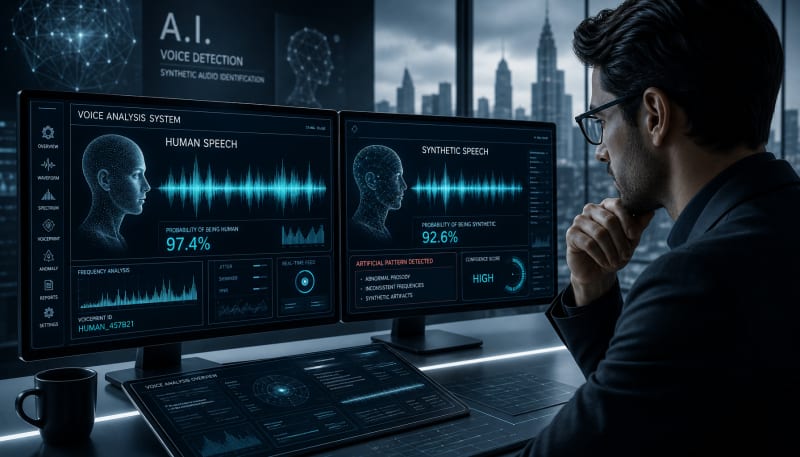
Protect yourself and your organization from phone scams, executive impersonation, and digital disinformation.
Synthetic voices have become eerily convincing. What once sounded robotic and mechanical now mimics human speech with startling accuracy. As AI-generated audio floods social media, phone scams, and even corporate communications, the ability to distinguish real voices from fake ones has become a critical skill.
The stakes are high. Deepfake audio has been used to impersonate executives authorizing fraudulent wire transfers, create fake celebrity endorsements, and spread political disinformation. Understanding how to detect synthetic speech isn't just about curiosity—it's about protecting yourself and your organization from sophisticated audio manipulation.
Related: If your workflow touches verification, provenance, or suspicious media, Synthetic Proof can help audit content and reduce trust risk.
The Technology Behind Synthetic Voice Generation
Modern voice synthesis relies on neural networks trained on massive datasets of human speech. These systems analyze pitch, cadence, emotion, and linguistic patterns to generate audio that sounds remarkably human. The same machine learning principles used in visual AI—similar to techniques for detecting fake images—now apply to audio.
Text-to-speech engines have evolved from simple concatenative systems to sophisticated models like WaveNet, Tacotron, and VALL-E. These platforms can clone a voice from just seconds of sample audio, creating entirely new sentences that sound authentic. The technology has legitimate uses in accessibility, content creation, and entertainment, but it also enables new forms of deception.
Key Indicators Of AI-Generated Speech
Unnatural Breathing Patterns
Human speech includes subtle breath sounds between phrases and sentences. AI-generated voices often lack these natural respiratory patterns or place them in unnatural locations. Listen for missing breath sounds during long sentences or awkward pauses where a human would naturally inhale.
Inconsistent Emotional Tone
Synthetic voices struggle with emotional continuity. The audio might shift abruptly from one emotional state to another without the gradual transitions humans naturally create. Pay attention to whether the emotional quality matches the context and content of what's being said.
Robotic Pronunciation Of Uncommon Words
AI models trained primarily on common language patterns often stumble over proper names, technical jargon, or regional expressions. These words may sound overly mechanical or be mispronounced in ways a native speaker wouldn't make.

Background Noise Inconsistencies
When synthetic speech is layered onto existing audio, background noise patterns may not match. The voice might sound too clean compared to ambient sounds, or noise may cut out unnaturally when the speaking stops.
Technical Methods For Audio Verification
Spectral Analysis
Audio spectrograms reveal frequency patterns invisible to the human ear. AI-generated speech often shows unusual regularities in the frequency spectrum or lacks the natural variations present in human vocal production. Tools like Audacity or professional software such as iZotope RX can visualize these patterns.
Acoustic Artifact Detection
Synthesis algorithms sometimes produce subtle digital artifacts—compression irregularities, phase inconsistencies, or harmonic anomalies. These technical fingerprints can indicate manipulation, though they require specialized knowledge and equipment to identify reliably.
Waveform Examination
The visual representation of sound waves can reveal telltale signs. Look for unnaturally smooth transitions, repetitive patterns, or amplitude characteristics that seem too perfect. Human speech contains micro-variations that AI struggles to replicate completely.
AI Detection Tools And Platforms
Several specialized platforms now offer AI voice detection capabilities. These tools use machine learning trained to recognize synthetic speech patterns, applying similar principles to how to detect AI images in the visual domain.
Commercial solutions like Pindrop, Reality Defender, and Intel's FakeCatcher analyze audio for manipulation indicators. These platforms examine hundreds of parameters simultaneously, identifying subtle discrepancies that human listeners would miss. Some achieve accuracy rates above 90% on known synthetic audio samples.
Open-source alternatives provide basic detection capabilities for researchers and developers. Projects like the Audio Deepfake Detection Challenge dataset enable testing and development of custom detection algorithms.
Practical Steps For Everyday Users
You don't need sophisticated equipment to develop better detection skills. Start by trusting your instincts—if something sounds off, investigate further. Request video calls instead of voice-only communication for sensitive matters. Verify unexpected requests through alternative channels before acting.
Establish verification protocols with family members and colleagues. Create code words or security questions that only genuine contacts would know. This low-tech approach provides a reliable backup when technology-based detection fails.
Stay informed about the latest deepfake capabilities and detection methods. The technology evolves rapidly, and what works today may become obsolete tomorrow. Just as detection methods for fake images continue advancing, audio verification techniques must keep pace with generation technologies.
The Future Of Audio Authentication
The arms race between synthesis and detection continues accelerating. Future solutions may include blockchain-based audio authentication, where legitimate recordings are cryptographically signed at the moment of creation. Hardware-level verification in recording devices could provide tamper-proof provenance for genuine audio.
Regulatory frameworks are beginning to emerge. Some jurisdictions now require disclosure when AI-generated voices are used in certain contexts. These legal protections complement technical detection methods, creating multiple layers of defense against audio deception.
Neural network architectures specifically designed for deepfake detection show promise. These systems learn to identify the subtle signatures left by specific generation algorithms, adapting as new synthesis techniques emerge.
Building A Culture Of Verification
Technology alone cannot solve the deepfake challenge. Organizations must establish verification cultures where questioning audio authenticity is normalized rather than seen as paranoid. Training programs should include audio authentication alongside other security awareness topics.
Media literacy education needs updating for the synthetic audio era. Teaching critical listening skills and verification habits prepares people to navigate a world where seeing—or hearing—is no longer believing.
Conclusion
Detecting AI-generated speech requires combining human judgment with technical tools. While no single method guarantees accuracy, a multi-layered approach incorporating auditory analysis, technical verification, and procedural safeguards significantly reduces vulnerability to audio deepfakes.
As synthetic voice technology becomes more sophisticated, detection methods must evolve in parallel. Stay skeptical, verify independently, and remember that in an age of audio manipulation, trust must be earned through multiple channels of confirmation. The ability to identify synthetic speech isn't just a technical skill—it's becoming an essential component of digital literacy in our increasingly AI-mediated world.
The Practical Solution
Always trust your instincts when something sounds off. For high-stakes situations like financial requests or sensitive instructions, establish verbal authentication protocols with colleagues using predetermined questions only real people would know. The most effective defense isn't sophisticated software—it's creating organizational processes that assume audio can be faked and require multi-factor (back-up) confirmation before any consequential action.
— Kevin Marsh, Editor-in-Chief
Synthetic Proof
Verified — Editorial Layer
This content has passed editorial verification for clarity, accuracy, and trust alignment.
Editor-in-Chief: Kevin Marsh
Verification Status: PASSED
Verification Status: PASSED
Comments
Post a Comment